
Can 5G IoT Become the Connectivity Engine Behind Smart Cities?
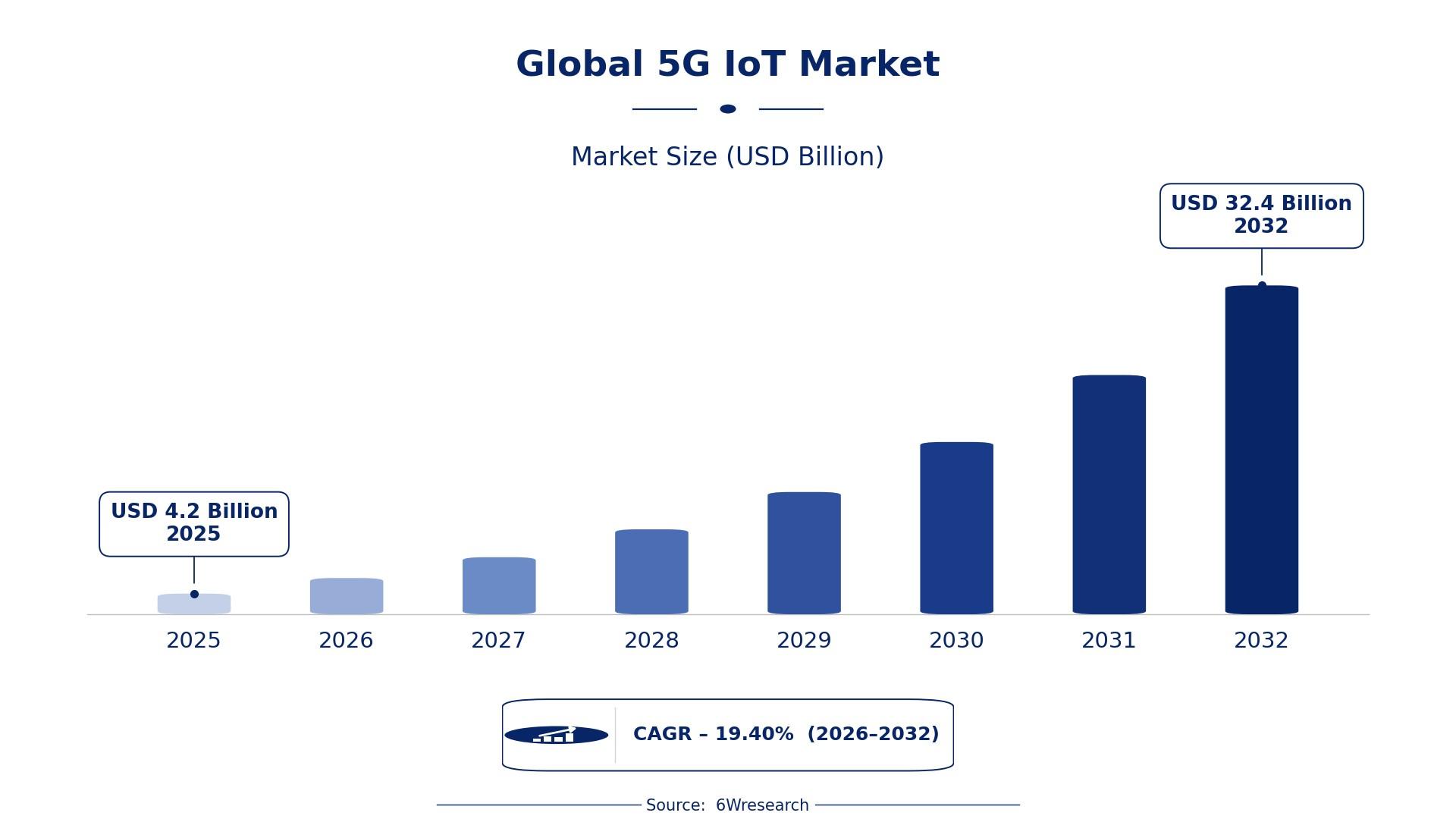
Cities are filling with connected cameras, sensors, vehicles, meters, streetlights, and public infrastructure. Behind many of these applications is a growing demand for faster and more dependable communication. The 5G IoT Market is emerging as an important technology ecosystem capable of connecting large numbers of devices while supporting real-time applications. 6Wresearch estimates that the global market was worth USD 4.2 billion in 2025 and projects it to reach USD 32.4 billion by 2032, growing at a CAGR of 19.40%.
What Makes a City Smart?
A smart city uses digital technologies to improve how infrastructure and services operate.
IoT devices can collect information about traffic, energy consumption, air quality, waste levels, parking availability, and public safety. When this information is combined with high-performance connectivity, city authorities can develop systems that respond to changing conditions.
5G can provide the communication infrastructure needed for many of these connected applications.
Smarter Traffic Management
Traffic congestion is one of the most visible challenges in growing cities.
Connected traffic signals, cameras, vehicles, parking systems, and road sensors can collect information continuously. Data can then be analyzed to understand traffic patterns and identify congestion points.
5G connectivity can support rapid communication among these systems, potentially enabling more responsive traffic-management platforms.
Connected vehicles can also communicate with infrastructure and other systems, creating opportunities for more coordinated transportation networks.
Intelligent Public Infrastructure
Streetlights are another example.
Traditional streetlights may operate according to fixed schedules. Smart lighting systems can use sensors to identify movement, environmental conditions, or changing requirements.
Connected infrastructure can potentially adjust lighting levels automatically, helping municipalities manage energy consumption while improving visibility.
Similar principles can be applied to water systems, waste collection, parking, and public facilities.
Environmental Monitoring
Cities also need better information about environmental conditions.
Connected sensors can monitor:
-
Air quality
-
Noise levels
-
Water conditions
-
Temperature
-
Humidity
-
Pollution levels
Continuous monitoring can provide city authorities with more detailed information than occasional manual measurements.
When sensors are connected through 5G-enabled networks, information can be transmitted quickly to analytics platforms.
Public Safety Applications
Public safety represents another potential area for 5G IoT.
Connected cameras, emergency communication systems, location technologies, and sensors can support coordinated responses during incidents.
However, these applications require careful attention to privacy, cybersecurity, data governance, and responsible deployment.
Technology alone does not determine whether a smart-city system delivers value. Governance and implementation practices are equally important.
The Importance of Edge Computing
Smart cities can generate enormous quantities of data.
Processing all information centrally can create bandwidth and latency challenges. Edge computing allows some processing to happen closer to connected devices.
For example, traffic cameras may analyze information locally and send only relevant events to a central platform. This approach can reduce unnecessary data transmission and support faster responses.
Asia Could Become a Major Growth Engine
6Wresearch identifies Asia as the fastest-growing regional market, with a projected CAGR of 23% from 2026 to 2032. The report associates this growth with government initiatives and investment in smart-city projects across countries including China and India.
As urban populations increase, governments and infrastructure developers may continue exploring digital solutions for transportation, utilities, safety, and resource management.
Challenges Cannot Be Ignored
Smart-city deployments require substantial investment and coordination.
Major challenges include:
-
High infrastructure costs
-
Cybersecurity risks
-
Interoperability problems
-
Data privacy concerns
-
Legacy infrastructure
-
Regulatory requirements
-
Skills shortages
Cities may also need to coordinate telecom providers, technology companies, infrastructure operators, and government departments.
A Connected Urban Future
The future city is unlikely to depend on one technology alone. Instead, it will combine 5G, IoT, AI, edge computing, cloud platforms, sensors, and analytics.
The 5G IoT Market can provide a connectivity foundation for this ecosystem. As more urban infrastructure becomes digital, the ability to connect devices and exchange information quickly could become increasingly important.
Who We Are
About 6Wresearch: 6Wresearch is a commercial strategy and growth advisory firm founded in 2011 and headquartered in New Delhi, India, with partners across Southeast Asia and the Middle East & Africa. The firm has delivered over 20,000 commercial engagements for over 2,000 organizations, including Fortune 500 companies, government agencies, and multilateral institutions such as the World Bank and the Asian Development Bank. Backed by proprietary market research and advanced analytics, 6Wresearch combines sector expertise with data-driven intelligence to help organizations navigate market complexity and drive sustainable growth. These capabilities explain why organizations trust 6Wresearch Global Market Research & Consulting Firm for reliable commercial insights and confident decision-making.
Our Proprietary Platform: 6W Export GTM
6W Export GTM is 6Wresearch's proprietary trade intelligence and go-to-market platform, built on UN Comtrade data and enhanced with 6Wresearch's in-house analytical and simulation models, including system dynamics-based forecasting. Unlike broad, sector-level market sizing tools, 6W Export GTM operates at the individual product level down to specific HS codes and micro-segments to identify precise, actionable export opportunities by country and product pair, including markets where trade currently does not exist. This granular, simulation-driven approach allows 6W Export GTM to surface opportunities that sector-wide analysis typically misses, positioning it among a small number of platforms globally offering this depth of product-and-country-specific export intelligence.

 English
 Arabic
 French
 Spanish
 Portuguese
 Turkish
 Dutch
 Italiano
 Russian
 Romaian
 Portuguese (Brazil)
 Greek