
Hydraulic Modeling Software Market Size, Emerging Trends & Competitive Landscape, 2034
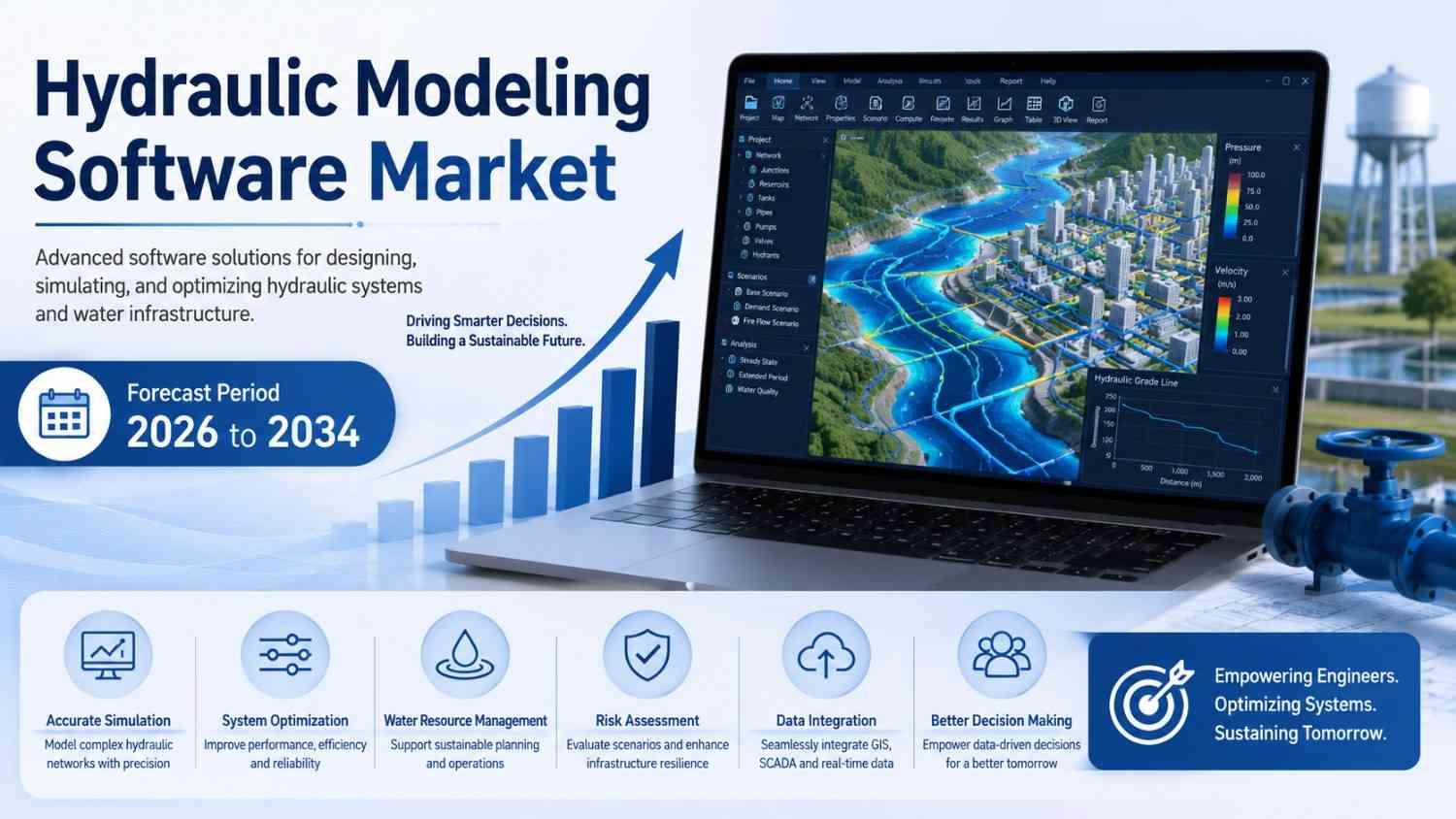
The management of complex water infrastructure has evolved into a highly specialized digital science. Municipalities and industrial entities are shifting from static, reactive asset management to continuous, dynamic system simulation. At the heart of this operational evolution is hydraulic modeling software. These advanced computational tools allow engineers to simulate, analyze, and optimize fluid flow systems across extensive water distribution networks, wastewater systems, and industrial pipelines.
According to industry data from The Insight Partners, the global hydraulic modeling software market size is projected to reach US$ 1,533.61 million by 2034 from US$ 841.01 million in 2025. The market is anticipated to register a CAGR of 6.90% during the forecast period 2026-2034.
Market Overview and Dynamics
Hydraulic modeling software serves as an indispensable engineering tool to prevent pipe bursts, analyze pressure fluctuations, assess water quality, and design stormwater infrastructure. As urban areas grow and resource scarcity intensifies, the necessity for sophisticated software that can predict how water moves through a built environment becomes critical. The market is transitioning from simple desktop design tools to complex, real-time digital twins that integrate with cloud systems and field devices.
Key Market Drivers
Two major structural shifts are propelling the adoption of hydraulic modeling solutions worldwide:
1. Aging Water Infrastructure and Active Asset Management
A significant percentage of municipal water pipelines globally are older than 50 years, causing excessive leakage and non-revenue water (NRW) losses. Hydraulic modeling software allows utility operators to systematically pinpoint weak segments, analyze stress points, and prioritize targeted infrastructure replacement. Optimizing pump operations and pressure distribution through simulation also decreases energy costs by 15% to 25%.
2. Digital Transformation and Smart Water Networks
Modern utilities are deploying extensive Internet of Things (IoT) sensor networks and Supervisory Control and Data Acquisition (SCADA) systems. Traditional static models cannot handle this influx of real-time data. Modern hydraulic modeling software is integrated directly with SCADA systems to process live sensor feeds, allowing operators to run simulations on the fly, balance system pressure instantly, and locate physical leaks within minutes.
Strategic Market Opportunities
1. High-Fidelity 2D and 3D Flood Risk Assessments
Increasingly volatile weather events have created massive demand for high-performance multidimensional modeling. Integrating 2D overland flow with 1D sewer pipe modeling allows cities to visualize real-time urban inundation pathways, creating an excellent opportunity for software developers to design robust, high-resolution flood simulation suites.
2. AI-Powered Predictive Calibration
Historically, calibrating a hydraulic model to match real-world field pressure required hundreds of manual engineering hours. The incorporation of artificial intelligence and machine learning represents a major growth opportunity. AI algorithms can automate model calibration by analyzing historical SCADA data, greatly lowering the barrier to entry for smaller municipalities.
Market Segmentation
The global market is segmented to accommodate diverse engineering workflows and infrastructure requirements:
- By Component: Solutions (simulation, pressure management, analytical SCADA models, CAD-based design tools) and Services (consulting, system integration, software maintenance).
- By Modeling Type: 1D (unidirectional pipe networks), 2D (overland flow and surface inundation), and 3D (complex localized structures like pump stations and spillways).
- By Deployment Mode: Cloud-based software-as-a-service (SaaS) platforms and on-premises software.
- By Enterprise Size: Small and Medium Enterprises (SMEs) and Large Enterprises.
Competitive Landscape and Key Players
The global market landscape is consolidated, with a select group of advanced software providers driving technological standards. Top players in this ecosystem are focusing heavily on acquiring specialized startups, expanding cloud deployment options, and integrating engineering design with geographic information systems (GIS).
Top Market Players:
- Bentley Systems, Incorporated (Known for WaterGEMS, SewerGEMS, and OpenFlows)
- Autodesk, Inc. (Significantly strengthened via the acquisition of Innovyze, featuring InfoWater and InfoWorks ICM)
- DHI Group A/S (Widely recognized for the MIKE software suite)
- Environmental Systems Research Institute, Inc. (Esri)
- Siemens AG
- Flow Science, Inc.
- HydroCAD Software Solutions LLC
- Stantec
- Trimble Inc.
Market News and Recent Developments
Industry partnerships and software consolidation are accelerating to meet the demand for integrated smart water technologies:
- Autodesk AI Integration: Autodesk has integrated specialized machine learning tools into its Civil 3D and InfoWorks portfolios to automate catchment boundary calculations and speed up heavy stormwater runoff calculations.
- Bentley Systems Cloud Migration: Bentley has pushed its OpenFlows engine deeper into the cloud, introducing digital twin capabilities that let multiple design firms collaborate on live pipe layouts in real time.
- Strategic Integrations: Leading companies are forging partnerships with IoT sensor manufacturers to build pre-calibrated software connectors, bridging the gap between physical hardware and virtual hydraulic models.
Future Outlook
Looking ahead to 2034, the hydraulic modeling software market will transition from isolated design packages to interconnected, self-calibrating digital representations of municipal ecosystems. The shift toward software-as-a-service (SaaS) models will allow smaller cities to access advanced 2D and 3D simulation tools without purchasing expensive local servers.
Regulatory standards regarding environmental safety and water conservation will become stricter, forcing industrial complexes to monitor their wastewater runoff with hydraulic software. Ultimately, these modeling programs will serve as the core decision-support systems for municipal infrastructure, keeping urban centers resilient in the face of resource scarcity and climate challenges.
Frequently Asked Questions (FAQs)
Q1: What is the main difference between 1D and 2D hydraulic modeling?
A1: 1D hydraulic modeling simplifies water flow along a single dimension, which is ideal for pipes, closed conduits, and uniform river channels. 2D modeling calculates lateral and longitudinal flow across surfaces, making it necessary for analyzing overland urban flooding, coastal wave behavior, and complex floodplain spreads.
Q2: How does hydraulic modeling software help in reducing non-revenue water?
A2: By comparing real-time flow and pressure data from SCADA sensors against the baseline hydraulic model, the software identifies abnormal pressure drops and flow spikes. This helps operators locate hidden leaks and pipe bursts quickly, preventing clean water from escaping before it reaches consumer meters.
Q3: Are open-source modeling tools like EPANET replacing proprietary software?
A3: Open-source engines like EPANET remain popular for basic research and academic teaching. However, large utilities and engineering firms prefer proprietary platforms like Bentley WaterGEMS or Autodesk InfoWater due to their rich user interfaces, seamless CAD/GIS integrations, automated model calibration tools, and continuous technical support.
The Insight Partners provides comprehensive syndicated and tailored market research services in the healthcare, technology, and industrial domains. Renowned for delivering strategic intelligence and practical insights, the firm empowers businesses to remain competitive in ever-evolving global markets.
• Email: [email protected]
• Website: theinsightpartners.com
• Phone: +1-646-491-9876
Also Available in : Korean|German|Japanese|French|Chinese|Italian|Spanish

 English
 Arabic
 French
 Spanish
 Portuguese
 Deutsch
 Turkish
 Dutch
Dutch
 Italiano
 Romaian
 Portuguese (Brazil)
 Greek
Greek