
Building Management System Market Growth, Key Players & Future Outlook 2034
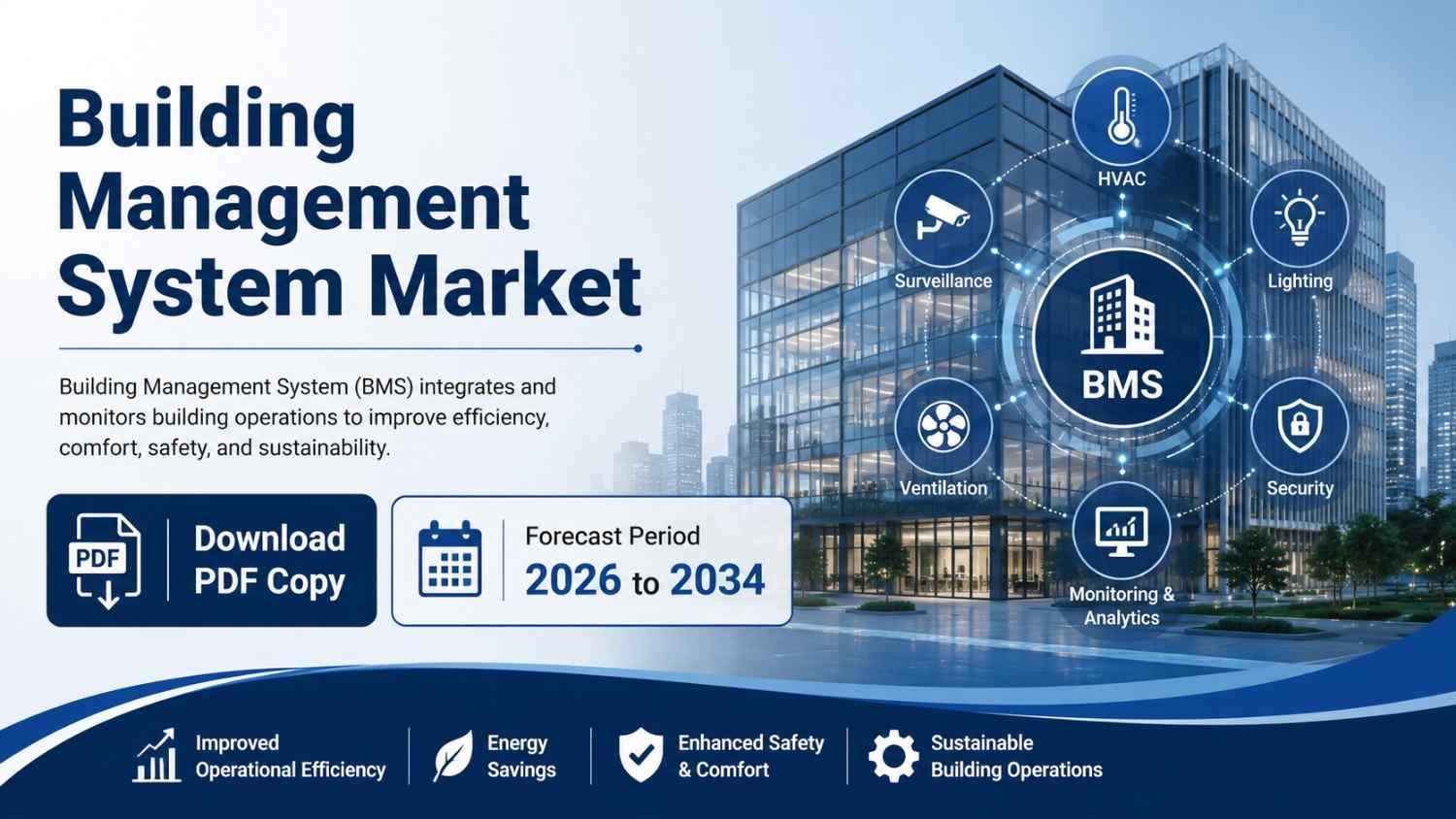
The global building management system market is undergoing a significant transformation, driven by digital engineering and structural automation. A building management system (BMS), otherwise known as a building automation system, acts as a centralized master control framework installed in structures to monitor and manage mechanical, electrical, and electromechanical services. These critical platforms oversee subsystems including heating, ventilation, air conditioning (HVAC), power infrastructure, lighting, and security access points.
Building Management System market size is expected to reach US$ 116.64 Billion by 2034 from US$ 25.81 Billion in 2025. The market is anticipated to register a CAGR of 18.25% during the forecast period 2026–2034.
Key Drivers
Rising Demand for Real Time Energy Efficiency
The global focus on reducing structural carbon prints and managing high electricity costs acts as a primary catalyst for industry growth. Modern building management solutions enable facility administrators to monitor exact consumption profiles, apply automated scheduling, and actively mitigate energy spikes.
Expansion of Smart Building and Smart City Initiatives
Governments worldwide are funding smart city infrastructure to accommodate growing urban populations. Smart buildings utilize integrated data ecosystems, relying on a central management system to coordinate municipal and commercial properties efficiently.
Advancements in Internet of Things (IoT) and AI
The integration of cheap IoT sensor arrays, cloud infrastructure, and artificial intelligence allows legacy structures to upgrade affordably. Predictive algorithms can now process sensor feeds to predict mechanical stress before a system breaks down, providing excellent returns on investment for property management groups.
Strategic Opportunities
Transition to Cloud Based Platforms
While historical deployments favored local, physical server systems due to local data privacy, cloud computing is opening massive opportunities. Cloud infrastructure lets property management firms manage dozens of geographically separated sites from a single browser dashboard, opening up the market to small and mid-sized enterprises.
Focus on Occupant Wellness and Air Quality
Modern property owners focus heavily on interior environmental wellness. Intelligent platforms that dynamically alter ventilation, fresh air exchange, and natural light levels based on real time indoor air testing present a major marketplace opportunity.
Comprehensive Market Segmentation
The market is generally broken down across four distinct technical criteria:
- By Component: Divided into Hardware (controllers, thermostats, actuators, smart sensors), Software (facility management, energy analytics, emergency interfaces), and Professional or Managed Services.
- By Software Module: Divided into Energy Management, Security and Access Control, Facility Management, Infrastructure Monitoring, and Emergency Systems.
- By Communication Protocol: Segmented into BACnet, Modbus, LonWorks, KNX, and various open source wireless networks like Zigbee or Wi-Fi.
- By End User Application: Segmented into Commercial Buildings (offices, shopping malls, hotels), Industrial Complexes, Government Properties, Healthcare Infrastructure, and Residential Spaces.
Competitive Landscape and Key Players
The global building management system arena is highly competitive and controlled by established engineering conglomerates alongside emerging software specialists. The primary strategy utilized by these companies focuses on research and development alongside strategic acquisitions to incorporate machine learning directly into edge controller hardware.
Top Industry Players:
- Siemens AG
- Schneider Electric SE
- Honeywell International Inc.
- Johnson Controls International plc
- ABB Ltd.
- Robert Bosch GmbH
- Emerson Electric Co.
- Delta Controls Inc.
Market News and Recent Developments
Technological developments are shifting from isolated mechanical interfaces toward open source communication protocols. Major players are expanding their platform frameworks to guarantee cross brand interoperability, helping consumers bypass traditional vendor lock barriers.
- Open Protocol Integration: Major manufacturers are updating their edge devices to seamlessly switch between BACnet and Modbus networks, lowering customization costs during physical renovations.
- AI and Digital Twin Adoption: Engineering software teams are rolling out digital twin features, letting operations staff build a virtual replica of a skyscraper to test energy saving scenarios virtually before deployment.
- Enhanced Operational Cybersecurity: As systems connect directly to cloud networks, cybersecurity features like encrypted hardware authentication have become standard protocol on newly manufactured microcontrollers.
Future Outlook
Looking onward to 2034, the market will transition toward autonomous facility networks that require little human configuration. Instead of simple scheduled routines, tomorrow's building networks will rely on edge artificial intelligence to predict weather shifts, energy grid costs, and precise room occupancy numbers to tweak HVAC and lighting layouts ahead of time. The long term outlook points toward a unified, sustainable world where structures dynamically balance energy generation and storage to achieve true net zero operational efficiency.
Frequently Asked Questions
What is the primary function of a building management system?
A building management system serves as an integrated software and hardware hub that monitors and regulates technical structural systems like heating, air conditioning, indoor lighting, power grids, and security barriers to maximize safety and reduce waste.
Why is the commercial sector leading the building management market?
Commercial entities like high rise corporate offices, hospital facilities, and large retail centers consume massive volumes of power and operate round the clock. These entities gain rapid financial returns from the utility cost savings and automated maintenance schedules provided by smart building automation.
How does cloud technology alter traditional building management solutions?
Cloud based management allows operations teams to centralize data analytics from multiple properties into a single remote network. This approach reduces the initial expenses of buying onsite server hardware while facilitating rapid system updates and remote mobile troubleshooting.
The Insight Partners provides comprehensive syndicated and tailored market research services in the healthcare, technology, and industrial domains. Renowned for delivering strategic intelligence and practical insights, the firm empowers businesses to remain competitive in ever-evolving global markets.
• Email: [email protected]
• Website: theinsightpartners.com
• Phone: +1-646-491-9876

 English
 Arabic
 French
 Spanish
 Portuguese
 Deutsch
 Turkish
 Italiano
 Russian
 Romaian
 Portuguese (Brazil)
 Greek