
Cullet Market Trends in Sustainable Raw Material Sourcing
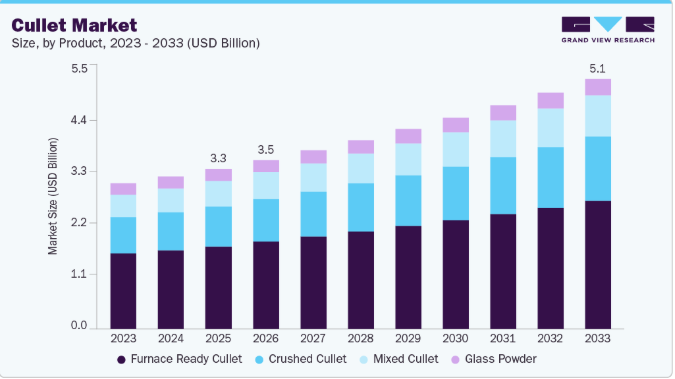
The global Cullet Market was valued at USD 3.3 billion in 2025 and is projected to reach USD 5.1 billion by 2033, expanding at a CAGR of 5.7% from 2026 to 2033. The market is witnessing steady growth as industries increasingly prioritize sustainable manufacturing practices, energy efficiency, and circular economy initiatives. Cullet, which consists of recycled and processed glass fragments, has become a critical raw material for glass production due to its ability to reduce energy consumption, lower carbon emissions, and minimize dependence on virgin materials.
As governments strengthen environmental regulations and industries pursue net-zero targets, glass manufacturers are increasing the proportion of recycled cullet in production processes. The material not only supports sustainability objectives but also delivers substantial cost benefits by lowering furnace operating temperatures and reducing fuel requirements. These advantages are making cullet an increasingly strategic resource across packaging, construction, automotive, and industrial manufacturing sectors.
Growing Demand for Sustainable Glass Manufacturing Driving Market Growth
The transition toward sustainable manufacturing remains one of the strongest growth drivers for the global cullet market. Traditional glass production relies heavily on raw materials such as silica sand, soda ash, and limestone, which require significant energy during melting and processing. By incorporating recycled glass cullet, manufacturers can substantially reduce energy requirements while improving production efficiency.
The growing focus on reducing greenhouse gas emissions is accelerating cullet adoption worldwide. Glass manufacturers are under increasing pressure to meet environmental compliance standards while maintaining profitability. Since recycled glass melts at lower temperatures than virgin raw materials, cullet helps reduce fuel consumption and furnace wear, creating both environmental and economic benefits.
Additionally, the adoption of circular economy models is encouraging industries to maximize material recovery and reuse. Governments and environmental agencies across developed and emerging economies are supporting glass recycling programs, creating a more stable supply of high-quality cullet for industrial applications.
Expanding Glass Packaging Industry Supporting Market Expansion
The rapid growth of the glass packaging sector continues to generate significant demand for recycled glass feedstock. Industries such as food & beverages, pharmaceuticals, cosmetics, and personal care increasingly prefer glass packaging due to its recyclability, premium appearance, and ability to preserve product quality.
Rising consumer awareness regarding sustainable packaging solutions is encouraging brands to shift away from single-use plastics and adopt recyclable glass containers. As a result, beverage manufacturers, pharmaceutical companies, and consumer goods producers are investing heavily in closed-loop recycling systems and bottle-to-bottle recycling initiatives.
A notable industry advantage is that increased cullet utilization directly contributes to energy savings. According to industry estimates, every 10% increase in cullet usage can reduce glass manufacturing energy consumption by approximately 2% to 3%. This economic benefit is becoming increasingly important as manufacturers face rising energy costs and stricter carbon reduction targets.
Emerging Trends Reshaping the Cullet Industry
Several emerging trends are transforming the competitive landscape of the cullet market:
Advanced Glass Recycling Technologies
Modern sorting and processing technologies are improving cullet quality and recovery rates. AI-powered optical sorting systems, automated color separation technologies, and contamination detection solutions are enabling recyclers to produce higher-grade cullet suitable for premium glass applications.
Closed-Loop Recycling Systems
Glass manufacturers are increasingly implementing closed-loop recycling programs that recover post-consumer and post-industrial glass waste for reuse in production. These initiatives improve resource efficiency while supporting sustainability commitments.
Low-Carbon Manufacturing Strategies
Manufacturers are incorporating higher percentages of recycled cullet to reduce Scope 1 and Scope 2 emissions. As ESG reporting becomes increasingly important, recycled glass content is emerging as a key sustainability metric across industries.
Growing Use in Fiberglass Production
Beyond container and flat glass manufacturing, cullet is gaining traction in fiberglass production. The material improves production efficiency while supporting demand for lightweight and durable materials used in transportation, construction, renewable energy, and infrastructure projects.
Looking for more specific insights? Customize this report to suite your business needs
Key Market Trends & Insights
- Europe dominated the global cullet market, accounting for approximately 32.0% of total revenue in 2025, supported by advanced recycling infrastructure, strong sustainability regulations, and growing demand for recyclable glass packaging.
- Furnace ready cullet held the largest market share of over 51% in 2025, driven by its ability to improve furnace efficiency, reduce energy consumption, and support sustainable glass manufacturing operations.
- The fiberglass application segment is projected to register the fastest growth, expanding at a CAGR of 6.3% from 2026 to 2033, supported by rising demand for lightweight, durable, and energy-efficient materials across multiple industries.
- Increasing investments in glass collection networks, recycling facilities, and automated sorting systems are improving cullet availability and quality worldwide.
- Circular economy initiatives and carbon neutrality goals are encouraging greater utilization of recycled glass across manufacturing value chains.
Market Size & Forecast
- 2025 Market Size: USD 3.3 Billion
- 2033 Projected Market Size: USD 5.1 Billion
- CAGR (2026–2033): 5.7%
- Europe: Largest Market in 2025
- Asia Pacific: Fastest-Growing Region
Key Cullet Company Insights
The global cullet market is characterized by the presence of major glass manufacturers, specialty material suppliers, and recycling companies focused on expanding recycled glass utilization and strengthening sustainable production capabilities.
AGC Inc.
AGC Inc. is a leading global producer of glass, chemicals, electronics materials, and advanced industrial products. The company actively supports glass recycling through its portfolio of recycled flat glass cullet solutions, furnace-ready cullet products, and low-carbon glass manufacturing initiatives. AGC continues to invest in circular economy programs that improve material recovery and reduce environmental impact across its operations.
Corning Incorporated
Corning Incorporated is a global technology leader specializing in specialty glass, ceramics, optical communications, and advanced materials. The company operates comprehensive glass recycling programs designed to maximize resource efficiency and minimize waste generation. Its cullet-related initiatives include recycled glass feedstock solutions, industrial glass recovery systems, and internal recycling processes that support sustainable manufacturing.
Explore Grand View Horizon to see global and regional level statistics related to the Cullet Market
Key Cullet Companies
The following companies have been profiled in the global cullet market:
- AGC Inc.
- Ardagh Group S.A.
- Corning Incorporated
- Guardian Industries
- Nippon Electric Glass Co., Ltd.
- O-I Glass, Inc.
- Owens Corning
- Saint-Gobain S.A.
- Sisecam Group
- Vetropack Holding Ltd.
Conclusion
The global cullet market is positioned for sustained growth as industries accelerate the transition toward sustainable and energy-efficient manufacturing practices. Rising demand for recyclable packaging, stricter environmental regulations, and increasing investments in glass recycling infrastructure are strengthening the market outlook. Furthermore, technological advancements in sorting, processing, and closed-loop recycling systems are improving cullet quality and expanding its industrial applications. As manufacturers continue prioritizing carbon reduction, resource conservation, and circular economy strategies, cullet will play an increasingly vital role in the future of global glass production and sustainable industrial development.
Looking for a report customized to your requirements? Explore our Custom Research Offering
Grand View Research offers
- Focused market intelligence reports on specific geographies or high-growth segments
- Extended forecast timelines for long-term planning
- Competitor Benchmarking and Supply Chain Analysis
- Inclusion of regulatory and policy assessments
- Inclusion of custom data models, KPIs, or applications unique to your business
- Specific high-impact Data Decks and Tables to support effective decision making
And much more…

 English
 Arabic
 French
 Spanish
 Portuguese
 Turkish
 Dutch
Dutch
 Italiano
 Russian
 Romaian
 Portuguese (Brazil)
 Greek
Greek