
Why does Gangnammould Double Layer Pallet Mold behave differently during long runs
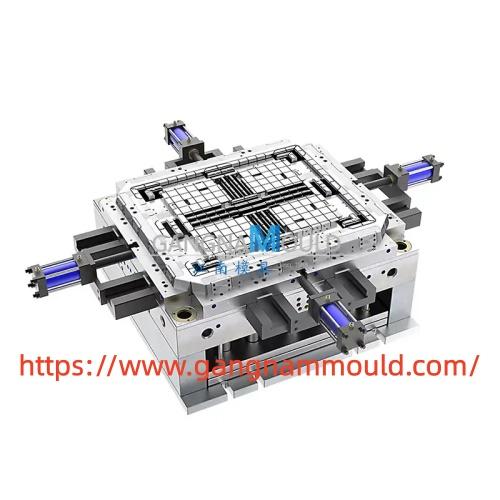
Double Layer Pallet Mold forming stability in production is shaped by a combination of mechanical, thermal, and operational factors that interact over time. In real factory environments, performance rarely changes suddenly. Instead, it develops gradually as working conditions, material behavior, and structural response influence each other across repeated cycles.
One of the main contributors is material flow behavior during injection. When molten material enters the cavity, it must distribute evenly across all sections. If flow paths are not balanced, slight differences in density or wall thickness can appear. These variations may seem minor at first, but over long production periods they can influence overall consistency and product uniformity.
Thermal conditions also play an important role. In continuous operation, heating and cooling phases rarely remain completely stable. Even small fluctuations in temperature can affect shrinkage behavior and internal stress distribution. When these small changes repeat over many cycles, they may gradually influence forming accuracy and surface condition.
Pressure control is another key factor. If pressure is uneven across different areas, certain regions of the structure may experience higher stress levels. This does not always lead to immediate issues, but repeated uneven loading can slowly affect alignment and surface performance. Operators often notice this through small adjustments needed during routine production rather than sudden breakdowns.
Surface condition inside the cavity evolves over time as well. Even with proper initial finishing, repeated material movement can slightly change friction levels. As friction increases or becomes inconsistent, flow behavior may also shift. This can affect release smoothness and surface uniformity in later production stages.
Mechanical alignment is closely related to long term stability. Small shifts in positioning can lead to uneven force distribution during operation. Over time, this may create localized wear in specific areas. Regular inspection helps identify these changes early and prevents gradual performance drift.
Environmental conditions around production equipment also contribute indirectly. Dust, humidity, and ambient temperature can influence cooling efficiency and surface cleanliness. While these factors may not directly change forming behavior, they can affect long term operational consistency when accumulated over time.
Maintenance practices remain one of the most practical ways to control stability. Simple actions such as cleaning residue, checking moving parts, and ensuring proper lubrication help reduce unnecessary friction and irregular wear. In many production settings, consistent maintenance habits have a stronger impact than occasional large adjustments.
Cycle planning also affects operational behavior. Continuous high frequency operation without sufficient pauses may lead to heat accumulation inside the system. When internal temperature does not fully stabilize between cycles, small variations in forming behavior may appear. Adjusting cycle rhythm can help reduce this effect and support more predictable production results.
From a structural perspective, balanced design helps distribute stress more evenly across the system. When load is concentrated in specific areas, wear tends to develop unevenly. A more balanced structure reduces this concentration effect and supports longer term consistency under repeated use.
Gangnammould focuses on aligning tooling design with real production conditions, especially in applications where long cycle stability is required. The design approach considers not only initial performance but also how the system behaves after extended use under continuous factory operation.
Monitoring small performance signals is often more useful than reacting to major issues. Slight changes in cycle timing, surface texture, or forming uniformity can indicate early stages of variation. Recognizing these signals early allows adjustments before they develop into larger production concerns.
Over time, production teams that pay attention to these gradual changes tend to maintain more stable workflows. This helps reduce interruptions and supports smoother operational planning in long term manufacturing environments.
Different structural setups and application references can be viewed at https://www.gangnammould.com/ where various configurations are presented in a simple and practical format for comparison and planning.

 English
 Arabic
 French
 Spanish
 Deutsch
 Turkish
 Dutch
 Italiano
 Russian
 Romaian
 Portuguese (Brazil)
 Greek