
Data Historian Market Share, Competitive Landscape and Forecast Report by Maximize Market Research
Data Historian Market
Market Overview
The global Data Historian Market is experiencing steady growth due to increasing industrial digitalization, rising adoption of automation technologies, and growing demand for real-time operational data management. A data historian is specialized software designed to collect, store, organize, and retrieve time-series data generated by industrial equipment, sensors, machines, and production systems. These solutions help organizations monitor equipment performance, analyze historical information, identify operational inefficiencies, and improve decision-making.
Data historians are widely used across manufacturing, oil and gas, energy, water management, data centers, and paper and pulp industries. The growing integration of Industrial Internet of Things (IIoT), cloud computing, and advanced analytics is increasing the importance of reliable industrial data management systems. Businesses are increasingly adopting data historian solutions to improve productivity, reduce operational costs, optimize asset performance, and support predictive maintenance activities.
Download Free PDF Brochure-https://www.maximizemarketresearch.com/request-sample/63023/
Market Size and Growth
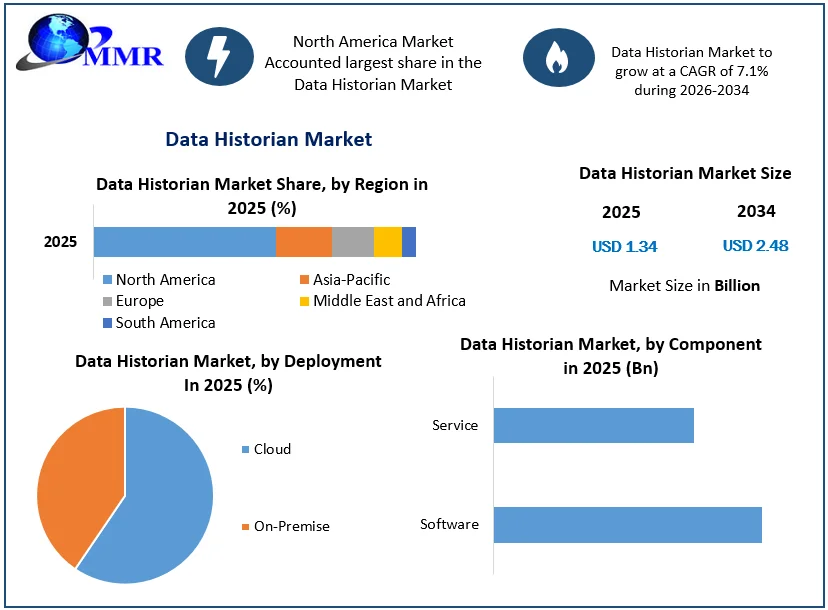
According to Maximize Market Research, the global Data Historian Market was valued at USD 1.34 Billion in 2025. The market is expected to grow at a CAGR of 7.1% during the forecast period from 2026 to 2034, reaching approximately USD 2.48 Billion by 2034.
The growing demand for centralized industrial data management is a major factor supporting market expansion. Organizations are generating large volumes of operational information through connected machines, sensors, and automated production systems. Data historian platforms help businesses manage this information efficiently and convert historical records into actionable insights.
Furthermore, increasing investments in smart manufacturing, industrial automation, and cloud-based infrastructure are creating new opportunities for market participants. The growing need for equipment monitoring, operational transparency, and production optimization is expected to support long-term market growth.
Key Market Segmentation
The Data Historian Market is segmented by component, deployment, end-user industry, and region.
Based on component, the market is divided into software and services. The services segment accounted for approximately 47% of the market revenue share. Services play an important role in supporting implementation, system integration, maintenance, technical assistance, and operational optimization. Increasing demand for professional and post-sales support is contributing to segment growth. The software segment also represents a significant market category due to the growing adoption of advanced industrial data storage and analysis platforms.
By deployment, the market is categorized into cloud and on-premise solutions. Cloud deployment is expected to experience the fastest growth during the forecast period because of its scalability, flexibility, and lower infrastructure requirements. On-premise solutions remain relevant for organizations requiring greater control over industrial information, security, and existing operational technology infrastructure.
Based on end-user industry, the market includes data centers, oil and gas, paper and pulp, water management, manufacturing, and other industries. The oil and gas segment dominated the market due to the industry's dependence on continuous equipment monitoring, process optimization, and predictive maintenance. Data historians help operators analyze equipment performance and reduce the risk of costly production interruptions.
Growth Drivers
The increasing demand for aggregated industrial data is one of the major factors driving the Data Historian Market. Manufacturing facilities and industrial organizations require accurate operational information to improve production efficiency, identify equipment problems, and optimize business processes. Data historian systems collect information from multiple industrial sources and provide centralized access to historical records.
The growing adoption of industrial automation and IIoT technologies is another important growth driver. Connected sensors, machines, and control systems generate substantial amounts of data that require efficient storage and management. Data historians help organizations monitor industrial operations and support data-driven decisions.
Additionally, the increasing focus on predictive maintenance is supporting market expansion. Historical equipment information helps businesses identify performance changes, detect potential failures, and reduce unplanned downtime. Growing investments in smart manufacturing and digital transformation are further strengthening demand.
Emerging Trends
Cloud-based deployment is one of the most significant trends in the Data Historian Market. Cloud platforms allow organizations to store and access large volumes of industrial data without maintaining extensive physical infrastructure. They also support collaboration across multiple manufacturing facilities and geographically distributed operations.
Artificial intelligence and machine learning integration is another emerging trend. These technologies enable advanced data analysis, anomaly detection, predictive maintenance, and improved operational forecasting.
The integration of data historians with Industrial Internet of Things platforms is also gaining importance. Businesses are combining historical information with real-time operational data to improve production visibility and asset management.
Additionally, hybrid cloud infrastructure, advanced cybersecurity solutions, and industrial data visualization tools are becoming increasingly important as organizations modernize their data management systems.
Regional Analysis
North America dominated the global Data Historian Market in 2025, accounting for approximately 29.5% of the market share. Regional growth is supported by strong investments in research and development, industrial automation, cloud computing, and advanced data analytics. The United States represents a major market due to the presence of leading technology providers, including Honeywell International, Rockwell Automation, and General Electric. The increasing adoption of smart manufacturing and industrial digitalization is further supporting regional demand.
Europe represents another important market, driven by increasing investments in Industry 4.0, industrial automation, and smart manufacturing technologies. Countries such as Germany, France, and the United Kingdom are adopting advanced data management solutions to improve manufacturing productivity and operational efficiency.
Asia-Pacific is expected to offer significant growth opportunities due to rapid industrialization, expanding manufacturing infrastructure, and increasing investments in automation technologies. China, India, Japan, and South Korea are strengthening their industrial digitalization capabilities. The growing adoption of IIoT, cloud computing, and smart factory solutions is expected to increase demand for data historian platforms.
The Middle East and Africa and South America are also witnessing growing adoption of industrial data management technologies, particularly across oil and gas, energy, and water management industries.
Competitive Landscape
The global Data Historian Market is fragmented, with established industrial technology companies and specialized software providers competing through product innovation, strategic partnerships, acquisitions, and research and development investments.
Major market players include Emerson, Rockwell Automation, OSIsoft, Automsoft, Canary Labs, COPA-DATA, Inductive Automation, Industrial Video & Control, InfluxData, Kx Systems, LiveData Utilities, Open Automation Software, Progea, Savigent Software, Sorbotics, ABB, AVEVA Group, General Electric, Honeywell, IBM, Siemens, Yokogawa, and Aspen Technology.
Companies are focusing on cloud-based platforms, advanced industrial analytics, cybersecurity, and integration capabilities to strengthen their market positions. The development of scalable solutions for manufacturing facilities and geographically distributed industrial operations is also becoming an important competitive strategy.
Download Free PDF Brochure-https://www.maximizemarketresearch.com/request-sample/63023/
Recent Developments
The Data Historian Market is witnessing continuous product innovation and strategic developments.
On February 26, 2026, GE Vernova unveiled its Proficy 2026 portfolio roadmap, outlining architecture updates and subscription models for its time-series data historian and manufacturing software solutions. The developments aim to support production optimization and cloud-based industrial data transformation.
On March 12, 2026, Inductive Automation published a security advisory recommending an upgrade to Ignition version 8.3.0 or later to address vulnerabilities affecting distributed industrial applications.
On March 24, 2026, AVEVA introduced an update to its PI Vision 2025 platform, adding regression line trace tools and enhanced database security capabilities.
On April 30, 2026, GE Vernova launched Proficy SCADA Ultimate, combining data visualization, process data management, and industrial analytics capabilities through a unified subscription model.
Future Outlook
The future of the Data Historian Market is expected to remain positive as industries increasingly prioritize digital transformation, industrial automation, and data-driven operational management. Growing adoption of cloud computing, IIoT, and artificial intelligence will create additional opportunities for software providers.
Demand for scalable data storage, predictive maintenance, real-time monitoring, and advanced analytics is expected to increase across manufacturing, oil and gas, data centers, and energy industries. Furthermore, investments in cybersecurity and hybrid cloud infrastructure will encourage organizations to modernize their industrial data management systems.
Asia-Pacific is expected to emerge as an important growth region due to expanding industrial infrastructure and increasing adoption of smart manufacturing technologies.
For full access to the comprehensive strategic report, visit:https://www.maximizemarketresearch.com/market-report/global-data-historian-market/63023/
Conclusion
The global Data Historian Market is growing steadily due to increasing industrial digitalization, rising demand for operational data management, and the adoption of advanced automation technologies. Cloud-based deployment, IIoT integration, and predictive analytics are transforming how organizations collect, store, and utilize industrial information. With the market projected to reach USD 2.48 Billion by 2034, continuous technological innovation, strategic partnerships, and investments in industrial data infrastructure will remain essential for market development.
About Maximize Market Research
Maximize Market Research is a multifaceted market research and consulting company with professionals from several industries. Some of the industries we cover include medical devices, pharmaceutical manufacturers, science and engineering, electronic components, industrial equipment, technology and communication, cars and automobiles, chemical products and substances, general merchandise, beverages, personal care, and automated systems. To mention a few, we provide market-verified industry estimations, technical trend analysis, crucial market research, strategic advice, competition analysis, production and demand analysis, and client impact studies.
Contact Maximize Market Research
3rd Floor, Navale IT Park, Phase 2
Pune Bangalore Highway, Narhe,
Pune, Maharashtra 411041, India
[email protected]
+91 96071 95908, +91 9607365656

 English
 Arabic
 Spanish
 Portuguese
 Deutsch
 Turkish
 Dutch
 Italiano
 Russian
 Romaian
 Portuguese (Brazil)
 Greek