
Biologic CDMOs Scale Up as Monoclonal Antibody Demand Surges
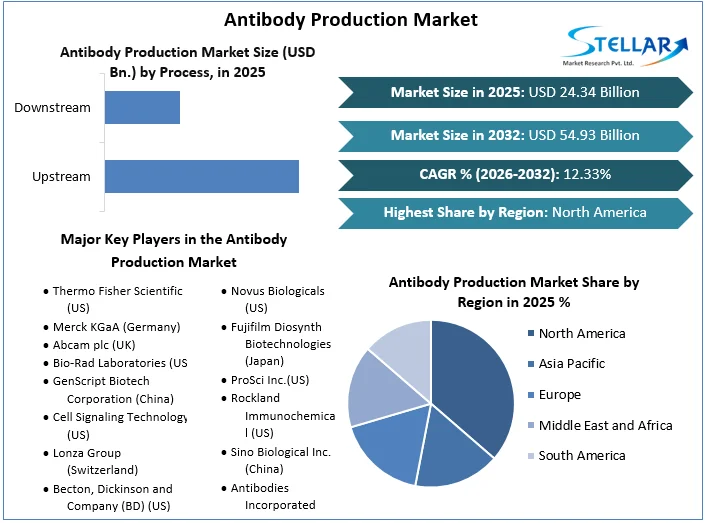
The Antibody Production Market is undergoing a structural shift toward agile, single-use bioprocessing and outsourced manufacturing, according to a comprehensive study by Stellar Market Research. Driven by rising biologic pipelines in oncology and immunology, modular single-use systems and contract development and manufacturing organizations (CDMOs) are lowering facility footprints and accelerating commercial batch turnaround for high-value therapeutics.
Biologics manufacturing has historically relied on capital-intensive stainless-steel bioreactors that lock drugmakers into rigid production schedules and lengthy changeovers. Today, surging demand for monoclonal, bispecific, and antibody-drug conjugate (ADC) therapies is forcing a pivot toward flexible, multi-product manufacturing architectures.
Key Findings from the Report
-
Market Trajectory: The global antibody production market demonstrates strong double-digit expansion across multi-year forecast horizons, with industry benchmarks placing current valuations near USD 19.42 billion in 2026 and long-range projections climbing above USD 45 billion through the early-to-mid 2030s at an 11.36% CAGR.
-
Dominant Antibody Type: Monoclonal antibodies (mAbs) command the largest revenue share—approximately 62% to 64%—anchored by widespread clinical adoption in oncology, autoimmune disorders, and infectious diseases.
-
Product & Process Split: Bioprocessing consumables (media, buffers, resins, and filters) generate the largest share of recurring revenue (around 49% to 62% depending on scope), while single-use bioreactor instruments and downstream purification technologies exhibit rapid growth momentum.
-
End-User Shift: Pharmaceutical and biotechnology companies represent the core revenue base (over 55% to 62% share), while CDMOs record some of the fastest growth rates as sponsors outsource complex biologics scale-up and tech transfer.
-
Regional Leadership & Momentum: North America leads global revenue with roughly 37.5% to 41% share backed by deep biopharma R&D and commercial infrastructure, while Asia-Pacific stands out as the fastest-growing region due to expanding biologics manufacturing hubs and cost-competitive production.
-
Investment Relevance: Capital deployment is concentrating in single-use bioreactor capacity (1,000 L to 5,000 L scale), continuous downstream purification trains, and regionalized GMP manufacturing hubs that mitigate geopolitical and supply-chain bottlenecks.
For further information, click the following link:https://www.stellarmr.com/report/req_sample/antibody-production-market/2476
Market Drivers and Restraints
Key Market Drivers:
-
Expanding Biologic & Next-Gen Antibody Pipelines: Growing clinical and commercial pipelines across monoclonal antibodies, bispecifics, and ADCs sustain baseline demand for reliable upstream cell culture and downstream purification capacity.
-
Adoption of Single-Use & Continuous Bioprocessing: Single-use bioreactors, disposable flow paths, and continuous chromatography shorten batch changeover times, reduce cross-contamination risk, and improve multi-product facility agility.
-
Outsourcing to Specialized CDMOs: Rising technical complexity in biologics manufacturing encourages biopharma innovators to rely on CDMO partners for rapid process scale-up, tech transfer, and commercial GMP supply.
Key Market Restraints:
-
High Capital Intensity & Process Complexity: Building and validating cGMP biomanufacturing suites, cleanrooms, and quality control systems requires substantial upfront capital and specialized technical talent, creating hurdles for smaller entrants.
-
Batch Consistency & Downstream Bottlenecks: Maintaining tight glycosylation profiles, high purity, and consistent yield across large-scale runs—especially as higher upstream titers strain downstream harvest clarification and purification—remains technically demanding.
Technology, Regulation, and Sustainability Trends
Process analytical technology (PAT), real-time process monitoring, and high-throughput antibody discovery platforms are accelerating cell-line selection and tightening control over critical quality attributes. Concurrently, regulatory agencies continue to emphasize strict comparability, sterility assurance, and end-to-end traceability for biologics and biosimilars.
Sustainability is also reshaping bioprocess engineering: operators are adopting alkaline-tolerant chromatography resins with longer lifecycles, inline buffer dilution skids, and closed single-use assemblies to reduce water consumption, buffer volume, and plastic/chemical waste in alignment with corporate ESG commitments.
Regional Insights
-
North America (Leading Region): Anchored by the United States, North America leads global market share on the strength of advanced biopharmaceutical R&D, high biologic therapy adoption, dense CDMOs, and mature regulatory frameworks.
-
Asia-Pacific (Fastest-Growing Region): Rapidly expanding biomanufacturing infrastructure, government life-sciences initiatives, and growing local and contract capacity across countries such as China, Japan, Singapore, and India are driving strong regional growth. Europe remains a major contributor, led by established biopharma hubs including Germany and Switzerland.
Recent Industry Developments
-
WuXi XDC Cayman Inc. (2026): Achieved GMP release for its BCM3 line in Singapore covering antibody intermediates and conjugated drug substances across 200–2,000 L batches, expanding regional and global supply capacity.
-
Elanco Animal Health Incorporated (2026): Completed a 25,000-square-foot expansion at its Elwood facility to boost monoclonal antibody manufacturing and quality control capacity.
-
Aragen Life Sciences (2026): Manufactured first commercial-scale GMP batches of Renaissance Pharma's Daretabart antibody using 2KL bioreactors and tech transfer capabilities to support oncology therapy supply.
-
FUJIFILM Biotechnologies (2026): Opened an expanded Teesside manufacturing facility equipped with 2,000 L and 5,000 L single-use bioreactors totaling 19,000 L of capacity to scale antibody production.
-
Biointron (2025): Launched AbDrop, a high-throughput platform designed for rapid discovery of fully human antibodies, accelerating early-stage antibody pipeline workflows.
Competitive Landscape
Leading participants in the global antibody production ecosystem—including Thermo Fisher Scientific, Lonza Group, Merck KGaA, Fujifilm Diosynth Biotechnologies, GenScript Biotech Corporation, Sino Biological Inc., Bio-Rad Laboratories, and Becton, Dickinson and Company (BD)—compete across bioprocess equipment, single-use consumables, cell culture media, and contract manufacturing services. Strategic priorities center on expanding large-scale single-use bioreactor footprints, integrating end-to-end process development with commercial GMP execution, and forming strategic partnerships to capture next-generation biologic demand.
Analyst Commentary
"Biologics manufacturers are moving away from rigid, legacy capacity models toward modular single-use architectures and regionalized supply networks that can adapt quickly to evolving modality pipelines," said a Senior Research Analyst at Stellar Market Research. "Winners over the next decade will be organizations that pair high-yielding upstream expression with streamlined downstream purification and predictable consumable supply."
Future Outlook
Through the forecast period, demand for antibody production capacity is expected to climb steadily alongside chronic disease incidence, precision medicine adoption, and biosimilar expansion. Investment will continue flowing into scalable single-use bioprocessing, intensified downstream purification, and geographically diversified manufacturing hubs, while tightening quality standards and sustainability metrics reward suppliers that deliver both operational efficiency and regulatory reliability.
For further information, click the following link:https://www.stellarmr.com/report/req_sample/antibody-production-market/2476
About Stellar Market Research
Stellar Market Research is a multifaceted market research and consulting company with professionals from several industries. Some of the industries we cover include medical devices, pharmaceutical manufacturers, science and engineering, electronic components, industrial equipment, technology and communication, cars and automobiles, chemical products and substances, general merchandise, beverages, personal care, and automated systems. To mention a few, we provide market-verified industry estimations, technical trend analysis, crucial market research, strategic advice, competition analysis, production and demand analysis, and client impact studies.
Address
Phase 3, Navale IT Zone, S.No. 51/2A/2, Office No. 202, 2nd floor, Near, Navale Brg, Narhe, Pune, Maharashtra 411041
Email
[email protected]
Mobile
+91 9607365656

 English
 Arabic
 French
 Spanish
 Portuguese
 Deutsch
 Turkish
 Dutch
 Russian
 Romaian
 Portuguese (Brazil)
 Greek