
Data Center Rfid Market Demand: Drivers, Segments, and Emerging Requirements
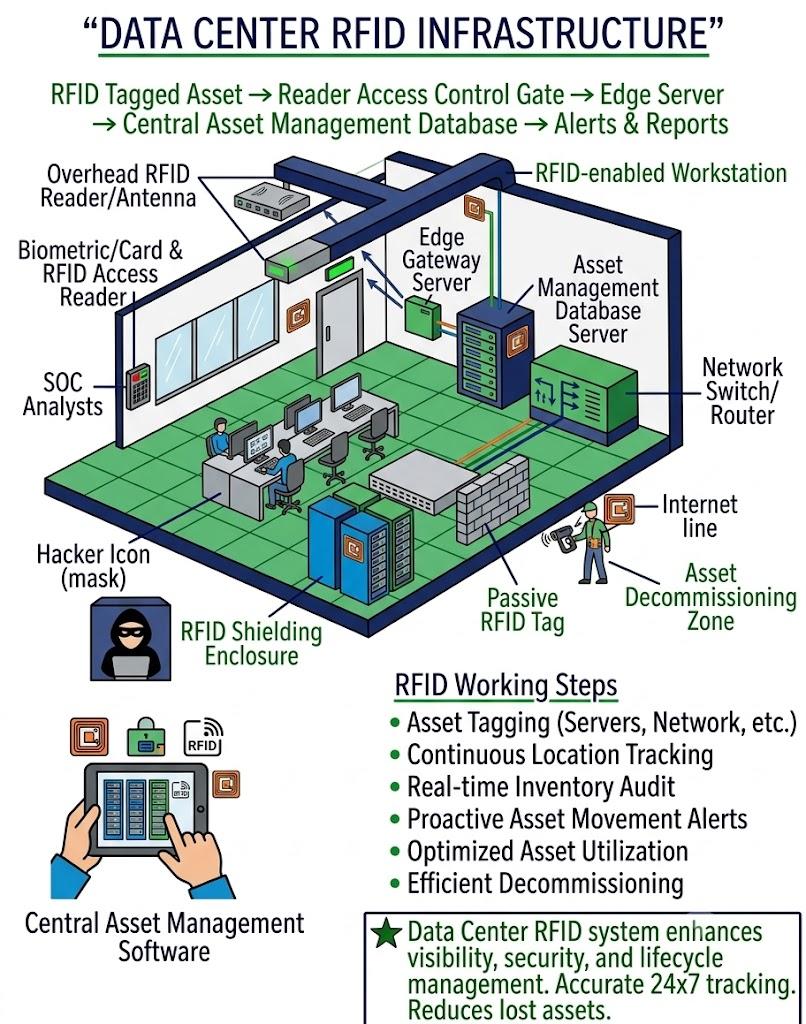
Data Center Rfid Market Demand originates from multiple organizational imperatives that converge on the need for automated, auditable, and real-time asset visibility. Hyperscale expansion represents the most universal driver, as manual tracking becomes operationally unfeasible at scale. Regulatory compliance creates demand for chain-of-custody documentation that RFID uniquely enables. Declining tag costs make comprehensive tracking economically viable for mid-tier operators. Edge computing proliferation creates demand for remote monitoring of unmanned sites. These drivers reinforce each other, creating compounding demand across data center types and organizational contexts, positioning RFID as foundational technology for modern infrastructure management.
Hyperscale Expansion and the Scale Imperative
Across hyperscale environments, the demand for RFID is inseparable from the scale of operations. Facilities containing tens of thousands of individually trackable assets cannot be managed through manual processes. RFID enables automated tracking at scales that would otherwise require prohibitive labor investment, making it essential infrastructure for hyperscale operations. The demand driven by hyperscale is particularly durable because it persists regardless of economic conditions; operators cannot retreat from automated tracking once they have adopted it, and competitive pressure continues to raise expectations for operational efficiency.
Compliance and Audit as Foundational Demand Drivers
The demand for RFID from compliance and audit functions has intensified as regulatory requirements tighten. Financial services and healthcare data environments require demonstrable chain-of-custody documentation for IT assets, and RFID provides automated, timestamped evidence that satisfies audit requirements. This demand is particularly durable because compliance is non-discretionary; organizations cannot defer audit documentation without risking penalties. As regulations expand globally, the demand for RFID-enabled compliance documentation is expected to grow correspondingly.
Edge Computing and Distributed Infrastructure Demand
The proliferation of edge and micro-data centers creates demand for RFID-enabled monitoring of unmanned sites. Edge facilities are often geographically dispersed and lack permanent on-site staff, making remote visibility essential. RFID provides automated tracking that enables operators to monitor assets across distributed locations without requiring physical presence. This demand is particularly significant for telecom operators deploying 5G infrastructure and content delivery networks. As edge computing continues to expand, the demand for RFID-enabled monitoring is expected to grow.
Emerging Demand Segments and Future Requirements
Beyond established drivers, emerging demand segments suggest where the market is heading. AI and predictive analytics demand RFID data as input for maintenance prediction and capacity forecasting. Sustainability reporting demands asset-level data for emissions tracking and circular economy documentation. Autonomous operations demand RFID as the sensory backbone for robotic maintenance and provisioning. These emerging requirements share a common thread: RFID must become more integrated, more intelligent, and more accessible, evolving from a tracking tool into strategic infrastructure intelligence.
➤ Featured Insights from Market Research Future:

 English
 Arabic
 French
 Spanish
 Portuguese
 Deutsch
 Turkish
 Dutch
 Italiano
 Russian
 Romaian
 Greek