
Pressure Sensor Market Demand Supported by Automotive Innovation
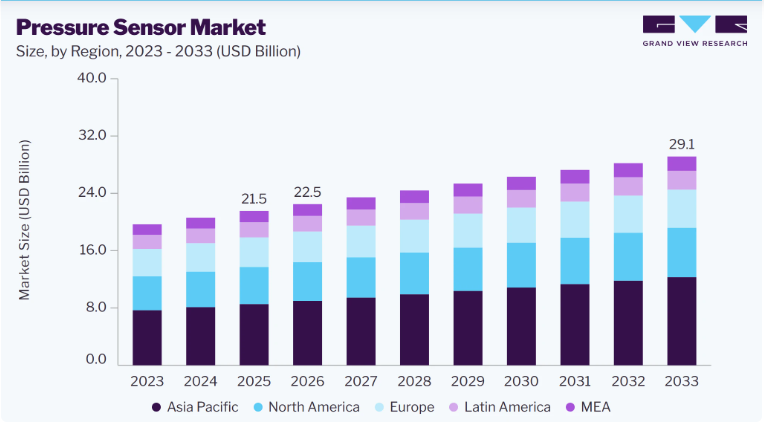
The global Pressure Sensor Market size was estimated at USD 21.5 billion in 2025 and is projected to grow from USD 22.5 billion in 2026 to USD 29.1 billion by 2033, registering a CAGR of 3.8% from 2026 to 2033. Asia Pacific dominated the global market with a revenue share of 39.7% in 2025. Increasing demand from the automotive, healthcare, industrial, and consumer electronics sectors is supporting market expansion. Technological advancements in Microelectromechanical Systems (MEMS), wireless connectivity, and smart sensing solutions are further strengthening the adoption of pressure sensors across diverse applications.
Pressure Sensor Market Overview
Pressure sensors are increasingly used in applications that require accurate pressure measurement, monitoring, and control. Their applications extend across automotive systems, medical devices, consumer electronics, industrial automation, home appliances, and connected equipment. The growing adoption of compact and cost-effective sensors has enabled manufacturers to integrate pressure measurement capabilities into smartphones, wearables, alarm systems, refrigeration systems, water purifiers, and medical breathing devices.
The development of smart pressure sensors with wireless connectivity and IoT integration is also transforming the market. These solutions support real-time monitoring, remote data collection, and improved operational efficiency. As industries adopt automation and connected technologies, demand for reliable and application-specific pressure sensing solutions is expected to increase.
Key Market Trends and Insights
- Product: Absolute pressure sensors accounted for the largest revenue share of 42.3% in 2025.
- Type: The wired segment held the largest revenue share of 84.5% in 2025.
- Technology: Piezoresistive pressure sensors led the technology segment with a 26.4% revenue share in 2025.
- Application: Automotive accounted for the largest application revenue share of 26.3% in 2025.
- Region: Asia Pacific dominated the global market with a 39.7% revenue share in 2025.
- Growth opportunity: The wireless segment is projected to register the fastest CAGR of 5.8% during the forecast period.
Want to Understand What’s Driving Market Growth? Ask Prism AI for research-backed insights into market size, evolving opportunities
Market Dynamics: Drivers, Restraints, and Opportunities
Technological advancements are a major factor supporting pressure sensor market growth. Improvements in MEMS technology have enabled the development of smaller, lighter, and more energy-efficient sensors with enhanced sensitivity and faster response times. These capabilities are increasing their suitability for applications such as tire pressure monitoring systems, electric vehicle battery management systems, industrial process automation, and medical equipment.
The integration of IoT, artificial intelligence, and wireless communication is further expanding pressure sensor capabilities. Smart sensors can support real-time monitoring, predictive maintenance, anomaly detection, and process optimization. These functions are particularly relevant to industrial automation and connected manufacturing environments.
Opportunities are emerging from the growing adoption of electric vehicles, smart medical devices, industrial automation, and Industry 4.0 initiatives. Increasing demand for low-power, highly accurate, and connected pressure sensors is encouraging manufacturers to develop application-specific products.
Product Segment Analysis
The absolute pressure sensor segment dominated the product category, accounting for 42.3% of market revenue in 2025. These sensors measure pressure relative to a perfect vacuum and are used in applications that require measurements independent of atmospheric pressure. Their use in industrial vacuum pump monitoring and medical product vacuum packaging supports segment demand. The need for accurate pressure measurement in automotive applications also contributes to adoption.
The differential pressure sensor segment is expected to grow at the fastest CAGR during the forecast period. These sensors measure pressure differences and are used to determine the flow of liquids and gases in industrial environments. Their applications in hydraulic and lubrication systems are creating demand across industrial equipment. Product innovations designed to monitor filter conditions and identify clogging are also supporting this segment.
Download a free sample report or claim your copy of this full market intelligence report
Type and Technology Insights
Based on type, wired pressure sensors held the largest revenue share of 84.5% in 2025. Their lower radio frequency interference, compatibility across manufacturers, relatively low installation costs, and lower power consumption support adoption across industrial and automotive applications.
By technology, piezoresistive pressure sensors led the market with a 26.4% revenue share in 2025. Their robustness, rapid response time, and high-frequency performance support applications in automotive, aerospace, and industrial systems. The optical segment is expected to register the fastest CAGR from 2025 to 2030. Optical pressure sensors are suitable for applications requiring resistance to electromagnetic interference, including use in harsh environments and medical applications.
Application Analysis
The automotive segment accounted for the largest application revenue share of 26.3% in 2025. Pressure sensors are used in engine management systems to monitor intake manifold pressure and optimize fuel delivery, supporting fuel efficiency and reduced emissions. They also play a role in tire pressure monitoring systems and other vehicle safety and performance applications. Growing adoption of electric vehicles and sensor-based automotive technologies is creating further opportunities.
Regional Market Outlook
Asia Pacific dominated the global pressure sensor market with a revenue share of 39.7% in 2025 and is anticipated to grow at a CAGR of 5.2% during the forecast period. Large-scale electronic component production, rising R&D investments, and increasing demand for smartphones, tablets, and wearable devices support regional growth. India and China are important contributors to the regional market.
India is expected to register the fastest CAGR during the forecast period. Growing demand across healthcare, automotive, and consumer electronics, along with investments in affordable medical technologies and local manufacturing, is supporting market expansion. China also represents a substantial market, driven by industrialization, electric vehicle manufacturing, and smart city development.
North America represents a lucrative market due to demand for pressure sensors in automotive tire pressure monitoring systems and exhaust gas recirculation applications. The region's oil and gas, petrochemical, and medical industries also contribute to demand. In the U.S., advanced automotive, aerospace, and healthcare sectors support the adoption of high-precision sensors, while smart manufacturing is increasing the use of sensor-integrated systems.
Europe's market is supported by industrial engineering, automotive manufacturing, and sustainability initiatives. Germany benefits from its strong manufacturing base and adoption of Industry 4.0 practices. The UK market is supported by investments in healthcare and smart technologies, with applications across medical devices, HVAC systems, and water treatment.
Competitive Landscape
The pressure sensor market identified companies in the market include ABB Ltd., Robert Bosch GmbH, AlphaSense, Process Sensing Technologies (PST) Group, Figaro Engineering Inc., and Membrapor. Product development and technological innovation remain important areas of competition as manufacturers address demand for accurate, reliable, and connected sensing solutions.
Future Outlook
The pressure sensor market is expected to experience steady growth through 2033, supported by expanding applications in automotive, healthcare, industrial automation, and consumer electronics. Advances in MEMS miniaturization, wireless connectivity, and AI-enabled analytics are improving sensor performance and expanding their use in connected systems. Although high development costs and stringent performance requirements remain challenges, growing investments in electric vehicles, smart manufacturing, and intelligent monitoring technologies are expected to create further opportunities.

 English
 Arabic
 French
 Spanish
 Portuguese
 Deutsch
 Dutch
 Italiano
 Russian
 Romaian
 Portuguese (Brazil)
 Greek