
Carbon Composites Market Analysis by Matrix, Process and Application
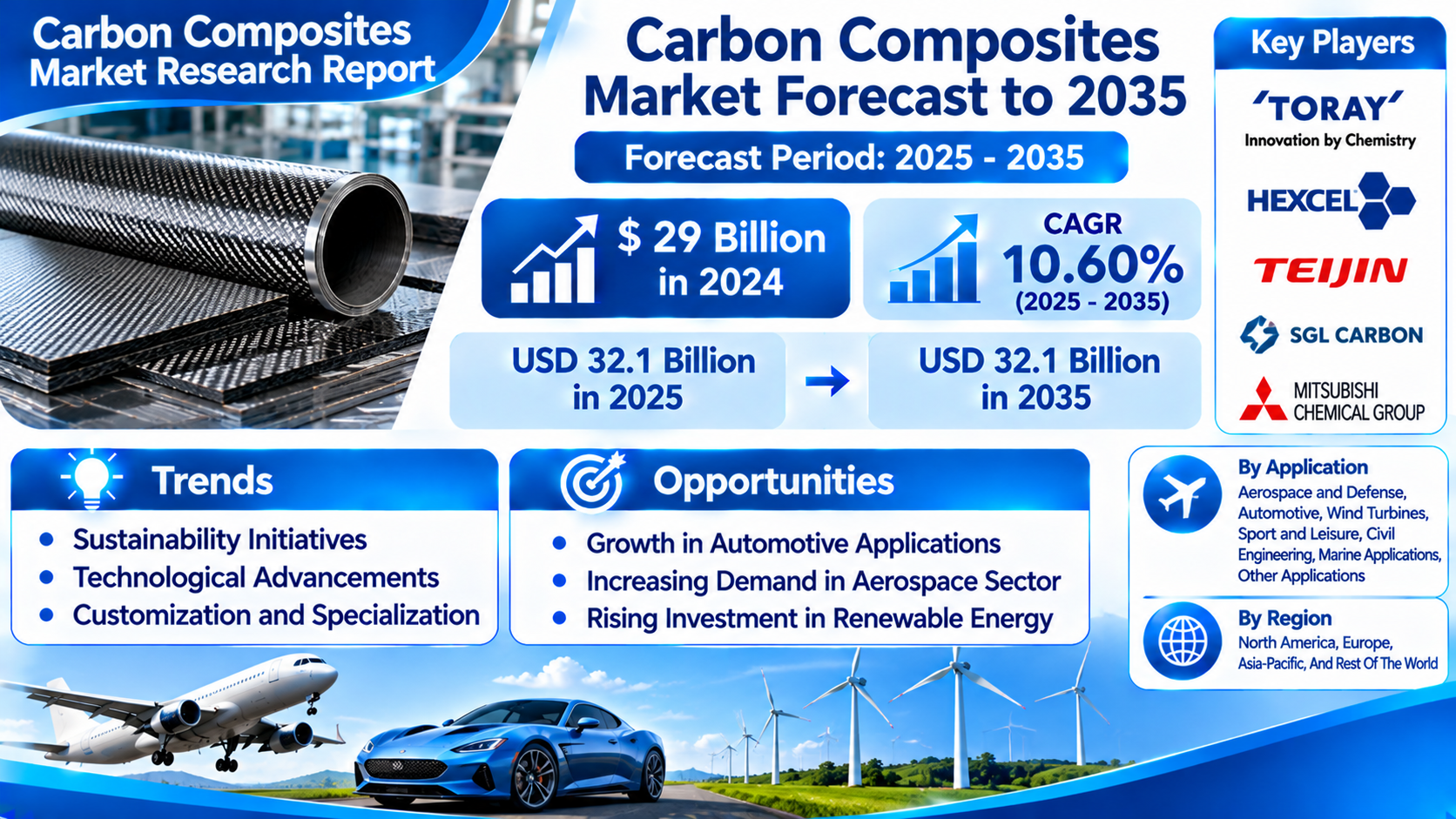
According to Market Research Future® (MRFR), the Carbon Composites Market is positioned for expansion as industries increasingly explore advanced materials for demanding applications. Carbon composites are relevant across aerospace and defense, automotive, wind turbines, sport and leisure, civil engineering, and marine applications. Their use across these sectors reflects the importance of material selection in applications where performance, design requirements, and manufacturing processes influence product development. Sustainability initiatives, technological advancements, and customization are among the key trends shaping the market.
Carbon Composites Market Overview
The market was valued at USD 29 billion in 2024 and reached USD 32.1 billion in 2025. The report lists a forecast value of USD 32.1 billion for 2035, with a compound annual growth rate of 10.60% during the 2025–2035 forecast period.
However, the supplied figures contain a notable inconsistency. The 2025 and 2035 market values are both stated as USD 32.1 billion, despite the reported CAGR of 10.60%. These figures do not indicate growth over the forecast period and cannot be reconciled with the stated CAGR without clarification. The reported values and growth rate should therefore be verified against the original report before being used in financial analysis or external publications.
The market is segmented by matrix, process, application, and region. This framework reflects the different material systems, manufacturing methods, and industries contributing to demand. It also provides a basis for examining how technological developments and application requirements influence the competitive environment.
Material Matrix and Product Characteristics
Matrix composition is a central segmentation dimension in the carbon composites market. The report identifies five matrix categories: hybrid, metal, ceramic, carbon, and polymer. These categories represent different material approaches within the broader composite landscape.
The selection of a matrix is relevant to the design and intended use of a composite product. Different applications may have distinct material requirements, making matrix selection an important consideration during product development and manufacturing. The range of categories included in the report highlights the diversity of material systems considered within the market.
Demand across matrix types is influenced by the needs of end-use industries and the suitability of different material combinations for specific applications. Manufacturers must consider the requirements of customers and the characteristics needed for their intended products. The supplied report information does not provide individual matrix shares or identify a leading category.
Manufacturing Processes and Technological Advancements
Manufacturing processes are another major dimension of the market. The report covers the prepreg layup process, pultrusion and winding, wet lamination and infusion process, press and injection processes, and other processes.
The availability of different manufacturing methods reflects the range of production approaches used across composite applications. Process selection can depend on product design, manufacturing requirements, and the needs of the target industry. As applications become more specialized, manufacturers may evaluate production methods that support particular product specifications and manufacturing objectives.
Technological advancements are identified as a key market trend. Continued process development can influence production capabilities and the ability of manufacturers to serve changing customer requirements. Innovation in manufacturing methods may also support customization and specialization, which the report identifies as another important trend.
Sustainability Initiatives and Advanced Materials
Sustainability initiatives are shaping the broader advanced materials industry and are identified as a significant trend in the carbon composites market. Manufacturers and end users increasingly consider sustainability as part of material selection and production planning. These considerations can influence product development priorities and the evaluation of manufacturing approaches.
For carbon composite producers, sustainability initiatives create a need to consider the relationship between material performance, production processes, and broader environmental objectives. Industry participants may assess opportunities to improve manufacturing practices and respond to evolving customer expectations.
The trend also intersects with technological advancement. Research and development can help manufacturers explore different production approaches and address application-specific requirements. While the supplied data does not identify particular sustainability technologies or quantify their market impact, it establishes sustainability as an important consideration for future industry development.
Customization and Specialization
Customization and specialization are among the trends identified in the report. Carbon composites serve a broad range of industries, each with different product designs and application requirements. As a result, manufacturers may need to develop solutions that address the specifications of particular customers and end-use markets.
This trend is relevant across aerospace and defense, automotive, wind turbines, sport and leisure, civil engineering, and marine applications. The range of sectors demonstrates the diversity of requirements that carbon composite suppliers may need to address. Specialized products and manufacturing approaches can help companies serve distinct application needs.
Customization also creates opportunities for manufacturers to differentiate their offerings. Companies that understand the requirements of individual industries and align their production capabilities accordingly may be better positioned to respond to changing demand.
Aerospace and Defense Applications
Aerospace and defense is one of the application categories covered in the report. This sector represents an important area for advanced composite materials because manufacturers must consider material requirements as part of complex product and engineering programs.
The report also identifies increasing demand in the aerospace sector as a market opportunity. This indicates the potential for aerospace-related requirements to contribute to future market development. However, the supplied information does not quantify the contribution of aerospace and defense to total market revenue or provide a separate application growth rate.
Automotive and Renewable Energy Opportunities
Automotive applications represent another opportunity for market expansion. The report identifies growth in automotive applications as a key opportunity, reflecting the potential for broader use of carbon composites in the sector. Automotive manufacturers' material choices can be influenced by product design and application requirements, creating opportunities for suppliers offering specialized composite solutions.
Renewable energy is another important area. The report specifically identifies rising investment in renewable energy as a market opportunity. Wind turbines are included as a distinct application segment, linking the market's opportunity landscape with activity in renewable energy infrastructure.
These opportunities demonstrate how demand may develop across both established industrial applications and sectors associated with energy investment. The supplied information does not provide separate revenue estimates for automotive or renewable energy applications.
Market Segmentation and Regional Coverage
The market is segmented as follows:
-
Matrix: Hybrid, Metal, Ceramic, Carbon, and Polymer.
-
Process: Prepeg Layup Process, Pultrusion and Winding, Wet Lamination and Infusion Process, Press and Injection Processes, and Other Processes.
-
Application: Aerospace and Defense, Automotive, Wind Turbines, Sport and Leisure, Civil Engineering, Marine Applications, and Other Applications.
-
Region: North America, Europe, Asia-Pacific, and Rest of the World.
The regional framework provides a geographic basis for examining market activity. The report covers North America, Europe, Asia-Pacific, and the Rest of the World. The supplied information does not specify regional market shares or identify a leading region.
Competitive Landscape
The key players profiled in the market are Toray Industries, Hexcel Corporation, Teijin Limited, SGL Carbon, and Mitsubishi Chemical Group. These companies form the competitive landscape identified in the report.
Competition may be influenced by material development, manufacturing processes, customer requirements, and the ability to provide specialized composite solutions. Technological advancements and customization are particularly relevant to the market's competitive environment. The supplied information does not provide company-level market shares or revenue rankings.
Carbon Composites Market Outlook
The carbon composites market is associated with opportunities across automotive applications, aerospace, and renewable energy. Sustainability initiatives, technological advancements, and customization are expected to remain important industry trends as manufacturers respond to diverse application requirements.
The report states a CAGR of 10.60% for 2025–2035, but the supplied 2035 market value of USD 32.1 billion is identical to the 2025 value. This discrepancy needs clarification before a reliable long-term market valuation can be presented. The market's underlying opportunities remain connected to industrial demand, manufacturing innovation, and the development of specialized composite applications.

 English
 Arabic
 French
 Spanish
 Portuguese
 Turkish
 Dutch
 Italiano
 Russian
 Romaian
 Portuguese (Brazil)
 Greek