
Quantum Computing Market Developments in Qubit Technology
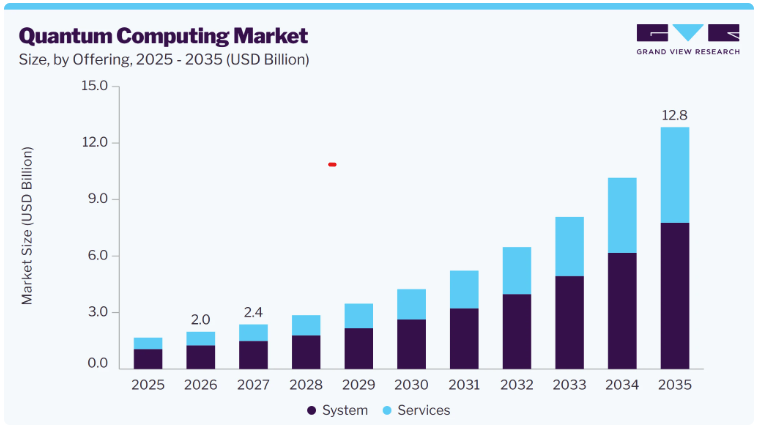
The global Quantum Computing Market size was valued at USD 2.0 billion in 2026 and is projected to grow from USD 2.4 billion in 2027 to USD 12.8 billion by 2035, registering a CAGR of 20.6% from 2027 to 2035. Europe dominated the market with a revenue share of 33.0% in 2026, while Asia Pacific is expected to register the fastest growth during the forecast period. Increasing demand for advanced computational capabilities, expanding applications across industries, and growing investments in quantum hardware, software, and cloud-based services are driving market development. The entry of specialized startups is also expanding the quantum computing ecosystem.
Quantum Computing Market Overview
Quantum computing is an emerging technology designed to address complex computational problems that are challenging for conventional computing systems. Unlike classical computers, which process information using binary bits, quantum computers use qubits that leverage superposition and entanglement to perform certain calculations more efficiently.
Advancements in quantum hardware, processor architecture, and error correction are improving system accuracy and reliability. Technology companies and emerging startups are investing in scalable quantum processors, fault-tolerant systems, software platforms, and deployment solutions to overcome existing technical limitations.
The growing use of quantum computing in pharmaceutical research, drug discovery, and materials science is creating new opportunities. Quantum systems can support the simulation of molecular structures, chemical reactions, and interactions involving complex particles. These capabilities are encouraging pharmaceutical companies and research institutions to explore quantum computing for molecular research and early-stage drug discovery.
Want to Understand What’s Driving Market Growth? Ask Prism AI for research-backed insights into market size, evolving opportunities
Key Market Trends and Insights
- Offerings: The system segment dominated the market with a revenue share of 63.3% in 2026.
- Deployment: Cloud solutions accounted for the largest share of 52.2% in 2026.
- Application: Machine learning held the leading share of 29.1% in 2026.
- End user: BFSI accounted for the largest revenue share of 21.7% in 2026.
- Regional leadership: Europe represented 33.0% of global revenue in 2026.
- Fastest-growing region: Asia Pacific is expected to record the highest CAGR from 2027 to 2035.
Market Dynamics: Drivers, Restraints, and Opportunities
The increasing demand for high-performance computing and complex problem-solving capabilities is a major driver of the quantum computing market. Industries such as financial services, healthcare, pharmaceuticals, aerospace and defense, automotive, energy, and logistics are exploring quantum technologies for optimization, molecular simulation, risk modeling, cryptography, and machine learning.
Technological advancements in quantum processors, qubit architectures, and error correction are expanding the potential applications of quantum computing. The integration of artificial intelligence, big data analytics, and high-performance computing is further encouraging organizations to explore quantum technologies for computationally intensive workloads. Government initiatives, public-private partnerships, and investments from technology companies are also supporting research and commercialization.
However, technical complexity, high development costs, and scalability challenges remain important restraints. Developing reliable quantum processors and fault-tolerant systems requires specialized infrastructure, technical expertise, and continued research investment. These requirements can limit the pace of commercialization.
Cloud-based platforms represent a significant market opportunity. Quantum cloud services allow businesses, academic institutions, and developers to access quantum processors, simulators, and development environments without investing in expensive in-house infrastructure. This approach supports experimentation, algorithm development, and hybrid quantum-classical computing workflows.
Download a free sample report or claim your copy of this full market intelligence report
Offerings Segment Analysis
The system segment dominated the quantum computing market, accounting for 63.3% of global revenue in 2026. This segment includes quantum hardware such as processors, qubit architectures, control systems, and quantum interconnects. Manufacturers are focusing on increasing qubit counts, improving fidelity, reducing computational errors, and developing fault-tolerant architectures. Advancements in superconducting, trapped-ion, photonic, and neutral-atom technologies are supporting the development of scalable quantum systems.
The services segment is expected to register the fastest growth during the forecast period. It includes consulting, quantum software development, algorithm design, system integration, and cloud-based computing services. As businesses evaluate the commercial potential of quantum technology, demand for specialized consulting and implementation support is increasing. Service providers help organizations identify suitable applications, develop algorithms, and integrate quantum solutions with existing computing environments.
Deployment Insights
The cloud segment held the largest deployment share of 52.2% in 2026. Cloud-based quantum computing platforms provide remote access to specialized processors, simulators, development tools, and applications. This reduces the need for organizations to purchase and maintain expensive quantum hardware. Hybrid quantum-classical computing is also gaining attention, as it combines conventional computing capabilities with quantum processors for specialized tasks involving optimization, simulation, and data processing.
The on-premises segment is also experiencing growth as enterprises and research institutions explore greater control over quantum hardware, data security, and computational environments. On-premises solutions are relevant for sensitive research and industry-specific applications. Quantum software deployment is also gaining traction as organizations integrate algorithms and development frameworks into existing computing infrastructure.
Application Analysis
Machine learning accounted for the largest application revenue share of 29.1% in 2026. The growing adoption of artificial intelligence, advanced analytics, and data-intensive applications is encouraging research into quantum machine learning. This approach combines quantum computing principles with conventional machine learning methods to explore complex data processing, pattern recognition, classification, and optimization. Financial services, healthcare, manufacturing, and telecommunications are among the industries researching these capabilities.
Simulation is another important application area. Demand for advanced simulation across pharmaceuticals, chemicals, materials science, and aerospace is supporting the use of quantum computing. Quantum systems can model molecular structures, chemical reactions, and material properties using quantum mechanical principles. Pharmaceutical companies are exploring these capabilities to understand molecular interactions and support early-stage drug discovery.
End-User Insights
The BFSI segment held the largest end-user revenue share of 21.7% in 2026. Financial institutions are exploring quantum computing for applications such as fraud detection, risk assessment, portfolio optimization, customer behavior analysis, and financial modeling. Its potential to evaluate complex scenarios and optimize large datasets is encouraging financial organizations to investigate quantum-based solutions.
The healthcare segment is anticipated to register the fastest CAGR during the forecast period. Quantum computing is being explored for drug discovery, disease modeling, and advanced medical research. Pharmaceutical companies and research institutions are investigating its potential to simulate molecular interactions, analyze biological structures, and identify potential drug compounds. Applications in genomic analysis, personalized medicine, and medical imaging are also creating opportunities.
Regional Market Outlook
Europe dominated the global quantum computing market with a revenue share of 33.0% in 2026. Regional growth is supported by research initiatives, cross-border academic collaborations, and government-backed funding programs. The European Union's Quantum Flagship and national strategies in Germany, France, and the United Kingdom are supporting quantum research, processor development, and commercialization. Germany held the largest country-level market share in 2026.
North America benefits from investments by technology companies, venture capital firms, and government research agencies. The presence of established technology providers such as IBM, Google, Microsoft, and Amazon supports innovation in quantum processors, cloud platforms, and algorithms. In the U.S., federal research initiatives and funding from government agencies are supporting quantum research centers, workforce development, and technology commercialization.
Asia Pacific is expected to register the fastest CAGR during the forecast period. Government funding, national technology strategies, and investments in domestic quantum research and development are supporting regional expansion. China, Japan, South Korea, Singapore, and Australia are prioritizing quantum technologies to strengthen their technological capabilities and reduce dependence on foreign computing infrastructure.
Future Outlook
The quantum computing market is expected to expand significantly through 2035 as demand for advanced computational capabilities increases across commercial industries. Advancements in quantum hardware, error correction, software ecosystems, and cloud-based access are expected to support wider adoption. Although technical complexity, development costs, and scalability remain challenges, growing investments from governments, technology companies, and startups are accelerating research and commercialization. Applications in machine learning, simulation, healthcare, and financial services are expected to remain important areas of market development.

 English
 Arabic
 French
 Spanish
 Portuguese
 Deutsch
 Turkish
 Dutch
 Italiano
 Russian
 Romaian
 Greek