
Prefabricated Bathroom Industry: Delivery Models, Materials and Growth Prospects Through 2035
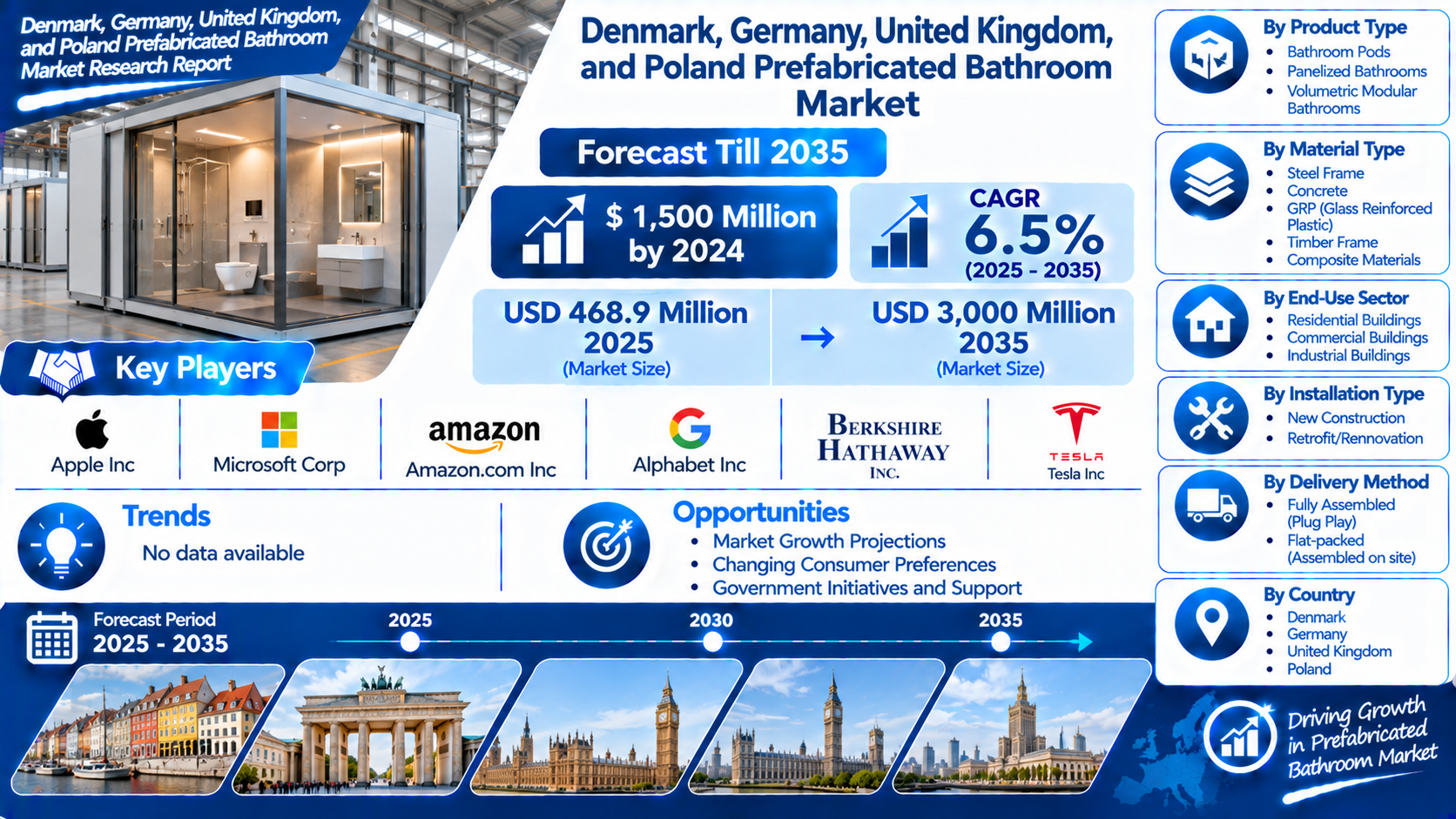
According to Market Research Future® (MRFR), the Denmark Germany United Kingdom Poland Prefabricated Bathroom Market is expected to reach USD 3,000 million by 2035, with a projected CAGR of 6.5% over the 2025–2035 forecast period. The supplied figures place the market at USD 468.9 million in 2025 and USD 1,500 million in 2024. These values require verification because the 2025 figure is markedly lower than the preceding year's stated size, despite the positive long-term growth forecast. The report covers Denmark, Germany, the United Kingdom, and Poland and examines prefabricated bathroom solutions by product type, material, end-use sector, installation type, and delivery method.
Prefabrication in Bathroom Construction
Prefabricated bathroom systems shift some or much of the work involved in producing a bathroom from the construction site to an off-site manufacturing facility. Depending on the selected format, manufacturers may deliver a complete bathroom module or separate components for assembly at the building location. This approach can help coordinate construction activities and provide repeatable specifications across projects that require multiple bathrooms.
The use of prefabricated systems can be relevant to developments where construction schedules, design consistency, and the coordination of multiple trades are important. Factory-based production may allow different stages of bathroom preparation to be organized before the components arrive at the site. However, the benefits depend on the project's design, transportation requirements, installation access, and the compatibility of the module with the building's structure and services.
The market's stated forecast suggests an expansion from the 2025 base through 2035. MRFR reports a CAGR of 6.5% and a projected value of USD 3,000 million in 2035. The supplied 2024 value of USD 1,500 million and 2025 value of USD 468.9 million present a material inconsistency. The figures should be checked with the original source rather than assuming that either value is a typographical error.
Three Product Formats
Bathroom pods are one of the principal product categories. These units are manufactured as complete or substantially completed bathroom modules before delivery to a project site. A pod can incorporate multiple bathroom elements within a single module, allowing it to be positioned and connected as part of the building installation process. This format may be useful in developments with repeated room layouts, subject to project design and logistics.
Panelized bathrooms take a component-based approach. Prefabricated panels and related elements are delivered for assembly at the construction location. This can provide a different level of flexibility where a complete volumetric unit is unsuitable because of access limitations, building geometry, or transportation constraints. The amount of work completed off-site depends on the system and supplier.
Volumetric modular bathrooms are three-dimensional modules produced before installation. They can be integrated into projects that use modular construction methods for other building elements. The selection among bathroom pods, panelized bathrooms, and volumetric modular bathrooms depends on the required layout, building configuration, project schedule, and delivery conditions.
Materials Used in Prefabricated Bathrooms
The market includes five material categories: steel frame, concrete, GRP (Glass Reinforced Plastic), timber frame, and composite materials. Each offers a different set of characteristics that can influence the design and production of prefabricated bathroom systems.
Steel frames can provide structural support for modules and may be selected according to load, dimensional, and building-integration requirements. Concrete is another listed option and can be used in systems designed around specific structural or performance needs. GRP is a lightweight material used in selected applications, while timber frames offer an alternative structural approach where appropriate to the building design.
Composite materials can combine different material properties to meet particular manufacturing or performance objectives. Material selection is not determined by a single factor. Manufacturers and project teams may need to consider weight, durability, moisture exposure, manufacturing processes, transport, installation, and compatibility with the building's structure.
Residential, Commercial and Industrial Demand
The end-use segmentation covers residential buildings, commercial buildings, and industrial buildings. Residential developments can provide opportunities for prefabricated bathrooms where multiple units share similar layouts. Standardized production may help coordinate installation across housing projects, although design variations and site conditions can affect the suitability of a particular system.
Commercial buildings can include hotels, offices, and other facilities where bathroom requirements may be repeated across rooms or floors. Project teams may consider prefabricated systems to coordinate delivery and installation with the wider construction schedule. Industrial buildings can have more specialized functional requirements, making customization and building-specific design important considerations.
The three end-use categories represent different project environments. Demand will depend on construction activity, the adoption of modular methods, building specifications, and the ability of suppliers to meet the requirements of each project type.
New Construction, Renovation and Delivery
The market distinguishes between new construction and retrofit or renovation installations. New construction projects can account for prefabricated bathroom systems early in the design process. This can help coordinate dimensions, structural provisions, service connections, transport routes, and installation sequences before production begins.
Retrofit and renovation work can be more complex because existing buildings may impose restrictions on access, dimensions, plumbing, and structural arrangements. Prefabricated components may be suitable where they can be adapted to the building, but the feasibility of installation must be assessed for each project.
Two delivery methods are identified: fully assembled (plug play) and flat-packed (assembled on site). Fully assembled systems arrive as completed modules, potentially reducing the amount of assembly needed at the project location. Flat-packed products are transported as separate components and assembled on site. They may offer practical advantages where access or transport dimensions make delivery of a complete module difficult. The preferred approach depends on logistics, project design, installation resources, and supplier capabilities.
Opportunities and Country-Level Considerations
The report identifies market growth projections, changing consumer preferences, and government initiatives and support as opportunities. Interest in efficient construction methods and standardized building components may support consideration of prefabricated bathrooms. Consumer preferences can also influence the layouts, finishes, and functionality specified for residential and commercial projects.
Government initiatives and support may shape construction investment and building practices, depending on the policies and programs introduced in each country. The market covers Denmark, Germany, the United Kingdom, and Poland. Differences in construction activity, building standards, procurement practices, and adoption of off-site methods can influence demand across these markets. The supplied information does not provide country-specific market values or quantified growth rates, so individual country rankings cannot be established from these figures.
Competitive Landscape and Data Considerations
The supplied key-player list includes Apple Inc, Microsoft Corp, Amazon.com Inc, Alphabet Inc, Berkshire Hathaway Inc, and Tesla Inc. These names are not readily associated with specialist prefabricated bathroom production based on the information provided. Their inclusion should be verified with MRFR before they are presented as direct manufacturers, competitors, or leading suppliers in this industry. It would be inappropriate to attribute bathroom products or market positions to these companies without supporting information.
The market data also needs clarification. The stated 2024 market size is USD 1,500 million, while the 2025 value is USD 468.9 million. This year-on-year movement conflicts with the stated positive CAGR and projected 2035 value. The figures have therefore been retained as supplied but not reconciled through an unsupported assumption.
Market Outlook Through 2035
MRFR projects a 6.5% CAGR for the 2025–2035 period and a market value of USD 3,000 million in 2035. Product formats, material choices, end-use requirements, installation conditions, and delivery methods will influence adoption across the four countries. The opportunity areas identified in the report include market growth projections, changing consumer preferences, and government initiatives and support. Confirmation of the inconsistent market-size figures and the supplied company list is important before using the data as a definitive representation of the market's historical performance or competitive structure.

 English
 Arabic
 Spanish
 Portuguese
 Deutsch
 Turkish
 Dutch
 Italiano
 Russian
 Romaian
 Portuguese (Brazil)
 Greek