
Biopharmaceutical Manufacturing Market Size, Share, Trends and Forecast 2035
Biopharmaceutical Manufacturing Market to Reach USD 2,627 Billion by 2035, Driven by Biologics Demand and Manufacturing Expansion
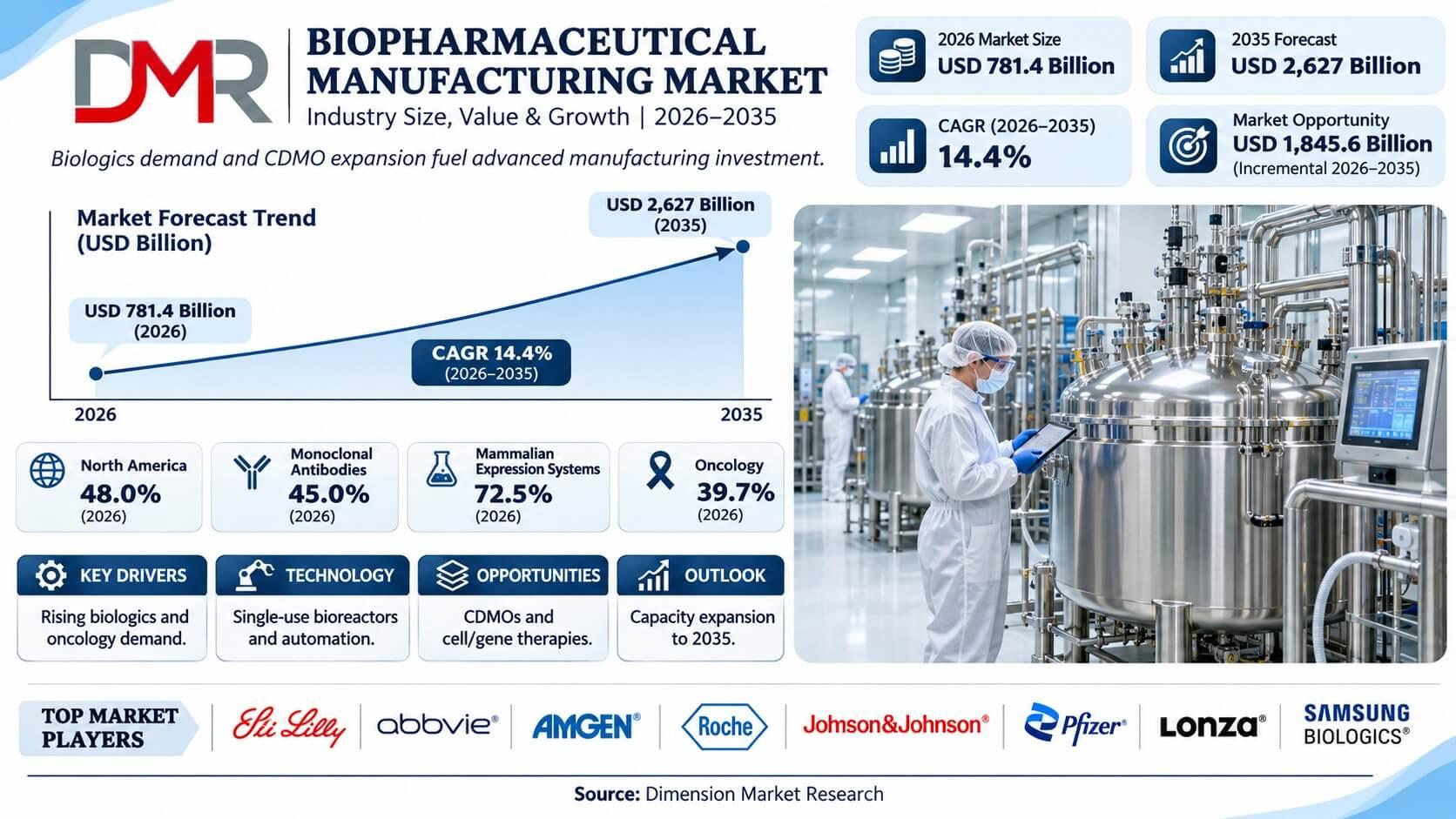
According to Dimension Market Research, the Biopharmaceutical Manufacturing Market is valued at USD 781.4 billion in 2026, rising from USD 680.3 billion in 2025. The global market is projected to reach USD 2,627.0 billion by 2035, registering a CAGR of 14.4% during 2026 to 2035. Growing demand for biologics, monoclonal antibodies, oncology treatments, and advanced biomanufacturing technologies is strengthening production investments across the pharmaceutical industry.
The expansion of contract development and manufacturing organizations (CDMOs), increasing investments in production facilities, and the growing adoption of advanced expression systems are further supporting the industry's long-term development.
Request Sample PDF of This Report: https://dimensionmarketresearch.com/request-sample/biopharmaceutical-manufacturing-market/
What Is the Current Overview of the Biopharmaceutical Manufacturing Market?
The biopharmaceutical manufacturing market encompasses the production of biological medicines, including monoclonal antibodies, recombinant proteins, vaccines, insulin, hormones, interferons, growth factors, coagulation factors, and cell and gene therapies. It includes manufacturing operations conducted internally by pharmaceutical companies as well as outsourced production through specialized contract manufacturers.
Unlike traditional pharmaceutical manufacturing, which primarily focuses on chemically synthesized medicines, biopharmaceutical production relies on living cells, microorganisms, and sophisticated biological processes. Increasing demand for targeted therapies, personalized medicine, and advanced treatments is encouraging manufacturers to expand production capacity and improve manufacturing efficiency. Commercial, pilot-scale, and clinical-scale manufacturing activities all contribute to the market's overall development.
What Is the Expected Value of the Biopharmaceutical Manufacturing Market by 2035?
The global biopharmaceutical manufacturing market is expected to experience substantial expansion throughout the forecast period, supported by increasing biologics consumption and manufacturing investments.
- The market reached USD 680.3 billion in 2025.
- The market is estimated at USD 781.4 billion in 2026.
- Revenue is projected to reach USD 2,627 billion by 2035.
- The market is forecast to expand at a 14.4% CAGR.
- Monoclonal antibodies held 45.0% of product revenue in 2026.
- North America accounted for 48.0% of revenue in 2026.
- Oncology represented 39.7% of application revenue in 2026.
- Mammalian expression systems captured 72.5% in 2026.
- Hospital pharmacies accounted for 53.2% in 2026.
What Are the Latest Biopharmaceutical Manufacturing Market Research Findings?
The research identifies monoclonal antibodies as the leading product category, accounting for 45.0% of market revenue in 2026. Oncology remains the dominant application, representing 39.7% of demand, while mammalian-based expression systems hold a 72.5% technology share. North America leads the global market with 48.0% of revenue. Hospital pharmacies represent the largest end-user category, capturing 53.2% of the market. The United States remains a major manufacturing investment destination, with its market valued at USD 318.8 billion in 2026. CDMO consolidation, facility expansion, automation, and continuous manufacturing are also reshaping competitive strategies and production capacity planning.
Why Is the Biopharmaceutical Manufacturing Market Growing?
The market is growing because of rising demand for biologic medicines used to treat cancer, autoimmune disorders, infectious diseases, and metabolic conditions. The expansion of monoclonal antibody therapies and increasing adoption of advanced treatments are creating sustained requirements for specialized manufacturing infrastructure. Pharmaceutical companies are also investing in domestic production facilities to strengthen supply chain resilience, reduce dependence on international manufacturing networks, and improve access to critical medicines. Meanwhile, outsourcing to CDMOs allows biotechnology companies to access advanced manufacturing capabilities without making substantial investments in their own facilities. These developments are supporting commercial production expansion and long-term market growth.
What Are the Key Growth Drivers of the Biopharmaceutical Manufacturing Market?
- Increasing demand for biologics and targeted therapeutic treatments.
- Rising prevalence of cancer and chronic diseases.
- Expansion of monoclonal antibody production capacity.
- Growing pharmaceutical outsourcing and CDMO partnerships.
- Government support for domestic biomanufacturing infrastructure.
- Advancements in cell culture and bioprocessing technologies.
- Increasing investments in advanced biologic therapies.
Which Region Is Expected to Witness the Fastest Market Growth?
- North America: Largest regional market with a 48.0% share in 2026.
- United States: Valued at USD 318.8 billion in 2026, projected to reach USD 1,090.4 billion by 2035 at a 13.9% CAGR.
- Europe: Supported by established pharmaceutical manufacturing infrastructure.
- Asia Pacific: Strengthened by manufacturing expansion in South Korea, China, and India.
- Latin America: Emerging opportunities through domestic biologics demand.
- Middle East and Africa: Long-term potential from healthcare and manufacturing investments.
Which Segments Show the Highest Growth Potential Within the Biopharmaceutical Manufacturing Market, and Why?
Monoclonal Antibodies
Monoclonal antibodies represent the leading product category in the biopharmaceutical manufacturing market, capturing 45.0% of revenue in 2026. Their dominance is supported by extensive therapeutic applications, particularly in oncology and autoimmune disorders. These biologics require sophisticated manufacturing processes, including mammalian cell culture, purification, and specialized quality control. Continued development of antibody-based therapies is creating additional demand for commercial-scale production capacity. Pharmaceutical companies are also investing in advanced manufacturing infrastructure to support expanding biologics pipelines and improve production efficiency.
- Strong demand for targeted cancer therapies.
- Growing applications in autoimmune disease treatment.
- Expansion of commercial-scale mammalian cell culture facilities.
- Increasing investments in biologics production infrastructure.
Read More About This Market: https://dimensionmarketresearch.com/report/biopharmaceutical-manufacturing-market/
Mammalian-Based Expression Systems
Mammalian-based expression systems accounted for 72.5% of the technology segment in 2026. These systems are widely used because they can produce complex therapeutic proteins with appropriate folding and glycosylation characteristics. Their suitability for commercial monoclonal antibody production makes them essential to modern biopharmaceutical manufacturing. The increasing adoption of single-use bioreactors, advanced process monitoring, and automated production systems is further improving operational flexibility. Manufacturers are also exploring continuous manufacturing approaches to optimize production efficiency and reduce processing requirements.
- Essential for complex therapeutic protein production.
- Strong compatibility with monoclonal antibody manufacturing.
- Increasing adoption of advanced bioreactor systems.
- Growing interest in automation and continuous processing.
Biopharmaceutical Manufacturing Market Dynamics
What Are the Major Trends Shaping the Market?
Continuous manufacturing, large-scale facility expansion, digital integration, and advanced bioprocessing are among the major trends influencing the market. Manufacturers are increasingly adopting single-use bioreactors, automated process monitoring, and digital manufacturing systems to improve operational flexibility and production consistency. The February 2025 WHO draft guideline on continuous pharmaceutical manufacturing also represents an important regulatory development for companies evaluating next-generation production facilities. Meanwhile, pharmaceutical investment commitments are supporting new manufacturing sites and capacity expansion, particularly in the United States. The growing importance of GLP-1 medicines and advanced oncology biologics is further influencing manufacturing priorities, equipment procurement, and production planning.
What Are the Future Growth Opportunities in the Biopharmaceutical Manufacturing Market?
Significant opportunities are emerging in contract manufacturing, cell and gene therapy production, radioligand therapies, and next-generation biologics facilities. CDMO consolidation is creating opportunities for large manufacturers with advanced infrastructure and established regulatory credentials. India is also gaining attention as a cost-competitive manufacturing partner, supported by its expanding pharmaceutical export capabilities and international partnerships. In addition, the growing demand for specialized fill-finish services, single-use technologies, and complex biologics production creates opportunities for equipment suppliers and manufacturing service providers. Companies capable of delivering reliable GMP-compliant capacity for emerging therapeutic modalities may benefit from increasing outsourcing requirements.
What Challenges Are Affecting the Market?
Despite strong growth prospects, biopharmaceutical manufacturers face several operational and financial challenges. Establishing biologics production facilities requires substantial capital investment, specialized equipment, skilled personnel, and extensive regulatory validation. Maintaining consistent product quality across complex biological processes also increases operational requirements. International supply chain dependencies, raw material availability, tariff uncertainty, and changing trade policies can affect manufacturing costs and investment decisions. Furthermore, cell and gene therapy manufacturing remains challenging because of its high production costs and complex commercialization requirements. Smaller CDMOs may also struggle to compete with larger operators that benefit from economies of scale, established customer relationships, and extensive manufacturing capacity.
Which Country Is Expected to Witness the Fastest Market Growth?
Among the country-level markets research, the United States is projected to expand at a CAGR of 13.9% from 2026 to 2035. Its market is valued at USD 318.8 billion in 2026 and is expected to reach USD 1,090.4 billion by 2035. Although this growth rate is slightly below the global market CAGR of 14.4%, the United States remains a major investment destination because of domestic manufacturing expansion, established pharmaceutical companies, and increasing investments in biologics production.
Who Are the Leading Companies in the Biopharmaceutical Manufacturing Market?
The competitive landscape includes established pharmaceutical manufacturers, biotechnology companies, and specialized contract development and manufacturing organizations. Market participants are focusing on capacity expansion, strategic partnerships, technological innovation, and manufacturing automation to strengthen their competitive positions.
- Eli Lilly and Company
- AbbVie Inc.
- Amgen Inc.
- Biogen Inc.
- Hoffmann-La Roche Ltd.
- Johnson & Johnson
- Merck & Co. Inc.
- Novo Nordisk A/S
- Pfizer Inc.
- Sanofi S.A.
- Novartis AG
- Bristol Myers Squibb
- Gilead Sciences Inc.
- AstraZeneca PLC
- Takeda Pharmaceutical Co.
- CSL Limited
- Lonza Group AG
- Boehringer Ingelheim
- Thermo Fisher Scientific Inc.
- Merck KGaA
- Samsung Biologics
- WuXi Biologics
- Ajinomoto Co. Inc.
Get 10% instant discount on report purchase
Related Reports:
- Biopharmaceutical Process Analytical Technology Market
- Human Microbiome Manufacturing Services Market
- Large Volume Parenteral Lvp Market
- Perfusion System Market
Frequently Asked Questions (FAQs)
1. What is the current size of the global biopharmaceutical manufacturing market in 2026?
2. What is the projected growth rate of the biopharmaceutical manufacturing market through 2035?
3. Which product type dominates the global biopharmaceutical manufacturing market?
4. Why are monoclonal antibodies important to biopharmaceutical manufacturing industry growth?
5. Which region holds the largest share of the biopharmaceutical manufacturing market?
6. What role do CDMOs play in the global biopharmaceutical manufacturing industry?
7. How are mammalian-based expression systems transforming biologics production?
8. What are the major challenges affecting biopharmaceutical manufacturing companies?
9. How are automation and continuous manufacturing influencing biopharmaceutical production?
10. Which companies are leading the global biopharmaceutical manufacturing market?
About Us
Dimension Market Research (DMR) is a global market intelligence and consulting firm delivering data-driven insights that help organizations make informed strategic decisions. With expertise across 12+ industries and global markets, DMR provides syndicated reports, custom research, competitive analysis, white space analysis, and business strategy consulting.
Our research solutions combine analytical rigor, industry expertise, and forward-looking intelligence to identify opportunities, reduce risks, and support sustainable growth. Trusted by clients across diverse sectors, DMR is committed to delivering accurate, actionable insights that enable businesses to navigate evolving market landscapes with confidence.
Contact Us
Phone USA: +17323699777
Phone India: +919310023843
E-mail: [email protected]
Address USA: 957 Route 33, Suite 12 #308, Hamilton Square, NJ-08690
Address India: D44, Sector 6, Noida 201301, India

 English
 Arabic
 French
 Spanish
 Portuguese
 Deutsch
 Turkish
 Dutch
 Italiano
 Romaian
 Portuguese (Brazil)
 Greek