
Can Interactive Projectors Transform the Future of Classrooms Across India?
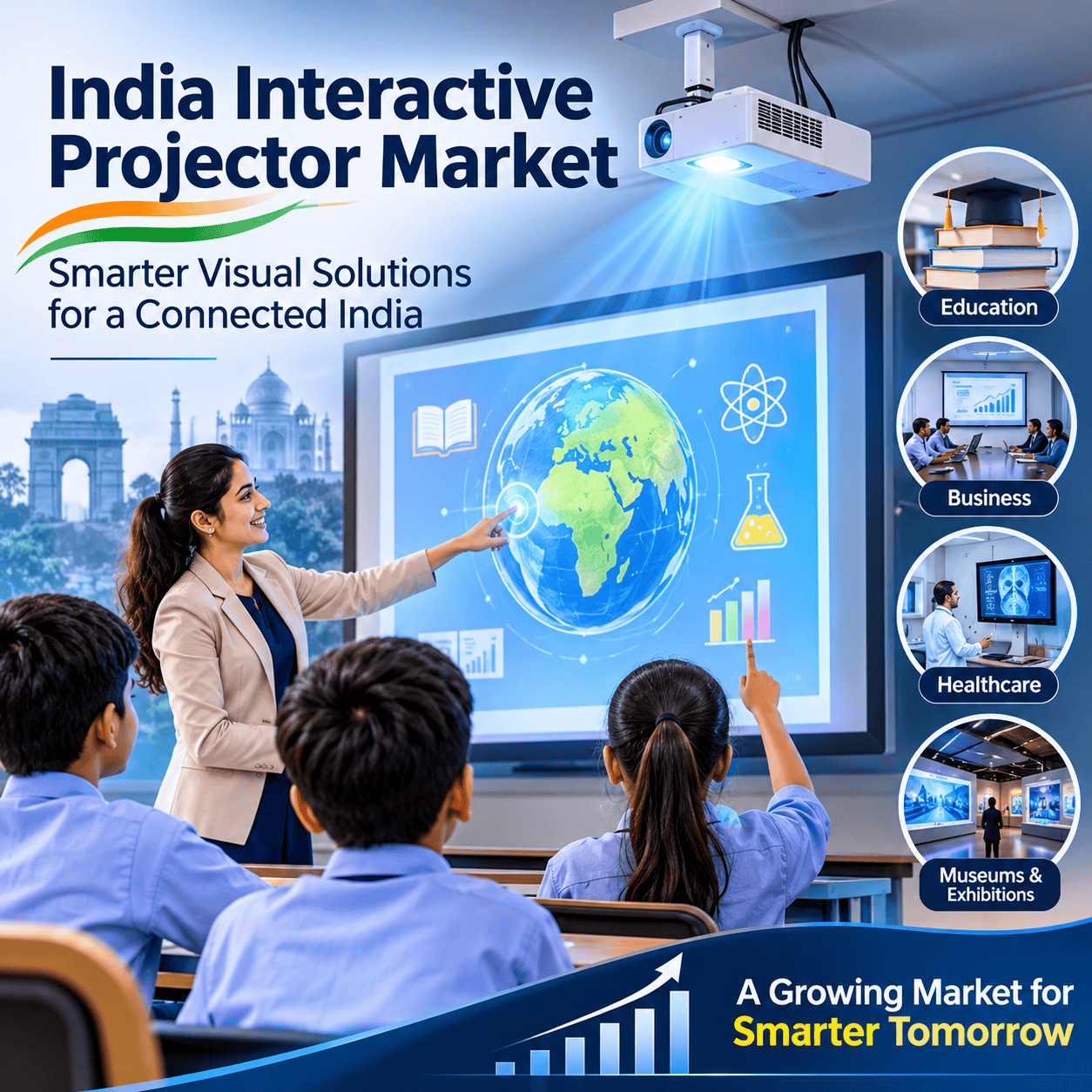
The growing adoption of digital education is changing how students learn and teachers deliver lessons across the country. The India Interactive Projector Market is gaining attention as educational institutions increasingly explore technology-driven teaching methods. Interactive projectors allow teachers to display digital content on large surfaces, annotate lessons, highlight important information and encourage students to participate directly in classroom activities. This combination of visual learning and hands-on interaction is creating new possibilities for modern education.
How Are Interactive Projectors Changing Traditional Classrooms?
Traditional teaching methods often depend on textbooks, blackboards and one-way communication. Interactive projectors introduce a more collaborative environment where students can engage with lessons rather than simply observe them.
Teachers can use these systems to:
-
Display educational videos, diagrams and digital presentations.
-
Explain complex subjects through interactive illustrations.
-
Highlight important concepts directly on projected content.
-
Encourage students to solve problems and participate in group activities.
-
Make lessons more engaging through multimedia learning materials.
These capabilities can help educational institutions create more flexible teaching environments.
What Is Driving Demand Across Educational Institutions?
Several factors are supporting the adoption of interactive projection technology in India.
1. Increasing Focus on Digital Learning
Schools, colleges and universities are incorporating digital tools into their teaching infrastructure. Interactive projectors provide an option for institutions seeking to combine conventional classroom teaching with digital educational resources.
2. Growing Preference for Visual Education
Subjects such as mathematics, science, geography and engineering often involve concepts that are easier to understand through visual demonstrations. Interactive projection solutions allow teachers to present diagrams, simulations and educational videos on larger surfaces.
3. Collaborative Classroom Activities
Interactive functionality allows multiple participants to contribute during lessons. Students can solve questions, annotate diagrams and share ideas, creating opportunities for collaborative learning.
4. Technology Integration in Education
Government initiatives encouraging digital infrastructure and technology integration in educational institutions are supporting interest in modern classroom equipment.
Which Technologies Are Shaping the Market?
The market includes different projection technologies, each offering distinct capabilities.
-
Digital Light Processing (DLP): Uses microscopic mirrors to produce projected images and is considered for applications requiring clear visual output.
-
Liquid Crystal Display (LCD): Uses liquid crystal technology to create images and supports various educational and professional applications.
-
Liquid Crystal on Silicon (LCoS): Combines liquid crystal technology with a reflective surface to deliver detailed image reproduction.
The selection of technology depends on institutional requirements, image quality expectations, maintenance considerations and available budgets.
Why Does Projection Distance Matter?
Classroom layout and available installation space influence projector selection.
-
Ultra-short-throw projectors: Can create large images from a very short distance, making them suitable for classrooms with limited space.
-
Short-throw projectors: Offer flexibility for smaller and medium-sized rooms.
-
Standard-throw projectors: Can serve larger spaces where sufficient installation distance is available.
Choosing the appropriate projection distance can improve visibility and classroom usability.
What Challenges Could Restrict Wider Adoption?
Despite their advantages, interactive projectors face several adoption barriers.
-
High initial investment: Purchasing equipment and installing supporting infrastructure can increase costs for schools.
-
Technical awareness: Teachers may require training to use interactive features effectively.
-
Maintenance requirements: Regular servicing and technical support are important for consistent performance.
-
Alternative technologies: Interactive flat-panel displays and other digital classroom solutions create competitive pressure.
Manufacturers and distributors that offer affordable products, reliable after-sales support and user-friendly interfaces may gain an advantage.
What Opportunities Lie Ahead?
The increasing integration of technology into education presents opportunities for projector manufacturers, distributors and institutional technology providers. Demand may emerge from private schools, universities, coaching centres and government-supported educational facilities.
Solutions offering improved responsiveness, better image quality, flexible installation and compatibility with commonly used digital devices could attract greater interest. Ultimately, the ability to deliver practical educational value will remain an important purchasing consideration.
Who We Are
About 6Wresearch: 6Wresearch is a commercial strategy and growth advisory firm founded in 2011 and headquartered in New Delhi, India, with partners across Southeast Asia and the Middle East & Africa. The firm has delivered over 20,000 commercial engagements for over 2,000 organizations, including Fortune 500 companies, government agencies, and multilateral institutions such as the World Bank and the Asian Development Bank. Backed by proprietary market research and advanced analytics, 6Wresearch combines sector expertise with data-driven intelligence to help organizations navigate market complexity and drive sustainable growth. These capabilities explain why organizations trust 6Wresearch Global Market Research & Consulting Firm for reliable commercial insights and confident decision-making.
Our Proprietary Platform: 6W Export GTM
6W Export GTM is 6Wresearch's proprietary trade intelligence and go-to-market platform, built on UN Comtrade data and enhanced with 6Wresearch's in-house analytical and simulation models, including system dynamics-based forecasting. Unlike broad, sector-level market sizing tools, 6W Export GTM operates at the individual product level down to specific HS codes and micro-segments to identify precise, actionable export opportunities by country and product pair, including markets where trade currently does not exist. This granular, simulation-driven approach allows 6W Export GTM to surface opportunities that sector-wide analysis typically misses, positioning it among a small number of platforms globally offering this depth of product-and-country-specific export intelligence.

 English
 Arabic
 French
 Spanish
 Portuguese
 Deutsch
 Turkish
 Dutch
 Italiano
 Russian
 Romaian
 Greek