
Microscope Market: Advanced Imaging Strengthens Diagnostic Capabilities
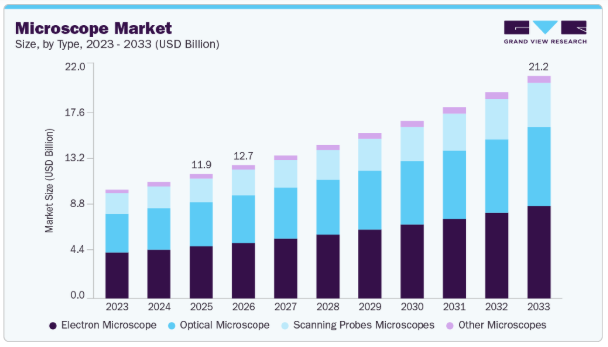
The global Microscope Market size was valued at USD 11.9 billion in 2025 and is projected to grow from USD 12.7 billion in 2026 to USD 21.2 billion by 2033, registering a CAGR of 7.6% from 2026 to 2033. North America dominated the market with a revenue share of 38.9% in 2025. Increasing demand for advanced imaging systems across life sciences research, clinical diagnostics, pharmaceutical development, materials science, and healthcare applications is supporting market growth. Technological advancements in optical, electron, digital, and automated microscopy are further expanding the applications of microscopy systems.
Key Market Trends & Insights
- By type, the electron microscope segment held the largest market share of 42.0% in 2025.
- By application, the life science segment accounted for the largest share of 32.4% in 2025.
- North America dominated the regional market with a revenue share of 38.9% in 2025.
- Asia Pacific is expected to register the fastest CAGR during the forecast period.
- The U.S. held the largest country-level market share in 2025.
Market Drivers and Opportunities
Growing research activities across life sciences, biotechnology, and drug discovery are increasing demand for high-resolution microscopy systems. These technologies enable researchers to examine cells, tissues, and molecular structures, supporting disease-mechanism studies, drug-target identification, cellular response analysis, and therapeutic evaluation. Expanding research in genomics, proteomics, stem cell biology, and personalized medicine is further encouraging the adoption of optical, fluorescence, electron, and other advanced microscopy technologies.
Rising demand for medical diagnostics is another important growth driver. Microscopes play a significant role in pathology, histology, microbiology, hematology, and infectious disease testing. Increasing diagnostic procedures for chronic diseases such as cancer, cardiovascular disorders, and diabetes are supporting the need for modern microscopy systems across hospitals, diagnostic centers, and clinical laboratories.
Want to Understand What’s Driving Market Growth? Ask Prism AI for research-backed insights into market size, evolving opportunities
Increasing investments in research and development are also contributing to market expansion. Government funding, academic research grants, and private-sector expenditure are enabling laboratories to upgrade conventional equipment and adopt digital, automated, and high-resolution microscopy platforms.
The expansion of healthcare infrastructure in emerging markets is creating additional opportunities. Investments in hospitals, diagnostic laboratories, research institutions, and pharmaceutical manufacturing are increasing the demand for microscopy systems across clinical diagnostics, biomedical research, and quality control. However, the high cost of advanced microscopy systems remains a key market restraint. The growing availability of digital and AI-enabled microscopy represents an important opportunity for future development.
Segment Analysis
The electron microscope segment dominated the type category with a 42.0% revenue share in 2025. Increasing demand for ultra-high-resolution imaging across materials science, nanotechnology, semiconductor manufacturing, and life sciences is supporting segment growth. Scanning electron microscopes and transmission electron microscopes are widely used for failure analysis, quality control, surface characterization, and nanoscale structural evaluation. Meanwhile, scanning probe microscopy is expected to register the fastest CAGR during the forecast period, supported by growing demand for precise surface imaging and nanoscale characterization.
By application, the life science segment accounted for the largest market share of 32.4% in 2025. Expanding biomedical research, biotechnology, pharmaceutical development, and clinical research are supporting demand. Microscopy systems are extensively used in cell biology, microbiology, pathology, genomics, and proteomics. The semiconductors segment is projected to grow at the fastest CAGR, driven by increasing requirements for defect detection, failure analysis, and nanoscale inspection as semiconductor devices become increasingly miniaturized.
Download a free sample report or claim your copy of this full market intelligence report
Regional Outlook
North America held the largest microscope market share of 38.9% in 2025. The region benefits from established research infrastructure, advanced healthcare facilities, and substantial investments in biomedical research, pharmaceutical development, and academic R&D. The U.S. represents a major contributor to regional demand, supported by the adoption of digital imaging and automated microscopy across research, healthcare, and industrial applications.
Europe is expected to witness strong market growth, supported by established research institutions, pharmaceutical companies, and industrial laboratories. Germany represents a significant market within the region, driven by its pharmaceutical, biotechnology, semiconductor, automotive, and materials research industries. Research programs such as Horizon Europe are also supporting scientific activities across biomedical sciences, advanced materials, and nanotechnology.
Asia Pacific is projected to register the fastest growth during the forecast period. Rapid industrialization and expanding manufacturing activities across China, Japan, South Korea, and other regional markets are increasing demand for microscopy in electronics, semiconductors, automotive, and precision engineering. India is also witnessing expanding domestic microscope manufacturing capabilities and increasing demand across education, healthcare, research, and industrial laboratories.
Latin America is expected to experience considerable growth through investments in healthcare, scientific research, and industrial infrastructure. Brazil accounted for the largest share of the regional market in 2025, supported by expanding scientific research capabilities and international collaborations.
The Middle East and Africa market is expected to register steady growth. Investments in healthcare facilities, research laboratories, and academic institutions, particularly in Saudi Arabia and the UAE, are supporting the adoption of advanced microscopy technologies.
Industry Developments and Competitive Landscape
The microscope market is characterized by a high degree of technological innovation, moderate merger and acquisition activity, and a high impact of regulatory requirements. Manufacturers are focusing on improving imaging resolution, automation, digital workflows, and AI-based image analysis. For instance, Medprime Technologies launched its AI-integrated Micalys digital microscopy platform in July 2024 to support diagnostic workflows through high-resolution imaging and automated analysis.
Mergers and acquisitions are also helping companies expand their technological capabilities and product portfolios. In January 2024, Bruker Corporation acquired Nion, a developer of high-end scanning transmission electron microscopes, strengthening its capabilities in materials science research and electron microscopy.
Regulatory requirements influence the development and commercialization of microscopy systems, particularly those intended for clinical and medical applications. Requirements associated with the FDA, European Medical Device Regulation, ISO 13485, and relevant IEC standards affect product validation, quality management, and safety compliance.
Key companies profiled in the market include Thermo Fisher Scientific Inc., Vision Engineering Ltd., UNITRON, EVIDENT, and Leica Microsystems.
Future Market Outlook
The microscope market is expected to expand steadily through 2033 as demand for advanced imaging increases across healthcare, life sciences, semiconductor manufacturing, and industrial research. Growing adoption of electron microscopy, digital imaging, automated systems, and AI-enabled analysis is expected to influence future technology development. Increasing investments in research infrastructure and healthcare facilities, particularly across emerging economies, will continue to create opportunities for microscopy manufacturers.
Explore Our Research & Intelligence Solutions
U.S. Healthcare Facility Intelligence: Make Better Decisions with Comprehensive Data – Explore the Platform

 English
 Arabic
 French
 Spanish
 Portuguese
 Turkish
 Dutch
 Italiano
 Russian
 Romaian
 Portuguese (Brazil)
 Greek