
Hospitality Workforce Management Market Analysis and Forecast 2034: Projected 9.18% CAGR
Hospitality workforce management software helps managers coordinate employees across different departments, including housekeeping, front desk operations, food services, and maintenance. Better coordination supports smoother daily operations and improves overall productivity.
Hospitality Workforce Management Market Overview
The Hospitality Workforce Management Market is gaining momentum as hotels, restaurants, resorts, and other hospitality businesses increasingly adopt digital solutions to manage employees, optimize staff schedules, and improve operational efficiency. Workforce management systems help organizations streamline employee scheduling, attendance tracking, payroll administration, labor forecasting, and performance monitoring. These solutions enable hospitality operators to manage fluctuating customer demand while maintaining service quality and controlling labor costs.
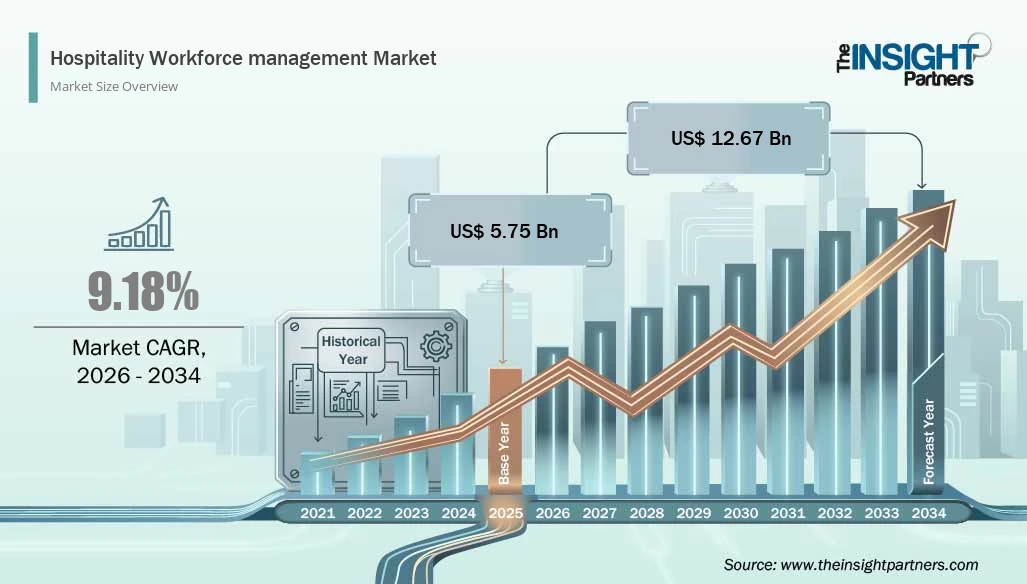
The hospitality workforce management market is projected to grow from US$ 5.75 billion in 2025 to US$ 12.67 billion by 2034, registering a compound annual growth rate (CAGR) of 9.18% during 2026–2034. This growth reflects the rising demand for automated workforce management tools, increasing digital transformation across the hospitality industry, and the need for efficient employee management practices.
Get a PDF Sample: https://www.theinsightpartners.com/sample/TIPRE00020447
Key Drivers of the Hospitality Workforce Management Market
One of the primary factors driving the hospitality workforce management market is the industry's dependence on a flexible workforce. Hotels and restaurants frequently experience seasonal demand, weekend peaks, and changing customer volumes. Workforce management software helps businesses schedule employees according to operational requirements, reduce unnecessary overtime, and maintain adequate staffing levels during busy periods.
The increasing adoption of cloud-based software is another important growth driver. Cloud platforms allow managers to access employee schedules, attendance records, and workforce information from different locations. This capability is particularly valuable for hospitality groups operating multiple hotels, restaurants, and service facilities.
Furthermore, labor shortages, rising employment costs, and growing expectations for better employee experiences are encouraging businesses to invest in workforce automation. Mobile applications, self-service scheduling, automated time tracking, and integrated payroll systems can reduce administrative workloads and improve communication between employees and managers.
Emerging Trends in Hospitality Workforce Management
Technology innovation is transforming workforce management across the hospitality sector. Artificial intelligence and predictive analytics are helping businesses forecast staffing requirements based on historical demand, occupancy rates, reservations, and anticipated customer traffic.
Mobile workforce management is also becoming increasingly important. Employees can use mobile applications to check schedules, request leave, exchange shifts, and receive workplace updates. These features improve scheduling transparency and provide greater flexibility.
Additionally, integration with human resource management systems, payroll platforms, and hotel management software is enabling hospitality organizations to centralize employee information. These integrated solutions support more accurate workforce planning and help managers make informed operational decisions.
Key Players in the Hospitality Workforce Management Market
Major companies operating in the hospitality workforce management market include:
-
Oracle Corporation
-
UKG Inc. (formerly Kronos Incorporated)
-
ADP, Inc.
-
SAP SE
-
Softworks Ltd.
-
Ceridian HCM Holding Inc. (Dayforce, Inc.)
-
Reflexis Systems, Inc. (Zebra Technologies Corporation)
-
ATOSS Software SE
-
Infor Inc.
-
Mitrefinch Ltd.
These companies provide workforce scheduling, time and attendance tracking, human capital management, labor analytics, and related software solutions. Their focus on product innovation, automation, and system integration supports the evolving workforce management requirements of hospitality businesses.
Challenges in the Hospitality Workforce Management Market
Despite its growth potential, the market faces challenges related to implementation costs, employee data security, and integration with existing business systems. Smaller hospitality operators may experience budget constraints or lack the technical resources required to implement advanced platforms.
Employee adoption can also be challenging when organizations transition from manual scheduling to digital workforce management. Vendors that offer user-friendly interfaces, flexible pricing, training, and reliable customer support can help businesses overcome these barriers.
Future Outlook of the Hospitality Workforce Management Market
The future outlook for the hospitality workforce management market remains positive, supported by continued digitalization and the growing emphasis on operational productivity. With the market expected to reach US$ 12.67 billion by 2034, opportunities are likely to expand for providers offering cloud-based platforms, AI-powered scheduling, mobile workforce applications, and advanced labor analytics.
In the coming years, hospitality businesses are expected to prioritize solutions that balance labor costs, employee satisfaction, and customer service quality. Predictive workforce planning and real-time operational insights may become increasingly important as businesses respond to changing travel patterns and customer expectations.
Overall, the hospitality workforce management market is positioned for sustained expansion. Companies that deliver scalable, secure, and easy-to-use solutions will be well placed to capitalize on rising demand for smarter workforce planning and efficient hospitality operations.
About Us
The Insight Partners is a leading market research and consulting firm delivering actionable insights through in-depth industry analysis and strategic intelligence. The firm supports clients across various industries in making informed decisions by providing comprehensive market forecasts, competitive assessments, and growth opportunities.
Contact Us:
If you have any queries about this report or if you would like further information, please contact us:
Contact Person: Ankit Mathur
E-mail: [email protected]
Also Available in : Korean | German | Japanese | French | Chinese | Italian | Spanish

 English
 Arabic
 French
 Spanish
 Portuguese
 Deutsch
 Turkish
 Dutch
 Italiano
 Russian
 Romaian
 Greek