
PW Consulting: Automotive Body Comfort Systems Market Poised to Grow at 7.11% CAGR in 2026–2032 — Global Insights
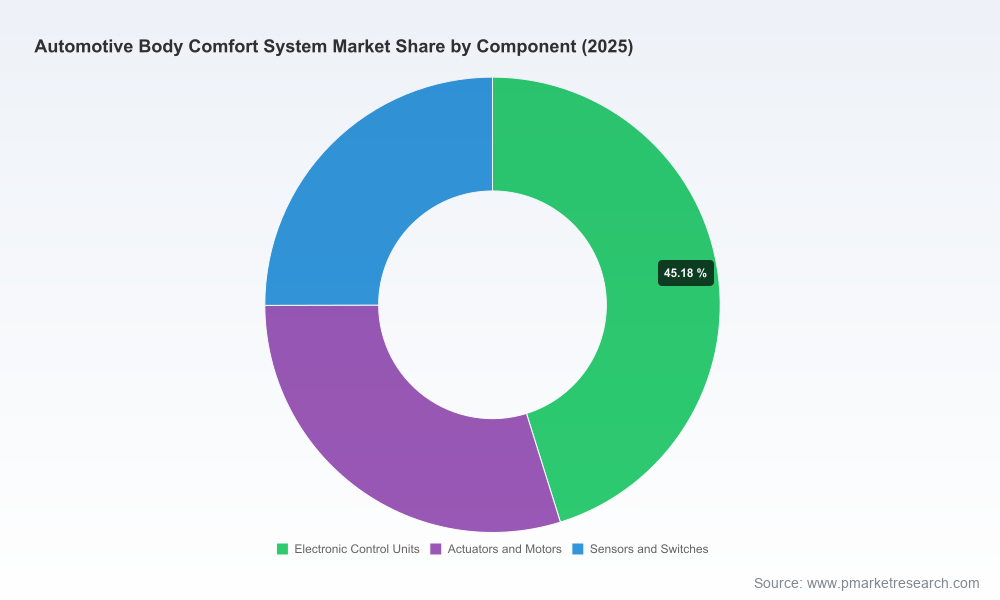
Worldwide Automotive Body Comfort System Market — 2026 Strategic Outlook
Executive summary
As vehicle interiors become a primary battleground for OEM differentiation, PW Consulting’s newest industry study — Worldwide Automotive Body Comfort System Market — provides the strategic intelligence manufacturers, suppliers, and investors will use to guide decisions in 2026. The global market for body and comfort systems has shown robust recovery and expansion since 2020, reaching roughly USD 100.3 billion in our base year (2025). Under our central forecast the market grows at a compound annual growth rate of 7.11% across the 2026–2032 horizon, with long‑term demand supported by rising feature content per vehicle and sustained investment in electronics, sensors and thermal systems.
Iodotrifluoromethane for Semiconductor Etching Market
Why 2026 is a strategic inflection point
Three converging forces make 2026 uniquely consequential for strategy in this space. First, software‑defined vehicle architectures are migrating comfort functions from discrete electromechanical assemblies to integrated domain controllers and ECUs — changing supplier economics and the nature of supplier‑OEM negotiations. Second, regulatory and safety mandates (for example, expanded in‑vehicle monitoring requirements in major markets) are accelerating cross‑domain integration between comfort electronics and safety/driver monitoring stacks. Third, sustainability targets and material mandates are forcing interior design and supplier sourcing decisions earlier in vehicle program timelines. These shifts convert what were largely hardware upgrades into systems and services plays — and create winners for companies that combine electronics, software and thermal expertise.
Silicon Nitride Heating Element Market
Market trajectory and what it means for 2026 decision-makers
After a multi‑year recovery, the body comfort market has moved from pandemic disruption into a higher‑content growth phase. Our base‑year sizing (2025) captures the combined contribution of traditional thermal and mechanical comfort components and the faster‑growing electronic comfort layers. From a planning perspective, the 7.11% CAGR we model for 2026–2032 implies meaningful incremental revenue pools for firms that can capture content growth per unit and expand into retrofit and aftermarket services.
Hotel Supplies Cleaning Service Market
For executives, the practical takeaway is clear: 2026 is the year to translate strategic intent into program commitments. Suppliers must decide which capabilities to own (e.g., low‑power ECUs, integrated sensor suites, thermal control algorithms) and which to access through partnerships. OEMs must decide whether to consolidate electronics and comfort control under fewer domain controllers or to preserve modular supplier relationships that accelerate feature time‑to‑market. The report quantifies the size and growth of these opportunity pools and maps them to realistic uptake scenarios for different vehicle architectures.
What the report contains — operational, decision‑ready workstreams
- Market sizing and topline forecasts (2020–2032): a vetted demand model that reconciles production, content‑per‑vehicle trajectories and substitution between legacy and next‑gen comfort features.
- Scenario roadmaps: three practical adoption curves (base, accelerated, conservative) for software‑defined and electrified vehicle segments to stress‑test product and investment plans.
- Technology deep dives: technical and commercial assessments of ECUs, actuators, sensors, HVAC modules and integration middleware that determine total systems cost and upgrade paths.
- Competitive playbooks: supplier scorecards, capability matrices and positioning blueprints that help commercial teams prioritize R&D, partnerships and M&A targets.
- Regulatory and materials impact analysis: clear line‑of‑sight on how safety regulations, new communications standards and recycled material targets influence product designs and sourcing strategies.
- Go‑to‑market and procurement toolkits: negotiation levers, cost‑curve benchmarks, and a supplier selection decision tree formatted for integration into 2026 program reviews.
Competitive landscape — profiles and strategic postures
The competitive map for body comfort systems is composed of large diversified Tier‑1s, specialized thermal and seating specialists, and component specialists that are expanding systems capabilities. The market is moderately consolidated; leadership derives from the ability to combine hardware, software and integration services.
- Gentherm (United States) — A specialist in thermal comfort solutions (seat heating, ventilation, active cooling). Gentherm’s core advantage lies in thermal systems IP and thermal management architectures that are extensible to multi‑zone seating systems (https://gentherm.com). For buyers, Gentherm represents a go‑to partner for differentiated thermal packages.
- Lear Corporation (United States) — A global seating systems integrator offering full seating platforms with integrated thermal comfort, lumbar and dynamic adjustment capabilities (https://www.lear.com). Lear’s strength is in system integration at scale — important for OEMs seeking turnkey seating modules.
- Adient plc (Ireland) — Focused on ergonomic, modular seating architectures and advanced comfort modules. Recent product introductions emphasize occupant safety integration alongside comfort (https://www.adient.com), positioning Adient for collaborative programs that require safety‑comfort co‑design.
- FORVIA / Faurecia (France) — Combines seating and interior electronics with advanced comfort features; strong in multi‑domain integration and electric vehicle interior architectures (https://www.forvia.com).
- Magna International (Canada) — Offers seating systems and interior components with a supplier model optimized for global production programs (https://www.magna.com).
- Continental AG and Robert Bosch GmbH (Germany) — Two heavyweight electronics and systems integrators that bring deep competence in control units, sensors and body‑level electronics (https://www.continental.com; https://www.bosch-mobility.com). Their advantage is cross‑domain expertise enabling comfort functions to be integrated with safety and vehicle networks.
- Denso Corporation & Toyota Boshoku (Japan) — Denso’s HVAC expertise and Toyota Boshoku’s seat systems capabilities make them important partners for OEMs with strong in‑house program standards (https://www.denso.com; https://www.toyota-boshoku.co.jp).
- Valeo, Kongsberg Automotive, Alfmeier Präzision and others — These firms provide focused modules, actuators and precision components. Their successful playbooks often involve deep OEM partnerships or narrowly scoped system wins (https://www.valeo.com; https://www.kongsbergautomotive.com; https://www.alfmeier.de).
Across these players, differentiation is increasingly determined by software, system architecture, and the ability to meet OEM sustainability and regulatory requirements as much as by raw mechanical capability.
Recent industry dynamics you must factor into 2026 plans
- Product innovation continues: major suppliers have announced new seating solutions that combine ergonomics, pretensioner‑integrated safety elements and enhanced comfort features, reflecting a trend toward convergence of comfort and occupant safety.
- Industry thought‑leadership: recent supplier studies underscore interior, body and comfort systems as central to OEM user‑experience strategies, elevating supplier bargaining power for differentiated content.
- Standards and connectivity: advances in vehicle communications (e.g., updated transceiver standards supporting low‑power modes) are enabling new comfort functions but require upfront engineering investments to meet ISO and OEM interoperability expectations.
- Material and sustainability targets: OEMs and suppliers are accelerating use of recycled and renewable plastics for interiors, which changes cost structures and validated material suppliers for 2026 programs.
Strategic recommendations for 2026
- Prioritize integration capabilities: invest in domain controller compatibility, ECUs and middleware stacks now to win architecture slots in 2026 program cycles.
- Segment your value capture: define which parts of the value chain (components, modules, software, services) you will own versus partner for, and align commercial models (licensing vs BOM supply) accordingly.
- Embed regulatory requirements early: integrate driver/occupant monitoring and safety sensor pathways in comfort designs to avoid late program design churn and compliance costs.
- Build sustainability into sourcing: validate recycled materials and secondary supply chains now to meet OEM timelines and avoid price and qualification shocks later in program lifecycles.
- Design for software monetization: create upgrade paths (OTA, configurable comfort packages) that can convert one‑time hardware sales into recurring revenue streams.
- Use M&A and partnerships defensively: target bolt‑on acquisitions for missing software, sensing or thermal IP, and form JVs to access OEM‑locked program windows when appropriate.
Why PW Consulting’s study is different — and how to use it in 2026
This report was developed for executives who need to act, not only to understand. We combine a granular market model with tactical playbooks: supplier negotiation templates, program‑level content calculators, and a buy/sell/partner decision matrix calibrated to 2026 procurement cycles. The study includes scenario models you can drop into your internal planning tools and an executive dashboard for rapid stakeholder briefings.
In keeping with the “trailer” approach, this release highlights the strategic conclusions and methodologies but deliberately withholds the full, granular breakdowns (regional and application splits, individual segment revenue series and certain competitive share tables). These detailed datasets and interactive models are available exclusively in the full report and through our bespoke advisory engagements.
Next steps — how to access the full intelligence
For teams planning supplier strategies, program bid decks or M&A screening in 2026, we recommend three immediate actions: (1) acquire the full report for access to the demand model and segment matrices, (2) schedule a half‑day workshop with PW Consulting to map the scenarios to your product roadmap, and (3) commission a supplier‑level benchmarking session to identify high‑probability partners or acquisition targets aligned to your architecture choices.
To obtain the full Worldwide Automotive Body Comfort System Market report or to arrange a workshop, visit our report landing page or contact our automotive practice leads. The full publication includes the complete data tables, regional and application breakdowns, supplier scorecards, and the downloadable Excel model you can integrate directly into your 2026 planning cycle.
For detailed analysis of this topic, please visit the official page:Worldwide Automotive Body Comfort System Market
Lacy Lee
Senior Marketing Manager
[email protected]
00852-95632430
PW Consulting: www.pmarketresearch.com

 English
 Arabic
 French
 Spanish
 Portuguese
 Deutsch
 Turkish
 Italiano
 Russian
 Romaian
 Portuguese (Brazil)
 Greek