
PW Consulting: Worldwide Nuclear-Grade LED Lighting Market Set to Grow at 5.85% CAGR Through 2032
Worldwide Nuclear-Grade LED Lighting Market: Strategic Insights for 2026 Decision Makers
Executive summary
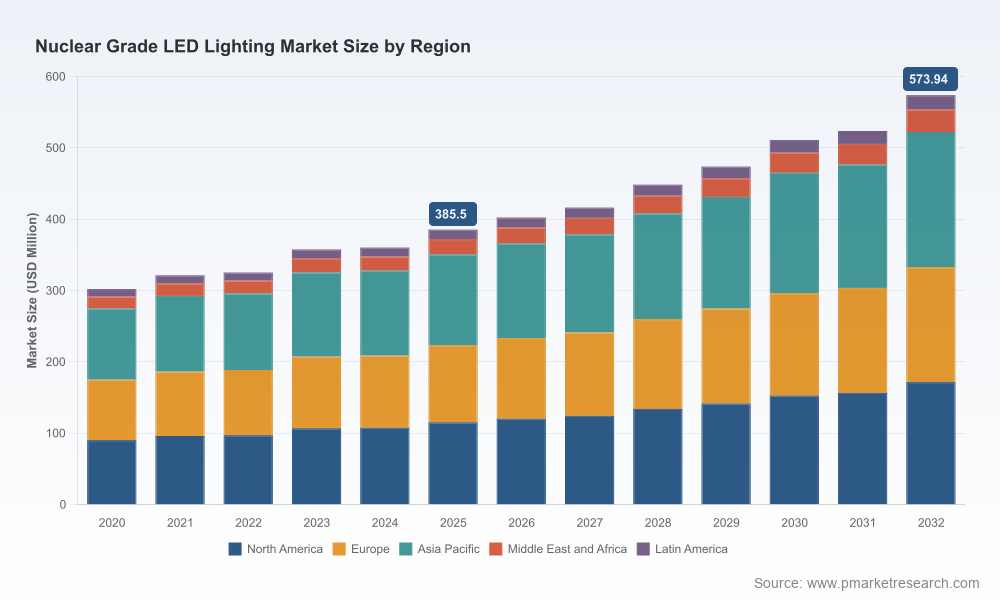
As global nuclear infrastructure stakeholders move from program planning into procurement and retrofit cycles, lighting systems are emerging as a critical reliability and safety node. PW Consulting’s latest market study — the Worldwide Nuclear-Grade LED Lighting Market (base year 2025) — consolidates historical performance (2020–2025) and a forward-looking forecast (2026–2032) into an actionable roadmap for 2026 corporate decisions. The market reached roughly USD 385.5 million in 2025 and is projected to grow to approximately USD 573.9 million by 2032, reflecting a forecast compound annual growth rate of about 5.85% (2026–2032). This trajectory underscores steady demand driven by new-build projects, life-extension programs, and a growing focus on resilience and maintenance minimization.
Specialty Multicore Fiber Market
Why this matters to executives in 2026
- CapEx and O&M trade-offs are now quantifiable. With LED architectures proving more radiation-tolerant and maintenance-lean than legacy fixtures, procurement teams must balance higher unit premiums against lifecycle savings. Our study provides scenario-based ROI templates calibrated to nuclear operational constraints.
- Regulatory and safety requirements are shaping vendor selection. Compliance with seismic qualification (IEEE-344), extended emergency illumination windows and U.S. NRC quality program expectations (10CFR50 Appendix B) is non-negotiable. 2026 procurement strategies must prioritize validated compliance pathways to avoid costly rework and project delays.
- Technical due diligence now extends beyond photometrics. Buyers must evaluate LOCA compatibility, gamma-dose endurance, driver integration (internal vs external shielding), EMC behavior in safety circuits, and decontaminability of housings — factors that materially affect lifecycle risk and cost.
What the PW Consulting report delivers (practical, not just descriptive)
- Commercial decision tools: Negotiation playbooks, supplier scorecards, and TCO models adjusted for nuclear-grade constraints that let CFOs and sourcing teams compare offers on identical risk-adjusted terms.
- Technical appraisal frameworks: A standardized checklist for LOCA testing, gamma irradiation protocols, EMC screening and seismic validation — aligned to industry test benchmarks and commonly accepted certification regimes.
- Deployment and maintenance matrices: Practical schedules for staged retrofits, spare-parts rationalization, on-site switchover plans, and strategies to convert emergency lighting to modern LED assemblies without compromising post-accident operability.
- Scenario planning: Four adoption pathways (Conservative, Incremental Upgrade, Accelerated Retrofit, Greenfield Standardization) with modeled impacts on construction timelines, outage durations and maintenance budgets.
- Risk register and mitigation playbook: Supply-chain exposure mapping (specialized components, coatings, lead times), vendor qualification protocols, and contingency actions to maintain plant availability during transitions.
Competitive landscape — capabilities that matter
The vendor ecosystem is a mix of specialized suppliers and niche engineering houses. The market displays moderate concentration: leading manufacturers capture a meaningful share while room remains for highly specialized entrants. Key vendor competencies highlighted in our analysis include radiation tolerance validation, in-house driver and mechanical design, LOCA compatibility, and the ability to deliver seismically-qualified emergency fixtures.
Embedded Switch Modules Market
- DITO Lighting d.o.o. (Slovenia) — Notable for fully integrated in-house design and manufacturing of ultra radiation-resistant luminaires across air and underwater applications. Recent product enhancements (e.g., upgraded CoB-based U-50 and consolidation of A-Series tech into the L-Series platform) demonstrate a roadmap toward more mechanically robust, thermally controlled fixtures with enhanced safety modes.
- Luminos Nuclear (Nanocut d.o.o.) (Slovenia) — Distinguished by gamma irradiation testing to industrial benchmarks (notably testing to hundreds of kGy levels at certified facilities) and stainless-steel emergency variants. Their verticalization across mechanical, LED and driver production reduces single-point supply risk for radiation-tolerant components.
- Ahlberg Cameras (Sweden) — Offers focused high-performance, radiation-tolerant lighting for pool and containment environments with productized solutions tailored to on-site CCTV and inspection use-cases.
- BIRNS, Inc. (USA) — Provides rugged fixtures with documented tolerance to very high cumulative doses and seismically-qualified emergency luminaires that meet extended illumination duration requirements; strength lies in designs that are engineered for containment heights and post-event operability.
- AO Sosny R&D (Russia) — Specializes in fixtures for hot cells, canyons and maintenance zones, typically supporting higher-power inputs for localized work-area illumination.
- G&G Industrial Lighting (USA) — Produces compact, zero-maintenance luminaire designs suited to accelerator-level radiation environments, emphasizing long-life operation and simplified logistics.
- Homewood Energy Services (USA) — Puts process-control and quality-program compliance front and center, offering products manufactured under 10CFR50 Appendix B-style quality systems with maintenance-free emergency power and seismic qualification.
- Martek Lighting & LED Lighting Supply (USA) — Provide customizable, compliance-oriented solutions for power generation facilities, focusing on NRC/FERC-aligned documentation, EMC adherence and lifecycle servicing capabilities.
Regulatory and technical dynamics shaping 2026 sourcing decisions
- Seismic and emergency illumination mandates: Procurement specifications must explicitly require IEEE-344 seismic qualification and emergency illumination provisioning that aligns with post-fire safe shutdown philosophies — this affects fixture mechanical design, battery architecture and mounting systems.
- Radiation testing expectations: Gamma-testing to specified dose thresholds and LOCA compatibility testing are becoming minimum expectations in vendor bids for containment and high-radiation zones. Buyers must demand test evidence from accredited labs and clear statements on driver shielding strategy.
- Interoperability and EMC: As control-room and instrumentation density increases, EMC performance and non-interference assurances are central to acceptance testing; request EMC documentation and field interoperability test plans during vendor selection.
- Materials and decontamination: Stainless-steel housings and smooth, decontaminable finishes are preferred in critical zones to reduce contamination risks and simplify maintenance during outages.
Actionable recommendations for 2026 procurement cycles
- Adopt a staged validation path: Move from sample-level gamma/LOCA verification to pilot installations in non-critical cells before fleet-wide rollout. This reduces schedule risk and validates O&M assumptions.
- Insist on modular driver strategies: Favor fixtures that minimize need for external shielding or that use easily replaceable, radiation-tolerant driver modules to shorten outage swaps.
- Demand cross-discipline documentation: Require combined mechanical, electrical, and radiation test dossiers in vendor submissions — piecemeal data increases acceptance risk.
- Buy lifecycle, not just lumens: Evaluate supplier service networks, spares provisioning and condition-monitoring offerings as part of total cost and availability calculations.
- Leverage competitive clustering: Our research shows the market is neither a pure oligopoly nor fully fragmented — targeted RFPs can elicit competitive pricing while preserving vendor specialization where required.
How PW Consulting translates insight into advantage
Our engagement model converts the study’s strategic findings into procurement-ready outputs: customized RFP templates aligned to your nuclear safety regime, bespoke TCO and risk models populated with your outage cost parameters, vendor shortlists mapped to capability gaps, and acceptance-test protocols that reduce commissioning time. For technology teams, we provide a prioritized matrix of technical evidence to request during qualification, reducing back-and-forth in vendor responses.
Worldwide Noise-muffling Infant Hat Market
Next steps and how to access the full intelligence
The analysis above highlights the structural dynamics and practical decision levers that will shape nuclear-grade LED spending in 2026. For program teams preparing capital plans, and for sourcing and engineering leaders finalizing vendor pre-qualification, the full PW Consulting report includes detailed scenario spreadsheets, validated checklists for LOCA and gamma testing, and downloadable RFP language tailored to regulatory jurisdictions.
To obtain the complete dataset, full segmentation analytics, and supplier scorecards that underpin our findings, please visit PW Consulting’s report page or contact our advisory team. The summary here is intentionally selective — real procurement advantage requires the complete market intelligence package and interactive tools provided in the full report.
For detailed analysis of this topic, please visit the official page:Worldwide Nuclear Grade LED Lighting Market
Lacy Lee
Senior Marketing Manager
[email protected]
00852-95632430
PW Consulting: www.pmarketresearch.com

 English
 Arabic
 French
 Spanish
 Deutsch
 Turkish
 Dutch
Dutch
 Italiano
 Russian
 Romaian
 Portuguese (Brazil)
 Greek
Greek