
Vulcanization Accelerator Market Opportunities Across Automotive and Industrial Applications
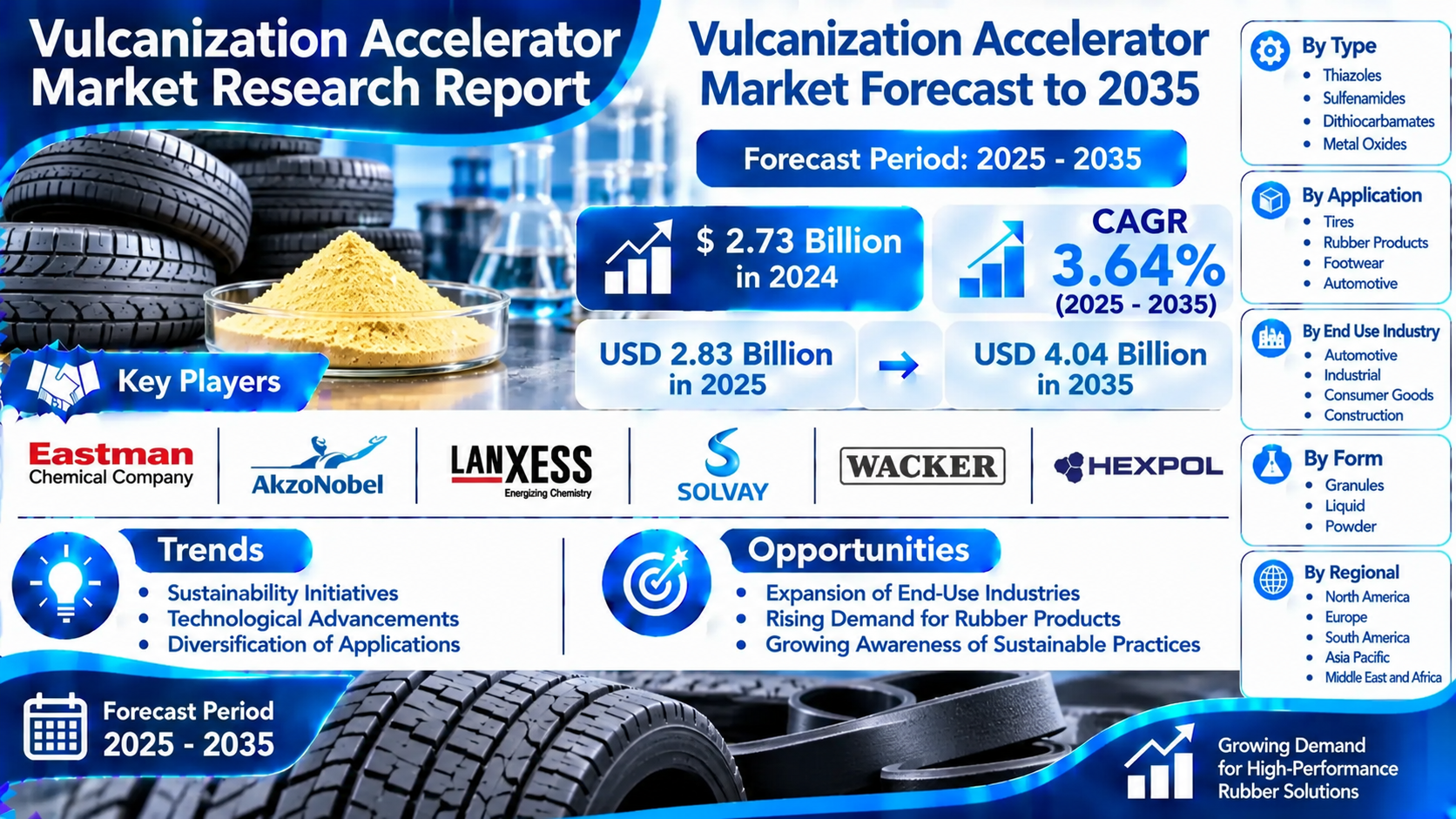
According to Market Research Future® (MRFR), the Vulcanization Accelerator Market is expected to grow from USD 2.83 billion in 2025 to USD 4.04 billion by 2035, reflecting a CAGR of 3.64% throughout the 2025–2035 forecast period. The market's 2024 valuation stood at USD 2.73 billion. Its development is connected to the broad use of rubber products in tires, footwear, automotive applications and other manufacturing activities, as well as opportunities arising from end-use industry expansion and increasing awareness of sustainable practices.
Market Structure and Product Categories
The vulcanization accelerator industry is organized around several product types and physical forms. Thiazoles, sulfenamides, dithiocarbamates and metal oxides are the types identified in the market segmentation. Granules, liquid and powder represent the specified product forms. Together, these categories describe the market's product range and provide a basis for examining demand across different manufacturing requirements.
The presence of multiple accelerator types reflects the variety of products included in the industry. Buyers and manufacturers may assess product categories in relation to their intended rubber applications and production needs. The market's form-based classification adds another dimension, distinguishing between granules, liquid and powder products.
Technological advancements are identified as a significant industry trend. Innovation can influence how suppliers develop and position their products as customer requirements change. In a market covering several product types and forms, technological development may provide opportunities to address specific manufacturing needs. The available market information does not, however, quantify the contribution of individual technologies or identify a leading product category.
Rubber Applications Drive Industry Relevance
The market's application segmentation covers tires, rubber products, footwear and automotive. These categories connect vulcanization accelerators with a broad set of products and manufacturing activities. The presence of tire and automotive applications highlights the market's relationship with vehicle-related demand, while footwear and other rubber products extend its reach into additional consumer and industrial markets.
Rising demand for rubber products is one of the principal opportunities identified for the industry. As rubber-based products serve multiple sectors, demand conditions across these markets can influence the requirements of manufacturers and suppliers. The application diversity also means that market participants can address different customer groups rather than relying on one end-use category.
The market is further segmented by end-use industry into automotive, industrial, consumer goods and construction. These sectors provide a wider view of the industries represented in the market. Automotive appears in both the application and end-use classifications, reflecting its relevance from the perspective of product use and broader industry demand. The remaining categories demonstrate the market's exposure to industrial production, consumer-oriented products and construction-related activities.
End-Use Expansion and Market Opportunities
Expansion of end-use industries is identified as a major opportunity for the vulcanization accelerator market. Growth and diversification across automotive, industrial, consumer goods and construction can create additional demand channels for suppliers. The extent of this opportunity will depend on the development of individual sectors and their requirements for rubber-based products.
The connection between end-use expansion and rising rubber product demand is important to the market's outlook. As applications extend across different industries, manufacturers may need to serve varied product specifications and purchasing requirements. This creates a competitive environment in which product range and the ability to address customer needs can influence market participation.
Diversification of applications is also identified as a trend. The market's coverage of tires, rubber products, footwear and automotive illustrates this breadth. A diverse application base can provide multiple sources of demand, although the relative contribution of each category is not specified in the supplied market figures.
Sustainability Becomes a Key Industry Consideration
Sustainability initiatives are among the major trends identified for the market. Growing awareness of sustainable practices is also listed as an opportunity, indicating that environmental considerations are becoming relevant to the industry's future direction.
For companies operating in the vulcanization accelerator market, sustainability can influence product development priorities and broader business decisions. Manufacturers may need to consider changing customer expectations and the importance of sustainable practices across rubber-related industries. These developments can create opportunities for businesses that are able to respond to evolving market priorities.
The supplied market information does not identify specific sustainable product technologies or quantify the impact of sustainability initiatives on market demand. Nevertheless, the inclusion of sustainability in both the trend and opportunity categories indicates its importance in the overall industry outlook.
Regional Coverage and Competitive Environment
The market is divided geographically into North America, Europe, South America, Asia Pacific, and the Middle East and Africa. This regional segmentation provides a structure for evaluating the industry's global reach. The available data does not include individual regional valuations, country-level market shares or growth rankings. Regional performance should therefore be assessed using the report's detailed regional figures rather than assumptions about geographic leadership.
The competitive landscape includes Eastman Chemical Company, AkzoNobel N.V., Lanxess AG, Solvay S.A., Wacker Chemie AG and Hexpol AB. These companies are identified as key players in the market. Competition takes place across an industry with multiple accelerator types, product forms and application areas. Suppliers must address the requirements of customers operating in different end-use sectors while responding to technological and sustainability-related developments.
Forecast and Industry Outlook to 2035
The market is projected to increase from USD 2.83 billion in 2025 to USD 4.04 billion in 2035. With a CAGR of 3.64%, the forecast points to steady growth over the ten-year period. The 2024 valuation of USD 2.73 billion provides an additional reference for the market's recent size.
Several factors are relevant to this outlook: expansion of end-use industries, rising demand for rubber products, technological advancements and growing awareness of sustainable practices. Application diversification may also support the industry's ability to serve a range of customer markets.
Overall, the vulcanization accelerator market is positioned for continued development through 2035. Its future performance will be influenced by the requirements of automotive, industrial, consumer goods and construction sectors, as well as changes in rubber product demand and industry approaches to sustainability. Market participants that respond to these developments may be able to pursue opportunities across the industry's diverse product and application landscape.

 English
 Arabic
 French
 Spanish
 Portuguese
 Deutsch
 Turkish
 Italiano
 Russian
 Romaian
 Portuguese (Brazil)
 Greek