
Eicosapentaenoic Acid (EPA) Market Share: What Drives Ingredient Demand?
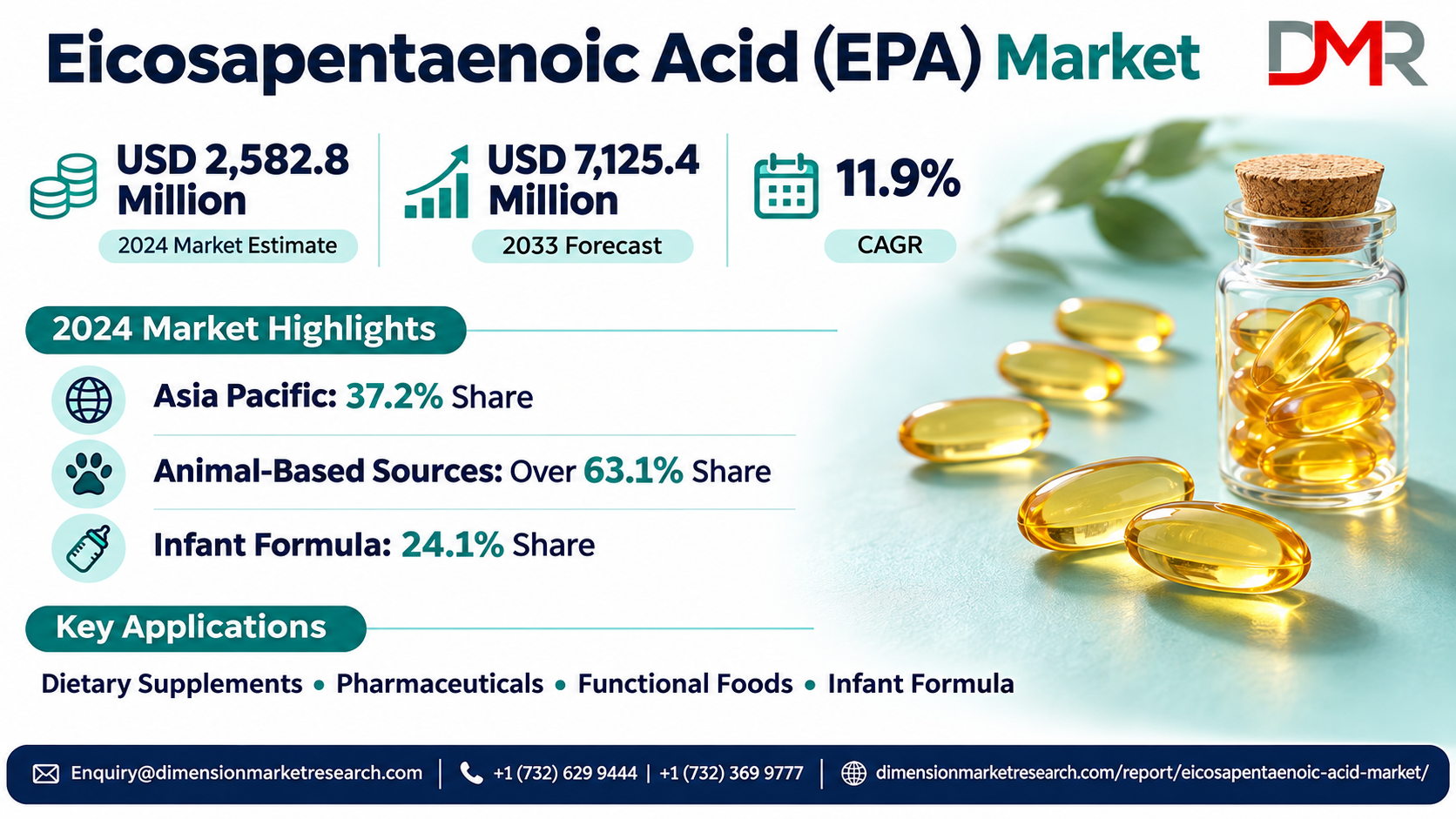
The Eicosapentaenoic Acid (EPA) Market Share analysis highlights two findings that can get overlooked in discussions about omega-3 supplements. Animal-based sources account for the largest share of EPA supply by source, and infant formula leads the report’s application breakdown. Dietary supplements, fortified foods, and pharmaceuticals give ingredient suppliers several other routes to market, each with its own formulation and sourcing needs.
According to Dimension Market Research, global EPA market revenue was estimated at USD 2,582.8 million in 2024 and is forecast to reach USD 7,125.4 million by 2033, at a reported compound annual growth rate of 11.9%. The outlook gives ingredient suppliers two questions to consider together: which applications are likely to buy more EPA, and which sources and concentrations will those buyers need?
What Is the Eicosapentaenoic Acid (EPA) Market?
EPA is a long-chain omega-3 fatty acid. The market covers ingredients sold for use in products such as infant formula, dietary supplements, fortified foods and beverages, pharmaceuticals, and animal feed. The report groups EPA ingredients by source, form, concentration, and application. Triglycerides, ethyl esters, and phospholipids are three forms covered in the analysis.
Those categories answer different questions. Source describes where the ingredient comes from. Form describes how the fatty acid is present in the ingredient. Concentration describes how much EPA it contains. The report classifies products with more than 50% EPA content as high concentrates. For procurement teams, specifying these attributes makes it easier to compare offers for the same finished product.
Get a Free Customized Sample of This or Any Other Market Research Report
https://dimensionmarketresearch.com/request-sample/eicosapentaenoic-acid-market/
Where Was EPA Market Share Concentrated in 2024?
● Animal-based sources led by source. The report puts their 2024 share at over 63.1%. Fish oils, including those derived from anchovies and sardines, are an established raw material for EPA ingredients.
● Infant formula led by application. The report estimates a 24.1% share in 2024. This measures infant formula within the EPA report’s application breakdown.
● Asia-Pacific led by region. The region accounted for an estimated 37.2% of global market revenue in 2024, supported by marine raw material supply and demand for supplements and fortified products.
How Do Fish Oil and Algal Oil Shape Supplier Competition?
Fish oil gives ingredient suppliers access to an established source of EPA. Algal oil gives formulators another option when developing products for consumers who prefer ingredients that do not come from fish. The Marine Nutraceutical Market provides a wider view of this sourcing shift because it covers both fish-derived and algae-derived ingredients alongside products such as marine collagen.
The EPA report profiles companies including BASF SE, Lonza, Glanbia Plc, Epax, and Croda International plc. It identifies higher-concentration products and encapsulation as areas of differentiation. For buyers, the relevant comparison starts with the finished product. An ingredient suitable for an omega-3 softgel may have a different specification from one selected for a fortified beverage, where it has to fit an existing formulation.
Why Does the End Product Matter?
The EPA and DHA Market includes both fatty acids, which can be sold together in an omega-3 formulation. A buyer evaluating a blend needs to know the amount of EPA and DHA it delivers. A buyer sourcing a high-EPA concentrate can begin with the target EPA content and work back to the ingredient specification. That distinction matters when comparing supplier quotes.
The Cardiovascular Health Supplements Market provides context for one part of downstream demand. Its report identifies capsules and softgels as the expected leading product form in 2026. The EPA report also covers infant formula, fortified foods, pharmaceuticals, and other uses. Looking at finished-product categories individually helps suppliers assess where an EPA ingredient fits and where they may need a different form or concentration.
What Does the Regional Outlook Tell Buyers?
Asia-Pacific’s lead reflects its role in both supply and consumption. The report points to regional fisheries and demand for omega-3 supplements and fortified foods, with China and India among the markets discussed. In the United States, EPA revenue was estimated at USD 651.6 million in 2024 and is projected to reach USD 1,690.2 million by 2033, at a reported CAGR of 11.2%. For suppliers, those figures help frame separate decisions about where to source ingredients and where to build a customer base.
Explore the Complete Eicosapentaenoic Acid (EPA) Market Analysis
https://dimensionmarketresearch.com/checkout/eicosapentaenoic-acid-market/
Frequently Asked Questions
How large is the Eicosapentaenoic Acid (EPA) Market?
The global market was estimated at USD 2,582.8 million in 2024 and is forecast to reach USD 7,125.4 million by 2033.
What is the projected market growth rate?
The report lists a CAGR of 11.9% from 2024 to 2033.
Which source accounts for the largest EPA market share?
Animal-based sources led with an estimated share of over 63.1% in 2024.
Which application led the EPA market?
Infant formula led the application breakdown with an estimated 24.1% share in 2024.
Which region holds the largest EPA market share?
Asia-Pacific led with an estimated 37.2% of global revenue in 2024.
Conclusion
Through 2033, opportunities for EPA suppliers include higher-concentration ingredients and algal oils for products aimed at buyers who prefer alternatives to fish oil. The commercial fit depends on the end product. A supplier serving formula manufacturers, beverage formulators, or supplement brands can use source, form, and concentration to match its portfolio to each customer’s requirements.
Related Omega-3 and Nutrition Market Insights
The EPA and DHA Market Size report covers both long-chain omega-3 ingredients. DHA was projected to account for 60.0% of the market by type in 2024.
The Marine Nutraceutical Market Share report covers omega-3 oils, marine collagen, and algae-derived ingredients. It projects global revenue of USD 10.8 billion by 2035.
The Cardiovascular Health Supplements Market Growth report projects an increase from USD 12.1 billion in 2026 to USD 26.2 billion by 2035, at a CAGR of 8.9%.

 English
 Arabic
 French
 Spanish
 Portuguese
 Deutsch
 Turkish
 Dutch
 Italiano
 Russian
 Romaian
 Greek