
Aluminum Anodizing Market to Grow at 3.64% CAGR During 2025–2035
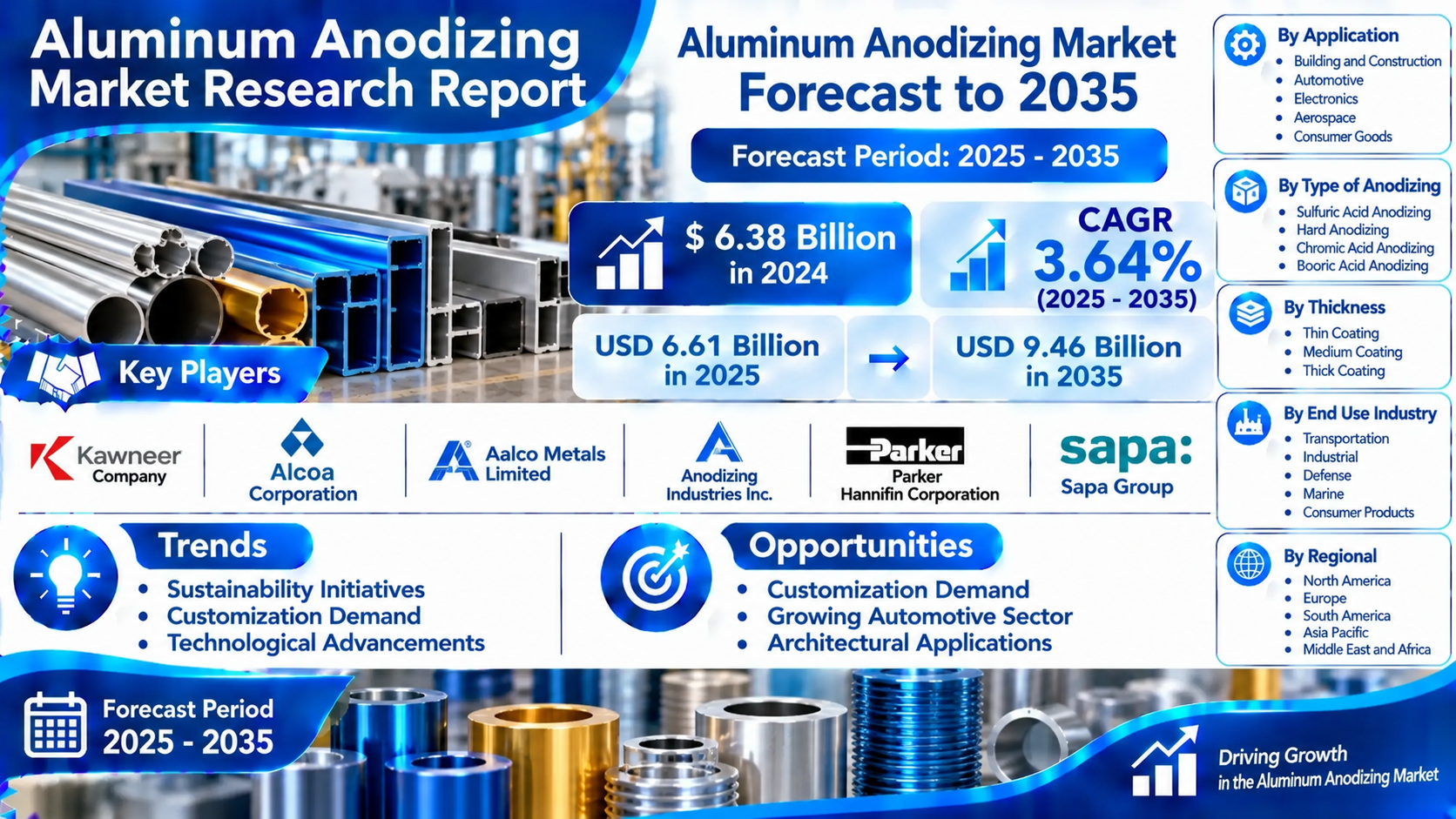
According to Market Research Future® (MRFR), the Aluminum Anodizing Market is projected to increase from USD 6.61 billion in 2025 to USD 9.46 billion by 2035, registering a compound annual growth rate (CAGR) of 3.64% during the forecast period from 2025 to 2035. The market was valued at USD 6.38 billion in 2024. Aluminum anodizing remains relevant across industries that use aluminum components and products, including building and construction, automotive, electronics, aerospace, and consumer goods. Sustainability initiatives, demand for customized finishes, and technological advancements are among the trends shaping the industry's outlook.
Market Overview and Industry Demand
Aluminum anodizing is a surface treatment process represented across several industrial and commercial applications. Its market is connected to the broad use of aluminum in products and structures where surface characteristics and finish requirements influence material selection. Demand from construction, transportation-related industries, electronics, aerospace, and consumer products contributes to the market's diversified application base.
The market's projected increase from USD 6.61 billion in 2025 to USD 9.46 billion in 2035 indicates continued expansion over the forecast period. Although the projected CAGR of 3.64% represents measured growth, the range of industries covered provides multiple sources of demand. Changes in product requirements, manufacturing practices, and architectural preferences can influence the adoption of anodized aluminum across these sectors.
Application-Based Market Segmentation
The application segment includes building and construction, automotive, electronics, aerospace, and consumer goods. Each category represents a different area of demand for aluminum anodizing.
Building and construction is an important application area because aluminum is used across a range of architectural and structural products. The appearance and finish requirements of building components can influence interest in anodized materials. Architectural applications are also identified as a market opportunity, reflecting the potential for demand from construction projects and design-oriented uses.
Automotive applications form another part of the market. The automotive sector's use of aluminum creates opportunities for anodizing in components and products where surface treatment is required. The growing automotive sector is specifically identified as an opportunity for market participants.
Electronics represents a separate application category, connecting anodizing demand with the manufacture of electronic products and components. Aerospace is also included, adding an industry with distinct material and component requirements. Consumer goods complete the application segmentation, covering products that incorporate aluminum and may require particular surface finishes.
Types of Aluminum Anodizing
The market is segmented by type of anodizing into sulfuric acid anodizing, hard anodizing, chromic acid anodizing, and booric acid anodizing. These categories reflect the different process types considered in the report.
Sulfuric acid anodizing is one of the identified process categories. Hard anodizing represents another segment, while chromic acid anodizing and booric acid anodizing complete the classification. The inclusion of multiple process types highlights the diversity of anodizing approaches available to manufacturers and users.
Demand across these categories can be influenced by the intended application, coating requirements, and the specifications of the finished product. Manufacturers serving different end-use industries may need to consider the requirements associated with particular components and applications when selecting an anodizing process.
Coating Thickness and End-Use Industries
Thickness-based segmentation comprises thin coating, medium coating, and thick coating. This classification reflects the range of coating thickness categories addressed by the market. The requirements of individual products and applications can influence the coating category selected, making thickness an important dimension in the market's structure.
The end-use industry segment includes transportation, industrial, defense, marine, and consumer products. Transportation represents a broad category that connects anodizing demand with mobility-related products and systems. Industrial applications provide another source of demand through the use of aluminum components in industrial settings.
Defense and marine applications extend the market's reach into specialized end-use environments. Consumer products represent the final category, linking anodizing demand to a broad range of finished goods. The diversity of these industries helps explain why market development is influenced by several distinct demand conditions rather than a single end-use sector.
Key Market Trends and Opportunities
Sustainability initiatives are one of the major trends identified in the Aluminum Anodizing Market. Manufacturers and end users are paying greater attention to sustainability considerations in industrial production and material choices. This trend creates an environment in which surface-treatment processes and their role in product manufacturing may receive increased consideration.
Customization demand is another important trend. Different applications can require distinct product appearances, finishes, and specifications. Demand for customized solutions can therefore influence the services and capabilities offered by anodizing providers. It also creates opportunities for businesses that can address varied requirements across architectural, automotive, industrial, and consumer applications.
Technological advancements form the third identified trend. Developments in manufacturing processes and related technologies can influence production practices and the ability of providers to respond to customer requirements. Continued attention to process capabilities is relevant as the market serves a wide range of applications and coating categories.
The report identifies customization demand, the growing automotive sector, and architectural applications as key opportunities. These areas offer potential avenues for market development. Customization can support demand from customers seeking application-specific finishes, while automotive activity provides an opportunity through the sector's use of aluminum. Architectural applications connect the market with building design and construction requirements.
Regional Market Landscape
The Aluminum Anodizing Market is analyzed across North America, Europe, South America, Asia Pacific, and the Middle East and Africa. These regions represent the geographic scope of the report and provide a framework for examining demand across different industrial and construction markets.
Regional market conditions can vary according to manufacturing activity, construction investment, automotive production, and the presence of relevant end-use industries. Demand for anodizing services is consequently connected to the development of these sectors in individual regions. The report's regional segmentation captures the market's international reach without assuming uniform growth across all geographies.
Competitive Landscape
Key players identified in the market include Kawneer Company, Alcoa Corporation, Aalco Metals Limited, Anodizing Industries Inc., Parker Hannifin Corporation, and Sapa Group. These companies form part of the competitive environment serving aluminum-related markets and anodizing applications.
Competition is influenced by the ability to address customer requirements across different applications, process types, and coating thickness categories. Customization, technological advancement, and the needs of end-use industries are relevant considerations for companies operating in this space.
Market Forecast Through 2035
The Aluminum Anodizing Market is expected to grow from USD 6.61 billion in 2025 to USD 9.46 billion in 2035, at a CAGR of 3.64%. Its 2024 valuation of USD 6.38 billion provides a baseline for the forecast outlook. Demand from construction, automotive, electronics, aerospace, and consumer goods will remain relevant to the market's development. Sustainability initiatives, customization requirements, and technological advancements, alongside opportunities in automotive and architectural applications, are expected to shape the industry's direction over the forecast period.

 English
 French
 Spanish
 Portuguese
 Deutsch
 Turkish
 Dutch
 Italiano
 Russian
 Romaian
 Portuguese (Brazil)
 Greek