
Roof Water Leak Detector Market Insights: Technology Developments and Competitive Landscape
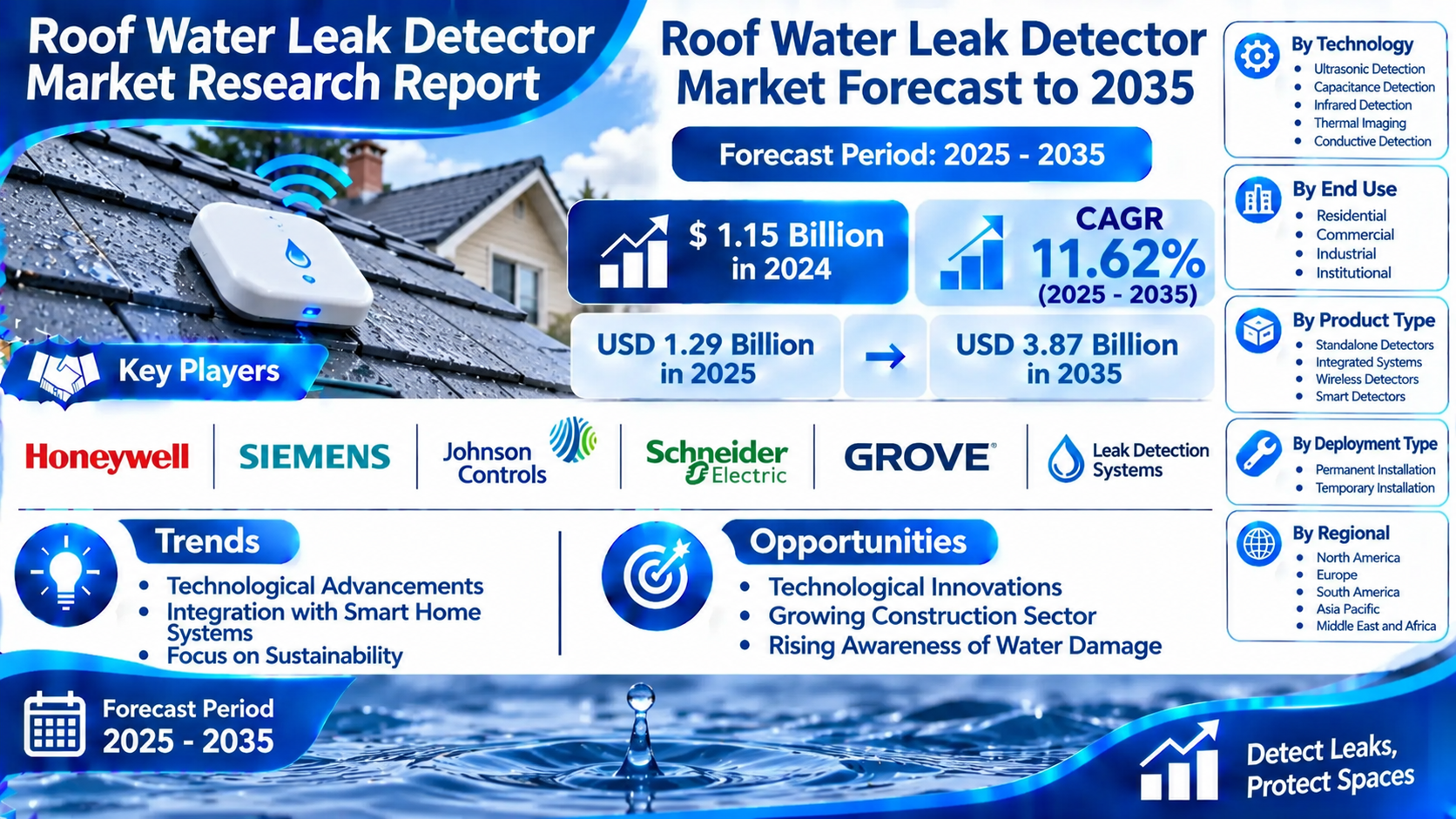
According to Market Research Future® (MRFR), the Roof Water Leak Detector Market is forecast to increase from USD 1.29 billion in 2025 to USD 3.87 billion in 2035, reflecting a CAGR of 11.62% over the 2025–2035 period. The market reached USD 1.15 billion in 2024. Its growth outlook is shaped by technological innovation, the integration of detection products with smart home systems, and rising awareness of water damage. Demand opportunities are also associated with the expanding construction sector and the need to monitor buildings across residential, commercial, industrial, and institutional settings.
Market Size and Industry Outlook
The projected rise in market value points to increasing interest in roof water leak detection solutions. From USD 1.29 billion in 2025, the market is expected to reach USD 3.87 billion by 2035. The forecast CAGR of 11.62% indicates the expected pace of expansion across the ten-year period. The 2024 valuation of USD 1.15 billion provides an earlier benchmark for the market's development.
The market is structured around five technology categories, four end-use segments, four product types, and two deployment models. This segmentation reflects the variety of requirements that can influence purchasing and installation decisions. Building owners and operators may consider the detection method, the type of equipment, and whether a permanent or temporary installation is appropriate for a particular property.
Technology Developments in Leak Detection
The technology segment covers ultrasonic detection, capacitance detection, infrared detection, thermal imaging, and conductive detection. These categories represent the different approaches included in the market assessment. Their presence highlights the role of detection technology in shaping product offerings and providing options for different building monitoring requirements.
Technological Advancements are identified as a key market trend, while Technological Innovations are separately listed as an opportunity. Together, these factors point to the importance of product development in the sector. Innovation can influence how detection systems are designed and incorporated into building environments. The available information does not identify a leading technology or provide comparative performance data, so the relative position of each category cannot be established.
Product types add another layer to the market structure. Standalone detectors, integrated systems, wireless detectors, and smart detectors are all included. These categories show that the market extends beyond individual detection devices to include connected and integrated product configurations. As building monitoring requirements evolve, the distinction between standalone equipment and connected systems becomes relevant to product selection.
Smart Home Integration and Connected Buildings
Integration with Smart Home Systems is one of the principal trends identified in the market. This trend reflects the growing relevance of connected technologies in building environments. Roof water leak detectors can be considered within wider monitoring arrangements, where smart products and integrated systems form part of a connected property setup.
The inclusion of smart detectors and integrated systems in the product segmentation reinforces this trend. Wireless detectors are also covered, providing a separate product category associated with connectivity. These product types offer different configurations for customers evaluating detection solutions.
Smart integration is not limited to residential buildings as a broader concept. Commercial, industrial, and institutional properties also form part of the market's end-use scope. The report does not specify the adoption rate of smart systems across these categories, but the overall segmentation demonstrates the range of building environments addressed by the industry.
End-Use Markets and Deployment Models
Residential, commercial, industrial, and institutional properties make up the four end-use segments. Residential demand is linked to homes and housing developments, while commercial applications include other property environments. Industrial facilities and institutional buildings broaden the potential customer base. Each segment may have different installation and monitoring requirements.
Deployment is classified into permanent installation and temporary installation. These two models reflect different approaches to placing leak detection equipment within a building or roof environment. Permanent installation can form part of ongoing property monitoring, whereas temporary installation provides another option for specific monitoring needs. The market segmentation does not provide deployment-level revenue figures or indicate which model is more widely adopted.
The combination of end-use and deployment categories demonstrates the market's flexibility in serving different property types. Product configuration and installation approach can be considered alongside the chosen detection technology.
Construction Activity and Water Damage Awareness
The growing construction sector is identified as a key opportunity for the market. Construction activity creates potential demand across residential, commercial, industrial, and institutional building projects. As new properties are developed, roof monitoring and water leak detection can become relevant considerations in building management and maintenance planning.
Rising awareness of water damage is another opportunity. Water intrusion can affect building conditions and create maintenance concerns. Greater recognition of these risks may encourage property owners and operators to consider detection systems as part of their approach to monitoring roof conditions. This opportunity is relevant across the market's different end-use categories.
The report also identifies technological innovations as an opportunity. Improvements in detection products and connected systems may support further market development. The scale of this opportunity will depend on the adoption of new products and the needs of customers across different building environments.
Sustainability as an Industry Trend
Focus on Sustainability is included among the major market trends. Building maintenance and water damage monitoring can be considered within broader efforts to maintain property assets and manage resources. A sustainability focus may encourage greater attention to monitoring systems that support the timely identification of water intrusion.
This trend exists alongside technological advancements and smart home integration. Together, the three identified trends illustrate the market's development across technology, connectivity, and sustainability considerations. The supplied information does not provide a separate valuation for sustainability-oriented products or quantify their effect on the overall forecast.
Regional Coverage and Market Participants
The regional segmentation includes North America, Europe, South America, Asia Asia-Pacific, and the Middle East and Africa. These regions define the geographic scope of the report. Since no regional revenue breakdowns or growth comparisons are provided, individual regional performance cannot be ranked using the supplied figures.
The key companies identified are Honeywell, Siemens, Johnson Controls, Schneider Electric, GROVE, and Leak Detection Systems. These participants form part of the competitive landscape for roof water leak detection products. Competition is influenced by the market's range of technologies, product configurations, and installation models, while smart integration and innovation provide additional areas of development.
Long-Term Market Perspective
The Roof Water Leak Detector Market is projected to grow from USD 1.29 billion in 2025 to USD 3.87 billion in 2035, at a CAGR of 11.62%. Its market structure covers multiple detection technologies, connected product categories, end-use environments, and deployment approaches. The growing construction sector and rising awareness of water damage are identified as opportunities, while technological advancements, smart home integration, and sustainability remain important trends. These factors define the industry's outlook through 2035.

 English
 French
 Spanish
 Portuguese
 Deutsch
 Turkish
 Dutch
 Italiano
 Russian
 Romaian
 Portuguese (Brazil)
 Greek