
Rare Earth Metals Leaching Chemicals: Market Analysis, Applications and Key Players
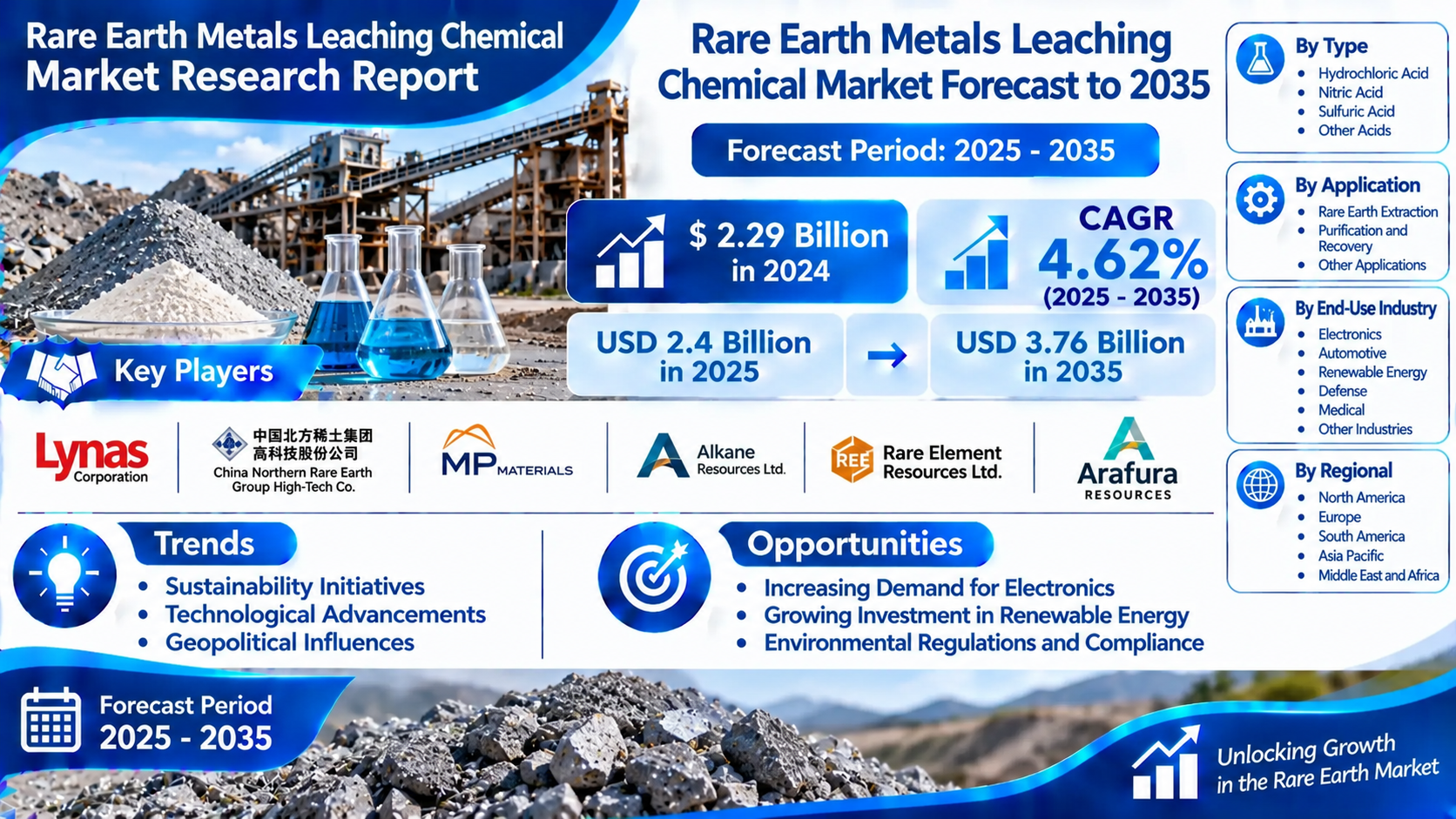
According to Market Research Future® (MRFR), the Rare Earth Metals Leaching Chemical Market is projected to grow from USD 2.4 billion in 2025 to USD 3.76 billion by 2035, registering a compound annual growth rate (CAGR) of 4.62% during the forecast period from 2025 to 2035. The market was valued at USD 2.29 billion in 2024. Its development is connected to chemical requirements across rare earth extraction, purification, and recovery, with demand linked to end-use industries such as electronics, automotive, renewable energy, defense, and medical applications.
Rare Earth Metals Leaching Chemical Market Overview
Leaching chemicals play a role in processing rare earth materials by supporting the extraction and separation stages of the broader value chain. The market is categorized by chemical type, application, and end-use industry, reflecting the different requirements associated with rare earth processing and the industries that depend on these materials. Hydrochloric acid, nitric acid, sulfuric acid, and other acids form the report's main product categories.
The market's valuation indicates a steady expansion outlook. From USD 2.4 billion in 2025, the market is forecast to reach USD 3.76 billion in 2035. The stated CAGR of 4.62% captures the expected annual growth over this period. The increase from the 2024 value of USD 2.29 billion to the 2025 estimate also establishes the market's position at the beginning of the forecast period.
Chemical Types and Their Market Role
The type segmentation includes hydrochloric acid, nitric acid, sulfuric acid, and other acids. These categories represent the chemical inputs covered in the market assessment. Their inclusion reflects the range of leaching chemicals associated with rare earth processing, where chemical selection forms part of extraction and material recovery operations.
The report does not provide individual revenue figures or market shares for these acid categories. Consequently, the available information does not establish which chemical type currently leads the market or which is expected to expand most rapidly. The segmentation nevertheless shows that the market encompasses several chemical options rather than a single product category.
Applications Across Rare Earth Processing
The application segment is divided into rare earth extraction, purification and recovery, and other applications. These categories represent different stages and requirements within the processing chain. Extraction is a central application area, while purification and recovery are separately recognized as important uses for leaching chemicals.
The distinction between extraction and purification and recovery highlights the range of processing activities represented in the market. Chemical requirements may vary according to the operation being performed and the material being processed. Other applications complete the segmentation, allowing the report to cover uses beyond the two specifically identified categories.
The market's application structure is closely related to its end-use industries. Demand for rare earth processing chemicals is connected to industries that use rare earth materials in their products and systems. As a result, changes in electronics, automotive, renewable energy, defense, and medical sectors can influence the wider demand environment.
End-Use Industries and Demand Drivers
Electronics is one of the end-use industries identified in the report. The opportunity associated with increasing demand for electronics highlights the relevance of this sector to the market's outlook. Continued requirements across electronics-related applications can support attention to rare earth material processing and the chemicals used in those operations.
Automotive is another covered industry. The inclusion of automotive alongside electronics demonstrates the market's exposure to multiple manufacturing sectors. Renewable energy is also an important category, supported by the identified opportunity of growing investment in renewable energy. Defense and medical applications add further dimensions to the end-use landscape, while other industries account for additional areas of demand.
The report does not quantify the contribution of each end-use industry. However, the broad segmentation indicates that market activity is not limited to one customer group. Demand conditions across these sectors may develop at different rates, shaping the overall requirement for leaching chemicals.
Sustainability and Technological Developments
Sustainability Initiatives are among the key trends identified for the market. Chemical processing and rare earth recovery are increasingly discussed in the context of environmental considerations. Sustainability initiatives can influence how companies evaluate processing practices, resource use, and the management of chemical operations.
Technological Advancements represent another trend. Developments in processing technology can affect the methods used in rare earth extraction, purification, and recovery. As the market covers several chemical types and applications, technological progress is relevant to the wider processing environment. The available information does not specify particular technologies or quantify their effects on market growth.
Geopolitical Influences also shape the market's trend landscape. Rare earth materials have strategic relevance across several industries, including electronics, automotive, renewable energy, and defense. Geopolitical developments can affect supply conditions and industry priorities, making them an important consideration for participants across the rare earth value chain.
Environmental Regulations and Market Opportunities
Environmental regulations and compliance are identified as an opportunity for the market. Regulatory requirements can influence how companies manage chemical use and processing operations. Businesses operating in rare earth extraction and recovery may need to consider compliance as part of their operating and investment decisions. The opportunity is therefore connected to the broader sustainability trend.
Increasing demand for electronics and growing investment in renewable energy are two additional opportunities. Both sectors are included in the report's end-use classification, connecting the opportunity outlook with the market's established demand areas. Expansion in these industries may support requirements for rare earth materials and the chemicals used in their processing.
Regional Outlook and Competitive Landscape
The market is segmented regionally into North America, Europe, South America, Asia Pacific, and the Middle East and Africa. This coverage reflects the international scope of the industry. The supplied market figures do not include regional valuations or rankings, so no particular region can be identified as the largest or fastest-growing.
The key players identified by MRFR include Lynas Corporation, China Northern Rare Earth Group High-Tech Co., MP Materials Corp., Alkane Resources Ltd., Rare Element Resources Ltd., and Arafura Resources Ltd. These companies form part of the competitive landscape associated with the market. Their inclusion reflects the connection between rare earth material supply and the chemical processing activities addressed by the report.
Market Forecast Through 2035
The Rare Earth Metals Leaching Chemical Market is expected to increase from USD 2.4 billion in 2025 to USD 3.76 billion by 2035, at a CAGR of 4.62%. Its outlook is shaped by requirements across extraction, purification, and recovery, as well as demand from electronics, automotive, renewable energy, defense, and medical industries. Sustainability initiatives, technological advancements, geopolitical influences, and environmental compliance are important themes influencing the market's development through 2035.

 Arabic
 French
 Spanish
 Portuguese
 Deutsch
 Turkish
 Dutch
 Italiano
 Russian
 Romaian
 Portuguese (Brazil)
 Greek