
A Yongxing Sample on the Table: Straps, Zips and Stitching
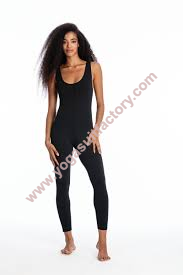
People like to say that a one-piece never needs adjusting because there is no waistband to roll and no hem of a shirt to ride up, and I repeated that line to myself for years without checking it against anything I owned. When I finally spread a pair of Yoga Jumpsuits on the floor and looked at where the cloth was cut, I saw that the claim depends almost entirely on how long the garment runs between shoulder and crotch, and that the outline decides how it behaves long before the fibre content or anything else comes into it.
Flat on the floor, the first thing that struck me was how long and narrow the outline is, a tall tube with two leg openings and a pair of straps that look far too small to carry anything. Hung from a door handle it settles into a gentle S, narrow through the waist and wide through the seat, and the place where the leg panels meet below the hip reads like a quiet fold of cloth. Because the whole thing is a single piece, any error in length shows up everywhere at once, which is why I now hold the garment against myself in a mirror, shoulder to crotch, before I think about colour.
The neckline and back are where the eye lands first. A scoop front looks soft, a square one looks sharp, and a racerback pulls the straps toward the spine so that the shoulder blades are framed instead of covered. I put one on at home and turned my back to the bedroom mirror, and a strap that sat a finger too wide kept slipping off my shoulder whenever I lifted an arm, which no product photo had hinted at. How the edge is finished matters here, because a clean knitted border lies flat against the skin while a loose one curls and shows through a thin shirt.
The sample on my table came from Yongxing, a knitting company in the Yiwu area of Zhejiang whose women's activewear range takes in bodysuits, yoga bras, pants, shorts and shapewear, and what I noticed is that styles with sewn joins and styles knitted without them sit in the same family. I laid a sewn one beside a knitted-through one under a lamp and the sewn one threw a faint stitched line down each side where the light caught the thread, while the other showed a soft, even grain from hip to hem, so the difference is something you can see from across a room.
Size is judged by stretch and by length, not by the number on a tag. Stretch fabric gives a lot, so one garment can look snug on a tall person and baggy on a short one, and the distance between shoulder and crotch decides whether it pulls when you reach overhead or gathers when you sit. I bent forward in front of the mirror and then crouched as if tying a shoe, watching the cloth thin across the knees and the seat, because a shade that looks deep when relaxed can turn pale and almost see-through when pulled wide.
Craftsmanship shows in small places, such as the gusset at the crotch, the edge around each leg opening and the spot where the shoulder bands join the back. A panel can be knitted denser across the seat and looser behind the knee, which reads from outside as a gentle change of texture instead of a visible edge. Where pieces are cut and joined by thread, I look for stitches that run level and joins that lie flat, and when they do not, the cloth puckers where two curves meet.
Colour and finish belong in the same conversation. A dark shade hides the texture and reads as one smooth form, a pale one shows every rib and tells you how even the knitting is, and a marled yarn looks speckled from a distance. Matte surfaces soak up light while glossy ones throw it back in bands, which changes how long the whole garment looks under the harsh lamps of a gym. A print that runs across the waist can also chop the outline into halves, whereas a plain panel keeps the line unbroken.
Any description of Yoga Jumpsuits, mine included, says little about how a particular cut will meet your own frame, and photographs flatten the very details I have been describing. The pictures of bodysuits, bras and shapewear at https://www.yogasuitfactory.com show outlines and surfaces for a range that covers styles with and without sewn joins, though depth does not survive a screen. A longer body keeps the shoulders from pulling when I reach up but leaves slack fabric around the middle when I sit, a shorter one fits close when I am seated and tugs when I stand, and I have not found a proportion that settles both.

 Arabic
 French
 Spanish
 Portuguese
 Deutsch
 Turkish
 Dutch
 Italiano
 Russian
 Romaian
 Portuguese (Brazil)
 Greek