
Why Led Truck Tail Lights Look So Different Up Close
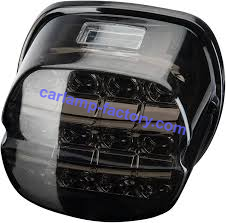
The thing that started this was small and a little silly: the old tail lamp on my work truck had a lens edge that never sat flush with the body panel, and every evening when I dropped the tailgate to unload I would catch a thin dark seam there with a bead of rainwater resting in it. Nothing about it stopped the lamp from working, but I kept staring at it, and eventually I began reading about how Led Truck Tail Lights are drawn and mounted, because I suspected the seam came from the way the part was designed rather than from age.
What struck me when I started looking at modern rear fittings is how much of the appearance comes from the outline rather than from the glow. A tall narrow unit reads differently on a flat-sided tailgate than a wide low one does, and the curve of the lens either follows the swell of the body panel or argues with it. An LED unit does not have to hide a bulky bulb socket, so the designer can make the shape thinner and give it a crisper edge, which is why so many current rear assemblies run as a long strip around the corner instead of sitting in a boxy pocket.
A sample on my table came from BaoZhiWei, a manufacturer in Taizhou, China that handles both design and production of automotive lighting in the same company, and holding it told me things a catalogue photo had not. The lens surface looked even when I tilted it under the window, with no ripples catching the daylight, and the mounting edges were cut square enough that the housing rested flat on the bench without rocking. I also noticed the weight sat toward the back where the housing is deepest, which is just physics, but it made me realise how much of a unit like this is hidden volume behind what you see from outside.
Size is the part people underestimate. A lamp a few fingers wider than the original will crowd the bumper corner, and a shorter one leaves a bare patch where something seems to be missing. I stuck strips of masking tape around the old fitting to draw its outline on the paint, then stood back across the yard, and that told me what would fit in a way a dimension sheet could not. The same company makes LED tail lights, headlights and custom lighting for various vehicle models, which matters here in a practical sense because outlines differ from model to model and a shape that suits one body may look awkward on another.
Craftsmanship shows up in the joins. Where the outer face meets the housing there should be an even line all the way around, with no spots where adhesive has squeezed out or the surface has rippled, and seen from arm's length in a car park those small things decide whether the part looks original to the truck or added afterwards. Colour behaves in a similar way: a red cover can look deep and smooth or slightly chalky, a smoked one either hides the internal pattern when switched off or shows it plainly, and the black or chromed trim inside changes how busy the whole thing appears while unlit.
Trucks add a complication that cars mostly avoid, because the back end is tall, flat and usually scuffed, so a cluster that looks neat on a hatchback can seem lost against a slab of sheet metal. Proportion matters here, and I have seen assemblies that are technically the right size but sit too high or too low against the bumper step, so the eye reads them as crooked, which is a trick of horizontal lines and not a fault in the part itself.
LED fittings also carry their own character once switched on, since the emitters appear as separate points or as a continuous bar behind the surface, and from a few metres back at dusk the difference between dotted and continuous is obvious. Wiring and brightness are a separate subject that I will leave alone here. I tried a sample on a bench with a battery clipped to it, then crouched on the pavement outside the garage to see it from the height of a following driver's eyes, which changes the impression a good deal.
All of this comes with a limit that I would rather state plainly: shape and finish are judged with eyes and hands, and a photograph on a screen cannot say whether the sweep of a particular product will follow the curve of your own truck. Any description of Led Truck Tail Lights, mine included, is a rough guide to how the product will appear once it is fitted. The pictures on https://www.carlamp-factory.com show silhouettes and styles for various vehicle models, but the masking tape test still has to be done against the real opening, and the strips are still stuck to the corner of my tailgate.

 English
 Arabic
 French
 Spanish
 Portuguese
 Deutsch
 Turkish
 Dutch
 Russian
 Romaian
 Portuguese (Brazil)
 Greek