
EPDM Rubber Market Research: Product Types, Fabrication Methods, and End-Use Applications
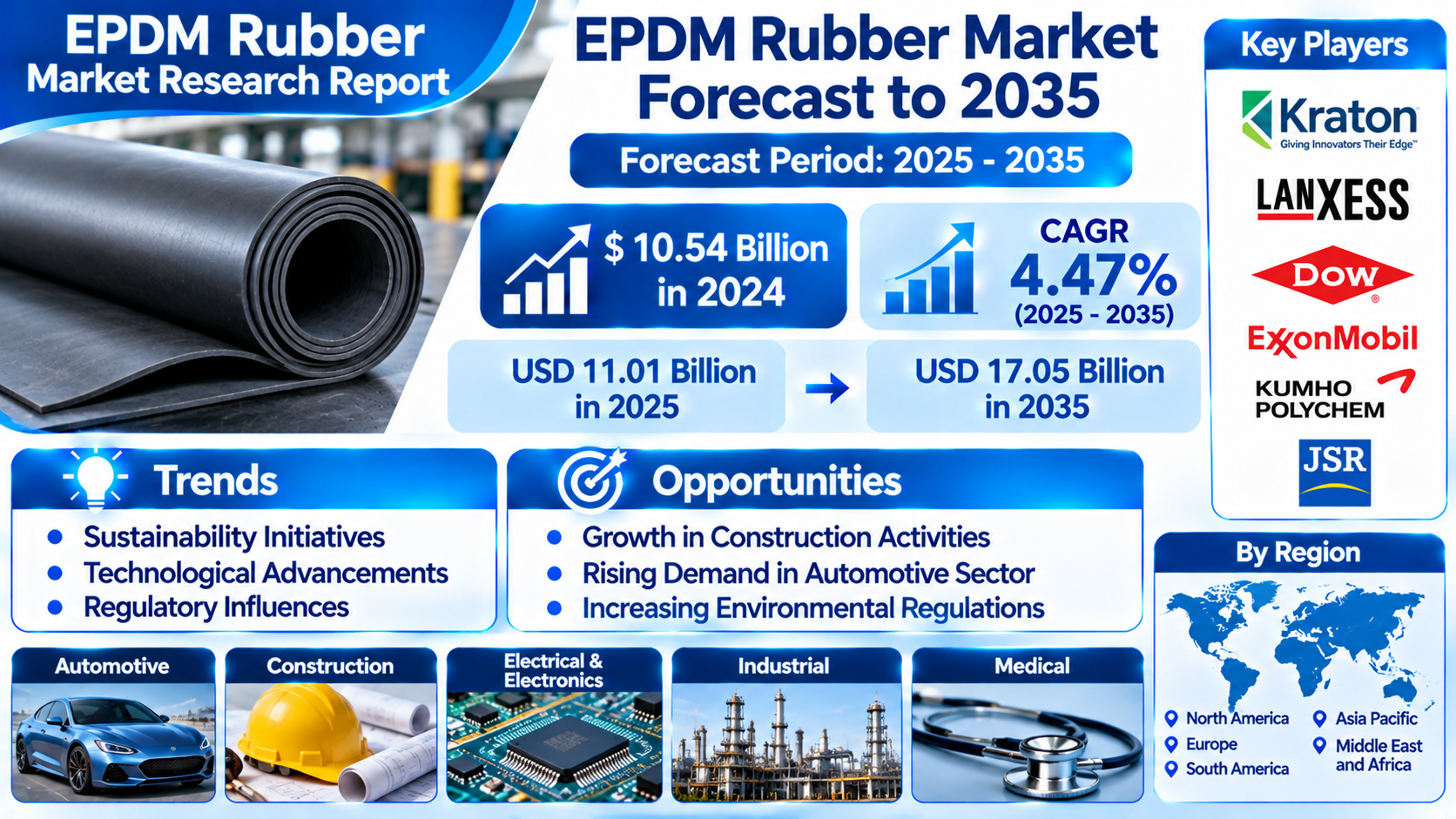
According to Market Research Future® (MRFR), the EPDM Rubber Market is expected to reach USD 17.05 billion by 2035, rising from USD 11.01 billion in 2025. The market recorded a value of USD 10.54 billion in 2024 and is forecast to grow at a CAGR of 4.47% over 2025–2035. Its scope includes automotive, construction, electrical and electronics, industrial, and medical applications, with product offerings spanning solid rubber, compounds, sheets, profiles, and molded products. Sustainability initiatives, technological advancements, and regulatory influences are among the factors shaping the industry's outlook.
A Market Supported by Diverse Industrial Requirements
EPDM rubber has a presence across several end-use industries, giving the market a broad demand base. Automotive and construction are prominent categories in the report's segmentation, while electrical and electronics, industrial, and medical uses add further breadth. This distribution means that market development is influenced by requirements across multiple sectors.
The market's projected rise to USD 17.05 billion by 2035 points to continued demand over the forecast period. The stated 4.47% CAGR for 2025–2035 provides the report's measure of expected expansion. Rather than depending on a single application, the market encompasses several industries with distinct purchasing and product requirements.
The opportunity landscape also reflects this diversity. Growth in construction activities and rising demand in the automotive sector are identified as important areas for expansion. Increasing environmental regulations provide another opportunity, connecting the market's commercial outlook with changes in the wider regulatory environment.
Automotive and Construction as Growth Opportunities
Automotive demand is a key part of the EPDM rubber market's outlook. The automotive category appears in both the application and end-use industry classifications, underlining its relevance to the market's structure. Rising demand in the automotive sector is specifically identified as an opportunity, making this industry an important area for market participants to monitor.
Construction is similarly represented in both segmentation categories. Growth in construction activities is identified as a market opportunity, providing a potential source of demand for EPDM rubber products. The sector's inclusion alongside automotive demonstrates the importance of industrial and infrastructure-related requirements to the market.
The other application categories are electrical and electronics, industrial, and medical. Together, these markets provide additional avenues for suppliers and manufacturers. Their presence broadens the potential customer base and shows that the industry's commercial scope extends beyond its two highlighted opportunity areas.
Product Portfolio and Market Segmentation
EPDM rubber products are classified into five types: Solid EPDM Rubber, EPDM Rubber Compounds, EPDM Rubber Sheets, EPDM Rubber Profiles, and EPDM Rubber Molded Products. These categories provide a structured view of the product formats covered in the report. They also indicate the variety of offerings available to serve different application and end-use requirements.
The product mix is complemented by five fabrication methods: Compression Molding, Injection Molding, Extrusion, Calendering, and Blowing. Each method represents a distinct category within the market's manufacturing landscape. The report's inclusion of these processes highlights the role of fabrication in organizing the industry and supplying different product forms.
The application segmentation includes Automotive, Construction, Electrical and Electronics, Industrial, and Medical. The end-use industry classification contains the same five categories. This alignment provides a consistent framework for examining the industries that use EPDM rubber and the applications through which market demand is assessed.
Manufacturing Developments and Technology Trends
Technological advancements are identified as a major trend in the market. Manufacturing processes are an important part of the industry's structure, particularly given the range of fabrication methods covered in the report. Developments in technology may influence how companies approach production and product offerings, although the supplied data does not identify specific innovations or quantify their effects.
The range of fabrication methods also illustrates why manufacturing capabilities matter to companies serving the market. Compression Molding, Injection Molding, Extrusion, Calendering, and Blowing form part of the available process landscape. Producers must consider their product portfolios and the requirements of the industries they serve when making manufacturing decisions.
Technological progress is therefore relevant to the market's future direction, alongside the demand outlook across automotive, construction, and other end-use sectors. The report identifies this trend but does not provide a separate forecast for technology-related revenue or production capacity.
Sustainability and Environmental Regulation
Sustainability initiatives are shaping the industry's development. Environmental considerations are becoming an important part of the broader industrial materials landscape, and the report identifies sustainability as a key trend for EPDM rubber. This creates a context in which companies may need to assess their practices and product strategies in response to changing expectations.
Increasing environmental regulations are also listed as an opportunity. Regulatory developments can influence the operating environment for manufacturers and other market participants. Companies must account for applicable requirements in the regions where they operate, while keeping track of changes that may affect production and market access.
The report separately identifies regulatory influences as a trend. Taken together, sustainability initiatives and regulatory developments represent connected considerations for the industry. Their importance sits alongside demand from automotive and construction, rather than replacing the market's established industrial applications.
Regional Scope and Competitive Environment
The report covers five regional markets: North America, Europe, South America, Asia Pacific, and the Middle East and Africa. This geographic segmentation provides a broad view of the global EPDM rubber industry. The supplied information does not include regional revenue figures, country-level estimates, or comparative growth rates, so the relative performance of these markets cannot be ranked from the available data.
The competitive landscape includes Kraton Corporation, Lanxess AG, Dow Inc., ExxonMobil Chemical, Kumho Polychem Co. Ltd., and JSR Corporation. These companies are identified as key players in the report. Their presence reflects the participation of established chemical and materials companies in the EPDM rubber market.
Competition is influenced by the breadth of the market's product portfolio and the industries it serves. Manufacturers operate across different product types and fabrication categories while responding to demand from automotive, construction, electrical and electronics, industrial, and medical customers. Sustainability, technology, and regulation also form part of the environment in which these companies compete.
Outlook to 2035
The EPDM rubber market is forecast to grow from USD 11.01 billion in 2025 to USD 17.05 billion in 2035, with a stated CAGR of 4.47% over 2025–2035. Its 2024 market size was USD 10.54 billion. These figures indicate an expanding market supported by demand across several industrial sectors.
Construction activity, automotive-sector demand, and increasing environmental regulations are the three opportunities highlighted in the report. Sustainability initiatives, technological advancements, and regulatory influences are the main identified trends. Together, these factors frame the industry's outlook over the coming decade.
Market participants will continue to operate across a diversified set of applications, product types, fabrication methods, and regions. The ability to address changing requirements in these areas will remain relevant as the industry moves toward its projected 2035 valuation.

 Arabic
 French
 Spanish
 Portuguese
 Deutsch
 Turkish
 Dutch
 Italiano
 Russian
 Romaian
 Portuguese (Brazil)
 Greek