
Coated Abrasives Industry Analysis by Application, End-Use Industry and Region
]
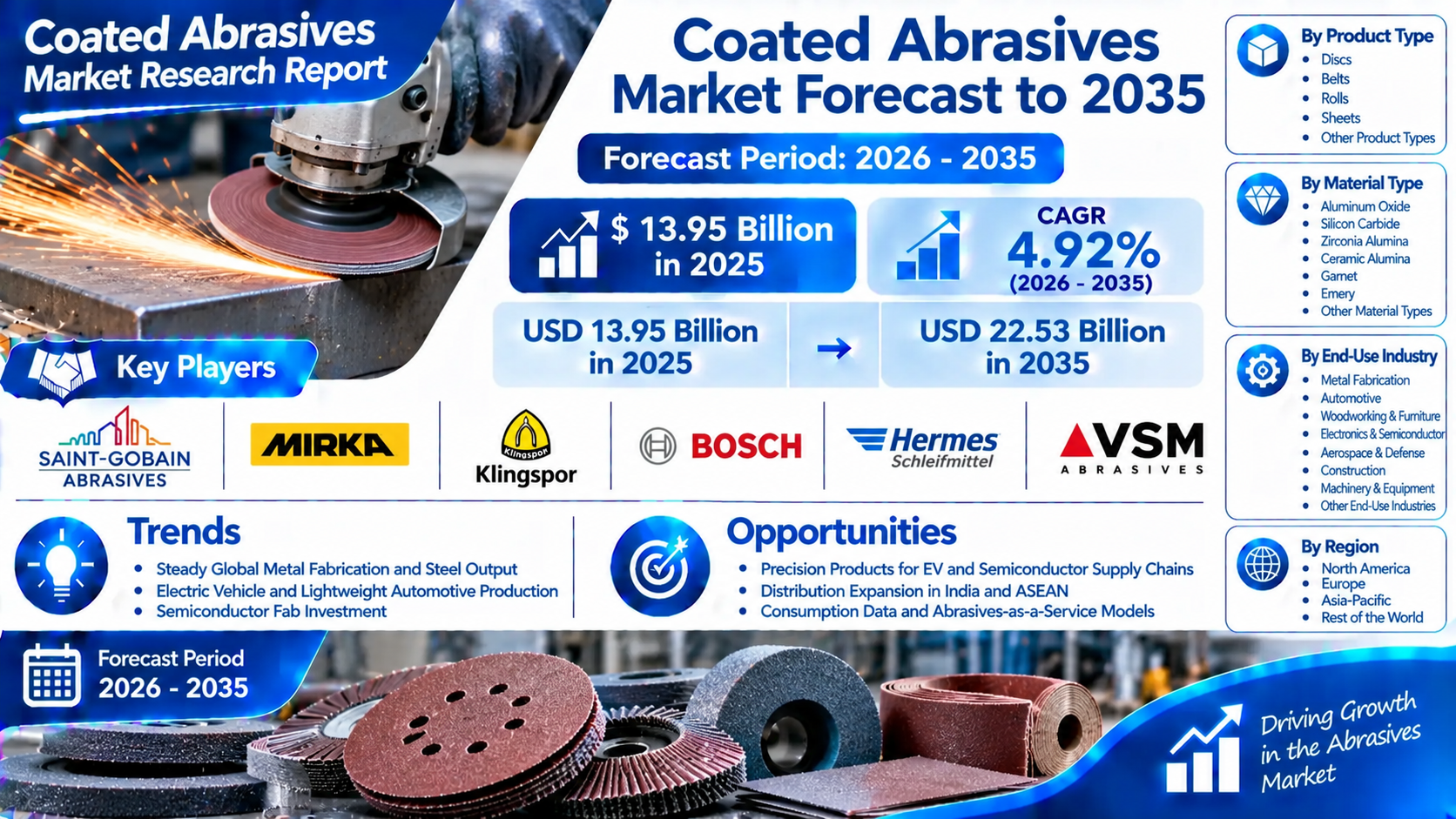
According to Market Research Future® (MRFR), the Coated Abrasives Market is projected to expand from USD 13.95 billion in 2025 to USD 22.53 billion by 2035, registering a compound annual growth rate (CAGR) of 4.92% during the forecast period from 2026 to 2035. Coated abrasives are used across manufacturing and finishing activities in industries such as metal fabrication, automotive, woodworking, electronics and semiconductor, aerospace and defense, construction, and machinery and equipment. Steady metal fabrication and steel output, electric vehicle production, and semiconductor fab investment are among the trends influencing the market's outlook.
Coated Abrasives Market Size and Growth Outlook
Coated abrasives are important industrial products used in surface preparation, finishing, and material processing. Their application across multiple industries creates a broad demand base, connecting the market with manufacturing output and investment in industrial production capacity.
The market was valued at USD 13.95 billion in 2025 and is forecast to reach USD 22.53 billion by 2035. The projected CAGR of 4.92% over 2026–2035 indicates continued expansion throughout the forecast period. Demand is linked to a wide range of industrial activities, including metal fabrication, automotive manufacturing, woodworking, electronics production, aerospace and defense, construction, and machinery manufacturing.
The market's product and material diversity also supports its broad industrial reach. Different applications require different abrasive formats and material types, making segmentation important for understanding the range of products available to end users.
Product Segmentation: Discs, Belts, Rolls and Sheets
By product type, the Coated Abrasives Market includes discs, belts, rolls, sheets, and other product types. These categories represent the principal product formats covered in the report.
Discs and belts are separately identified segments, while rolls and sheets provide additional formats for industrial and other applications. The other product types category accounts for products not individually listed. This range of formats allows the market to serve different processing and finishing requirements across its end-use industries.
Product selection is influenced by the intended application and the type of work being performed. Metal fabrication, automotive production, woodworking, and machinery manufacturing can involve different surface treatment requirements. The variety of product types therefore forms an important part of the market's supply structure.
Material Types and Product Diversity
The market is segmented by material type into aluminum oxide, silicon carbide, zirconia alumina, ceramic alumina, garnet, emery, and other material types. This classification highlights the variety of abrasive materials included in the market.
Aluminum oxide and silicon carbide are among the identified material categories. Zirconia alumina and ceramic alumina provide additional options, while garnet and emery are also included. Other material types complete the segmentation.
The range of materials reflects the different abrasive solutions available to industrial users. Material requirements can vary according to the workpiece, manufacturing process, and desired finishing result. The market's segmentation therefore provides a framework for understanding how suppliers serve diverse applications.
End-Use Industries Supporting Demand
The Coated Abrasives Market serves metal fabrication, automotive, woodworking and furniture, electronics and semiconductor, aerospace and defense, construction, machinery and equipment, and other end-use industries.
Metal fabrication is a major area of market coverage, and steady global metal fabrication and steel output is identified as an important trend. Activity in this sector is closely connected to the need for abrasive products used in manufacturing and finishing operations.
Automotive production is another important end-use area. The growth of electric vehicle production and lightweight automotive manufacturing is creating opportunities for precision abrasive products. These developments connect the market with changes in vehicle manufacturing and material requirements.
Woodworking and furniture, electronics and semiconductor, aerospace and defense, construction, and machinery and equipment further broaden the market's demand base. The inclusion of these sectors demonstrates that coated abrasives serve a wide range of industrial activities rather than a single manufacturing segment.
Key Trends Shaping the Industry
Three trends are particularly relevant to the market's development. The first is steady global metal fabrication and steel output. Manufacturing activity in these areas supports the need for abrasive products used in processing and finishing operations.
The second trend is electric vehicle and lightweight automotive production. As automotive manufacturing evolves, demand for precision products that serve changing production requirements becomes increasingly relevant. This trend also connects with the opportunity to supply abrasive products to EV-related manufacturing and supply chains.
The third trend is semiconductor fab investment. Investment in semiconductor manufacturing facilities creates an additional area of opportunity for suppliers serving electronics and semiconductor applications. The trend highlights the market's connection with advanced manufacturing beyond traditional industrial sectors.
Opportunities in EV and Semiconductor Supply Chains
Precision products for EV and semiconductor supply chains are identified as an important opportunity. Both areas involve specialized manufacturing environments in which product suitability and process requirements are relevant. Suppliers that can address these needs may benefit from demand associated with the development of these industries.
Distribution expansion in India and ASEAN represents another opportunity. Strengthening distribution networks in these markets can improve access to customers and support the supply of coated abrasive products across industrial sectors. This opportunity highlights the importance of regional market development alongside product innovation.
Consumption data and abrasives-as-a-service models provide a further opportunity. The use of consumption data can help companies better understand product usage patterns, while service-based models offer an alternative approach to supplying and managing abrasive products. These developments may create additional customer engagement opportunities for suppliers.
Regional Market Coverage
The report divides the market into North America, Europe, Asia-Pacific, and the Rest of the World. These regions provide the geographical framework for assessing global coated abrasive demand.
Regional market activity is connected to manufacturing output, industrial investment, automotive production, and semiconductor capacity development. The opportunity for distribution expansion in India and ASEAN highlights the importance of Asia-Pacific within the market's broader development landscape. However, the supplied market information does not provide individual regional valuations or growth rates.
Competitive Landscape and Key Players
The key players identified in the Coated Abrasives Market include Saint-Gobain Abrasives, Mirka, Klingspor, Robert Bosch, Hermes Schleifmittel, and VSM AG.
These companies operate in a competitive environment shaped by product formats, abrasive material types, and demand from diverse end-use industries. Manufacturing requirements across metal fabrication, automotive, electronics and semiconductor, and other applications influence the market's product landscape. Precision products and service-based models also represent areas of potential differentiation.
Market Outlook Through 2035
The Coated Abrasives Market is forecast to reach USD 22.53 billion by 2035, growing from USD 13.95 billion in 2025 at a CAGR of 4.92% during 2026–2035. Its outlook is supported by demand across metal fabrication, automotive, woodworking, electronics and semiconductor, aerospace and defense, construction, and machinery and equipment.
Steady metal fabrication and steel output, electric vehicle production, and semiconductor fab investment are important market trends. Meanwhile, precision products for EV and semiconductor supply chains, distribution expansion in India and ASEAN, and consumption data-based service models offer opportunities for industry participants. These developments are expected to shape the market's competitive and commercial landscape through 2035.

 English
 Arabic
 French
 Spanish
 Portuguese
 Deutsch
 Turkish
 Dutch
 Italiano
 Romaian
 Portuguese (Brazil)
 Greek