
India Advanced Materials Forecast to 2035: Government Support and Cross-Sector Collaboration
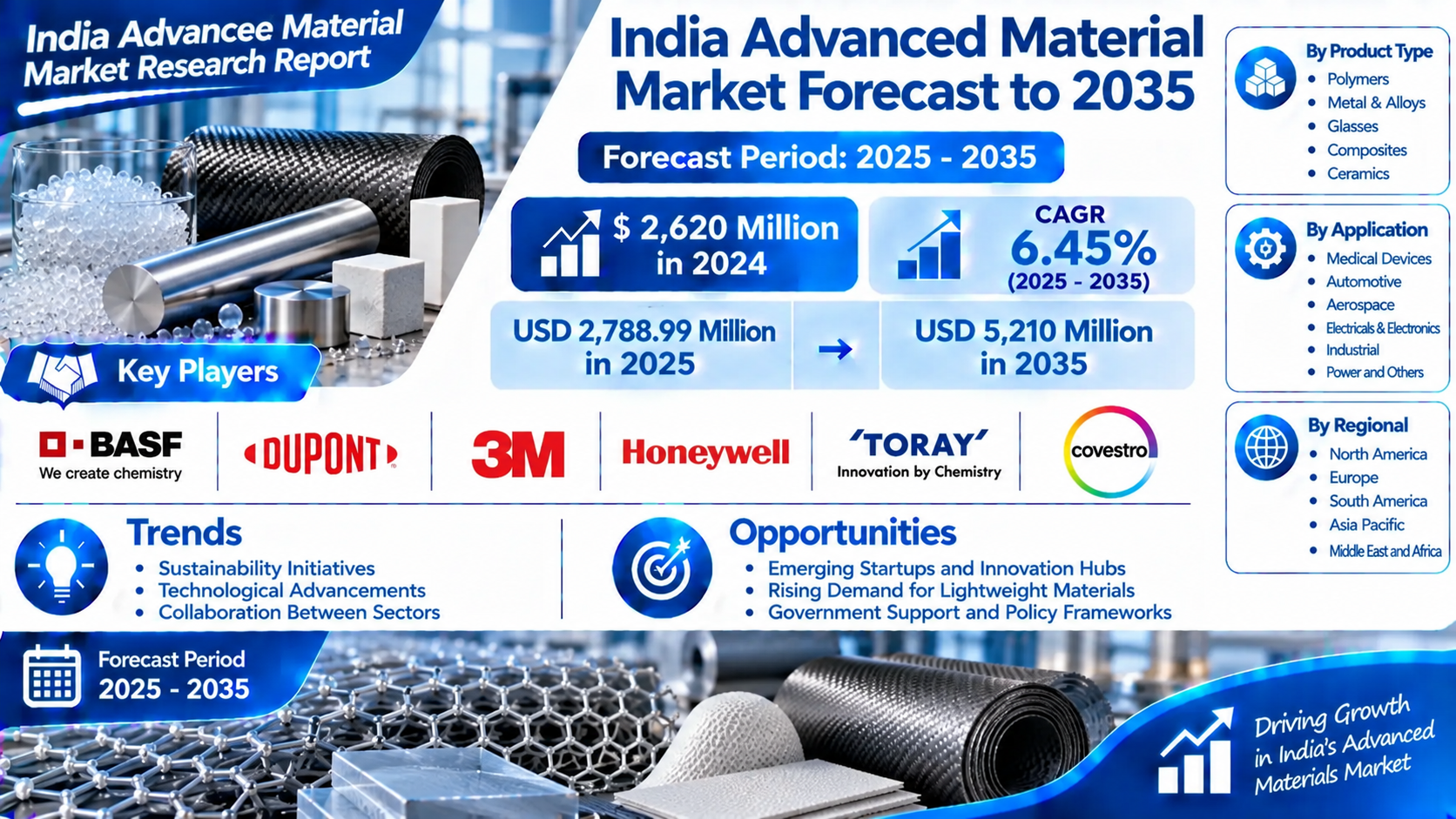
According to Market Research Future® (MRFR), the India Advanced Material Market is expected to increase from USD 2,788.99 million in 2025 to USD 5,210 million by 2035, expanding at a CAGR of 6.45% over the 2025–2035 forecast period. The market recorded a value of USD 2,620 million in 2024. Its growth outlook reflects the expanding role of advanced materials across India's industrial ecosystem, where product requirements span healthcare, transportation, aerospace, electronics, manufacturing, and power. Developments in technology and sustainability, together with collaboration among sectors, are shaping the industry's future direction.
A Market Supported by Diverse Industrial Requirements
Advanced materials are relevant to industries that require a range of material properties and product solutions. India's market includes polymers, metal and alloys, glasses, composites, and ceramics, with applications extending from medical devices to automotive and aerospace. This breadth gives the market exposure to several areas of industrial activity.
The market's financial outlook indicates sustained expansion. Its value stood at USD 2,620 million in 2024 and rose to USD 2,788.99 million in 2025. Over the following decade, it is projected to reach USD 5,210 million by 2035. The expected CAGR of 6.45% reflects the forecast growth rate for the period.
The market's development is not dependent on one application alone. Medical devices, automotive, aerospace, electrical and electronics, industrial, and power applications contribute to the overall demand landscape. These sectors have different material requirements, making the availability of varied product categories an important part of the industry's structure.
Product Types and Their Market Relevance
The report identifies five product groups: polymers, metal and alloys, glasses, composites, and ceramics. Together, they define the product scope of India's advanced material industry.
Polymers and metal and alloys represent two broad categories within this structure. Glasses, composites, and ceramics provide additional material groups that contribute to the market's diversity. The segmentation reflects the range of materials that can be considered across different manufacturing and application environments.
The importance of this product diversity lies in the different requirements that industries must address. A material suitable for one application may not necessarily meet the requirements of another. Manufacturers therefore assess material options according to the needs of their products and operations. The advanced material market provides a broad supply landscape for these varied requirements.
Rising demand for lightweight materials is one of the opportunities identified in the report. This creates a relevant connection between product development and applications such as automotive and aerospace. As industries evaluate material choices, weight considerations may influence the assessment of available solutions. The report identifies this as an opportunity but does not provide separate adoption figures for lightweight materials.
Applications Across Healthcare, Transport and Industry
The application segmentation includes medical devices, automotive, aerospace, electrical and electronics, industrial, power, and others. This broad coverage demonstrates the market's connection to several important industrial sectors.
Medical devices are part of the market's healthcare-related demand base. Automotive and aerospace applications connect advanced materials with transportation and aircraft-related manufacturing. These areas are relevant to the opportunity associated with lightweight materials, as well as the wider trend of technological advancements.
Electrical and electronics applications provide another market area, while industrial uses extend the scope to broader manufacturing activities. Power applications further diversify the demand base. The others category includes applications outside the separately identified segments.
This distribution across sectors can help reduce dependence on a single industry, although actual demand conditions may differ between applications. The report's overall market forecast reflects the combined market rather than specifying individual segment contributions. Consequently, the listed applications should be viewed as the principal areas covered by the market assessment, not as a ranked list of demand sources.
Technology and Sustainability Shape Industry Direction
Technological advancements are an important trend in the market because they influence the development and use of advanced materials. As industrial requirements evolve, material innovation remains relevant to the search for products that can serve changing applications. Progress in technology can also support collaboration among organizations working across related areas.
Sustainability initiatives represent another major theme. Environmental priorities are increasingly part of industrial planning, encouraging businesses to consider material choices and production approaches in a broader context. This trend creates opportunities for advanced material suppliers to respond to changing expectations across end-use industries.
Collaboration between sectors completes the report's list of key trends. Advanced materials are used across several industries, creating opportunities for knowledge sharing and cooperation. Partnerships between different sectors can help connect material development with practical application requirements. This collaborative approach is relevant to an industry whose customer base spans multiple areas of the economy.
Emerging Startups and Innovation Hubs
The emergence of startups and innovation hubs is identified as an opportunity for India's advanced material industry. These participants can contribute to the market through new ideas, research activity, and the development of material-related solutions. Their presence can broaden the innovation environment beyond established industry participants.
Innovation hubs may also support collaboration between businesses and other organizations. This connects directly with the market trend of cross-sector cooperation. As advanced materials serve multiple applications, innovation ecosystems that bring together different areas of expertise can be relevant to the development process.
The opportunity is complemented by government support and policy frameworks. Public policy can shape the conditions for industrial activity and innovation, making government initiatives relevant to the sector's longer-term outlook. The report identifies this support as an opportunity but does not specify particular programs or quantify their expected contribution to market growth.
Competitive Landscape
The report names BASF SE, DuPont de Nemours Inc, 3M Company, Honeywell International Inc, Toray Industries Inc, and Covestro AG as key players in the India Advanced Material Market.
The competitive environment is shaped by the need to serve multiple product categories and application segments. Companies operating in this space must address a market that includes polymers, metals and alloys, glasses, composites, and ceramics, alongside demand from sectors such as medical devices, automotive, aerospace, electronics, industrial operations, and power.
Technological advancements and sustainability initiatives provide important themes for market participants. Collaboration between sectors may also support the development of solutions suited to different application requirements. The report identifies the companies listed above as key players without providing a market-share breakdown or competitive ranking.
Future Outlook for India's Advanced Material Industry
The market is projected to expand from USD 2,788.99 million in 2025 to USD 5,210 million in 2035, with a CAGR of 6.45%. This outlook reflects the broad industrial reach of advanced materials and the range of product categories available to serve different applications.
Demand from medical devices, automotive, aerospace, electrical and electronics, industrial, and power sectors will remain central to the market's overall development. Sustainability initiatives, technological advancements, and collaboration between sectors define the main industry trends, while emerging startups, lightweight material demand, and government support represent notable opportunities. These factors establish a diverse foundation for the India Advanced Material Market through 2035.

 English
 Arabic
 French
 Spanish
 Portuguese
 Deutsch
 Turkish
 Dutch
 Italiano
 Romaian
 Portuguese (Brazil)
 Greek