
India Thermoplastic Composites Industry Forecast: Sustainability and Advanced Manufacturing
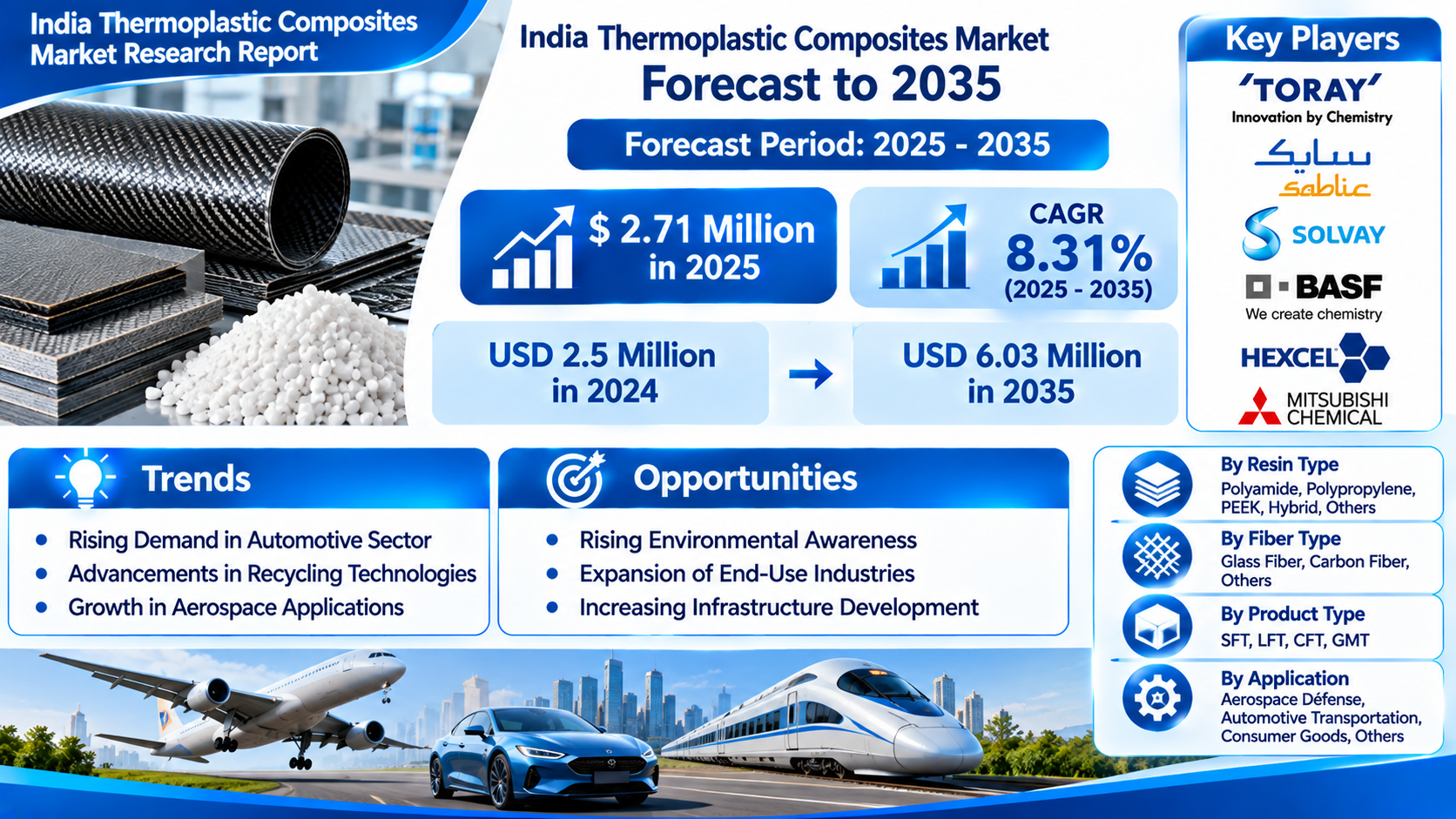
According to Market Research Future® (MRFR), the India Thermoplastic Composites Market is forecast to witness sustained development between 2025 and 2035, reflecting the growing interest in composite materials across automotive, aerospace, transportation, and consumer goods industries. The market is estimated at USD 2.71 million in 2025, following a valuation of USD 2.5 million in 2024, and is projected to reach USD 6.03 million by 2035. The forecast represents a CAGR of 8.31%. Rising automotive demand, recycling technology advancements, aerospace application growth, and expanding end-use industries are identified as important factors shaping market opportunities.
Market Dynamics and Industry Outlook
Thermoplastic composites are gaining attention within the broader advanced materials landscape as manufacturers assess material options for diverse production and application requirements. The Indian market's forecast growth reflects opportunities associated with the development and adoption of composite products across multiple industries.
The market assessment covers different resin materials, reinforcing fiber categories, product types, and applications. This diversified structure provides a basis for understanding how the industry is organized and where material-related opportunities may emerge. The development of applications in transportation, consumer products, and aerospace and defense contributes to the broader outlook for thermoplastic composites in India.
According to the supplied forecast, the market is expected to increase from USD 2.71 million in 2025 to USD 6.03 million in 2035. The 8.31% CAGR projected for this period highlights the anticipated expansion over the forecast horizon. Future market development will be influenced by manufacturing demand, material innovation, industry expansion, and the evolving emphasis on sustainability.
Automotive Sector and Transportation Applications
The automotive sector is identified as a significant trend influencing the market. Rising demand in automotive applications reflects the industry's evolving material requirements and continuing interest in manufacturing technologies and component materials. Automotive manufacturers and suppliers assess materials according to various product, manufacturing, and operational considerations, creating a context for the development of composite solutions.
Thermoplastic composites form part of the material landscape being evaluated across automotive and transportation applications. Their market prospects are linked to the extent of adoption across relevant manufacturing processes and component requirements. Continued developments in the automotive sector may support opportunities for suppliers and composite material manufacturers.
The report includes automotive transportation within its application coverage, but it does not provide specific automotive component categories, individual application valuations, or adoption rates. Accordingly, the market's automotive opportunity is supported by the identified trend rather than by a detailed breakdown of automotive-specific demand.
Aerospace and Defense Market Potential
Growth in aerospace applications is another trend highlighted by the report. Aerospace and defense represent a distinct application category in the India thermoplastic composites market, providing an area for evaluating the development and use of composite materials.
The aerospace sector's material requirements can make material development and manufacturing considerations relevant when evaluating composite applications. Thermoplastic composite solutions may be assessed for different purposes based on product specifications, processing considerations, and application needs. Continued growth in aerospace-related applications is identified as a potential influence on the market's development.
The report does not provide details about specific aerospace component applications, individual defense projects, or the revenue contribution of aerospace and defense to the market. These applications should therefore be considered within the broader industry outlook rather than treated as independently quantified market opportunities.
Recycling Technology and Environmental Awareness
Recycling technology advancements are among the key trends identified for the market. The development of recycling processes can be relevant to composite material lifecycle management and manufacturing considerations. As material producers and end-use industries examine sustainability objectives, recycling-related developments may influence research priorities and material selection.
Increasing environmental awareness is also identified as an opportunity. Greater attention to environmental considerations may encourage businesses to evaluate material efficiency, recycling possibilities, and manufacturing practices. These developments can contribute to interest in thermoplastic composites and related technologies.
The report does not provide specific recycling technologies, commercial recycling capacity, or quantified environmental benefits. The opportunity is therefore grounded in the stated trend toward recycling advancements and rising environmental awareness, rather than in a particular recycling method or performance claim.
Resin Type and Fiber Type Analysis
The resin-type segmentation includes Polyamide, Polypropylene, PEEK, Hybrid, and Others. These categories form part of the market's material structure and help organize the different resin options covered by the report. Resin selection can be an important consideration in composite development, depending on the requirements of the intended application.
Fiber-type segmentation comprises Glass Fiber, Carbon Fiber, and Others. Reinforcing fiber categories provide another dimension for analyzing the market. Material choices across these categories are influenced by application specifications and manufacturing considerations, although the supplied report does not provide comparative performance data or individual segment valuations.
The available information does not establish which resin or fiber type holds the largest market share. Further segment-level data would be required to assess revenue distribution, relative demand, or the growth rate of individual material categories.
Product Types and Application Coverage
The report categorizes products into SFT, LFT, CFT, and GMT. These product categories provide a structured overview of the market's product segmentation and can support analysis of different material-product offerings.
Applications covered include Aerospace Défense, Automotive Transportation, Consumer Goods, and Others. This broad segmentation indicates that the market assessment extends beyond a single industry and considers different areas of potential demand.
Consumer goods form part of the application landscape, while the Others category provides additional coverage beyond the specifically identified applications. However, the supplied information does not identify individual consumer goods products, detailed subcategories, or application-specific market shares.
Infrastructure Development and Industry Expansion
Expansion of end-use industries is identified as a market opportunity. The development of industrial activity and the changing requirements of manufacturers may create additional avenues for composite material adoption. The market's growth potential is therefore associated with the broader expansion of industries using composite products.
Increasing infrastructure development is also listed as an opportunity. Infrastructure-related activity may contribute to a wider environment of material demand and industrial investment. However, the report does not identify specific infrastructure applications for thermoplastic composites or quantify the contribution of infrastructure projects to market revenue.
Rising environmental awareness, expanding end-use industries, and infrastructure development collectively provide a context for assessing the market's opportunities through 2035. Their commercial significance will depend on adoption patterns and the requirements of individual industries.
Competitive Landscape and Forecast
The companies profiled in the report are Toray Industries, SABIC, Solvay, BASF, Hexcel Corporation, and Mitsubishi Chemical. These companies represent the competitive coverage included in the supplied market report. Individual market shares, company-specific revenue contributions, and rankings are not provided.
The India thermoplastic composites market is forecast to grow at a CAGR of 8.31% from 2025 to 2035, reaching USD 6.03 million by the end of the forecast period. Automotive demand, aerospace applications, recycling advancements, environmental awareness, and end-use industry expansion are among the identified influences on market development.
The industry's future direction will depend on the adoption of composite materials across applications, continued development of manufacturing and recycling technologies, and evolving requirements across India's industrial sectors. The forecast indicates an expanding market, while the listed trends and opportunities provide a framework for evaluating its longer-term prospects.

 English
 Arabic
 French
 Spanish
 Portuguese
 Deutsch
 Turkish
 Dutch
 Italiano
 Romaian
 Portuguese (Brazil)
 Greek