
Biopharmaceutical Boom Drives Expansion in the Cleanroom Technologies Market
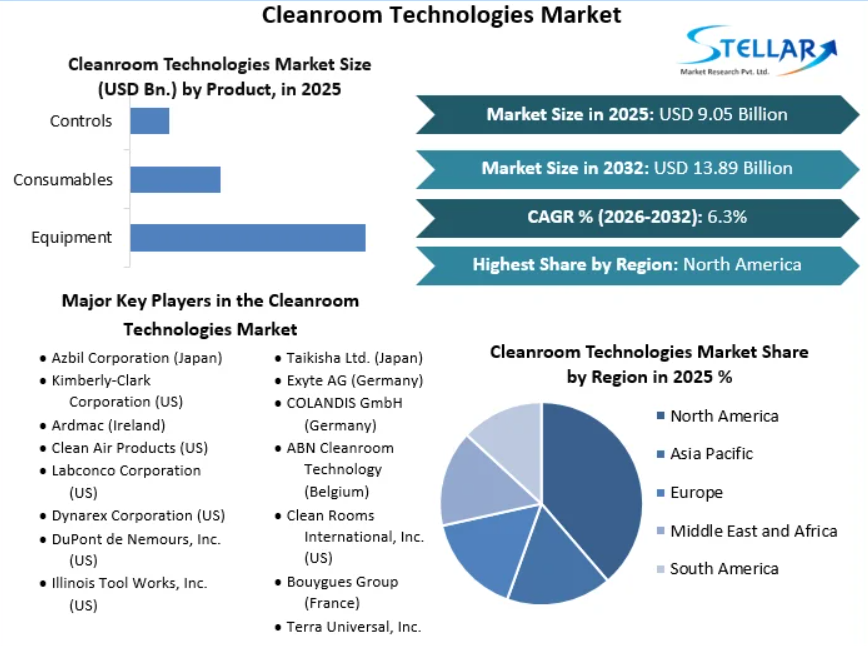
The global Cleanroom Technologies Market is experiencing unprecedented structural expansion, according to a comprehensive intelligence report released by Stellar Market Research. Valued at USD 8.6 billion in 2026, the market is poised to scale up to USD 14.6 billion by 2033, registering a robust compound annual growth rate (CAGR) of 7.8%. This market is strategically critical as strict particle control, regulatory compliance, and sterility standards become mandatory foundations for advanced life sciences, biotechnology, and semiconductor fabrication facilities worldwide.
Modern manufacturing ecosystems face an inflection point where microscopic impurities can trigger catastrophic yield losses or biological batch failures. The cleanroom technologies market has transcended basic structural containment, evolving into an integrated digital environment powered by real-time particle monitoring, modular engineering, and high-efficiency particulate air (HEPA/ULPA) innovations. As biologics, gene therapies, microelectronics, and nanotechnology miniaturize, the demand for ultra-clean production environments has surged. Stakeholders are no longer just buying physical panels and HVAC hardware; they are investing in turnkey, scalable, and energy-efficient contamination control systems that guarantee regulatory adherence across sensitive production pipelines.
For further information, click the following link:https://www.stellarmr.com/report/req_sample/Cleanroom-Technologies-Market/300
Key Findings from the Report
-
Market Valuation: The global cleanroom technologies market stands at USD 8.6 billion in 2026, advancing toward a projected USD 14.6 billion by 2033.
-
Growth Momentum: Driven by rising production complexities, the market is expanding at a steady 7.8% CAGR over the forecast period (2026–2033).
-
Dominant Product & Service Segment: Equipment and professional services command the largest revenue share, with professional design, engineering, and certification services capturing over 65% of specialized service allocations.
-
Construction Type Dominance: Hardwall cleanrooms lead the structural landscape, accounting for a dominant 45.6% revenue share due to their superior durability and pressure containment.
-
Leading End-Use Vertical: The healthcare and biotechnology vertical remains the primary revenue contributor, fueled by scale-ups in monoclonal antibody production, vaccines, and sterile drug formulations.
-
Geographic Leadership: North America captured a leading 39.4% revenue share, anchored by dense biopharmaceutical infrastructure and rigorous FDA compliance guidelines.
-
Fastest-Growing Region: Asia Pacific emerges as the highest-growth region, propelled by surging semiconductor foundries and contract manufacturing hubs in South Korea, Taiwan, Japan, and India.
Market Drivers and Restraints
Drivers
-
Exponential Growth in Biopharmaceutical Manufacturing: The commercialization of complex biologics, cell and gene therapies, and recombinant vaccines requires ultra-clean environments to eliminate microbial and particulate cross-contamination risks.
-
Miniaturization and Advancement in Semiconductors: Sub-nanometer semiconductor fabrication demands ultra-pure, particle-free environments to protect sensitive silicon wafers from microscopic defects.
-
Stricter Regulatory Frameworks: Global regulatory bodies (such as the US FDA, EMA, and ISO) are enforcing stringent validation protocols for aseptic processing, compelling facilities to upgrade HVAC, air filtration, and continuous monitoring systems.
Restraints
-
High Initial Capital Expenditure (CapEx): Designing, engineering, and validating modular or hardwall cleanrooms involve substantial upfront investments in specialized HVAC architecture and barrier isolation technology.
-
Complex Operational and Maintenance Costs: Energy-intensive air change rates, continuous filtration replacement cycles, and strict certification procedures create persistent operational expenditures for facility managers.
Technology, Regulation, and Sustainability Trends
The cleanroom technology landscape is undergoing a profound digital and environmental transformation. The integration of IoT-enabled environmental monitoring sensors allows operators to track airborne particulate levels, differential pressure, and humidity in real time, minimizing human intervention and contamination risks. On the regulatory front, compliance with ISO 14644 standards continues to dictate facility designs, pushing engineering firms toward automated validation workflows. Simultaneously, sustainability has emerged as a core operational focus. Next-generation cleanroom deployments incorporate energy-efficient Fan Filter Units (FFUs), variable air volume (VAV) controls, and LED lighting systems to dramatically curb the notoriously high energy consumption associated with continuous cleanroom air handling.
Regional Insights
-
North America: Leading the global market with a 39.4% share, North America's dominance is underpinned by advanced healthcare infrastructure, substantial venture investments in biotechnology, and rigorous federal compliance standards.
-
Asia Pacific: Positioned as the fastest-growing regional market, Asia Pacific is witnessing rapid infrastructural investments. Government-backed semiconductor manufacturing incentives in India, alongside expanding biopharmaceutical contract development and manufacturing organizations (CDMOs) in China, South Korea, and Japan, are driving unprecedented demand for modular and prefabricated cleanrooms.
Recent Industry Developments
-
Azbil Corporation (2025): Expanded its advanced cleanroom equipment and automation product line, specifically targeted at upgrading pharmaceutical manufacturing compliance across key facilities in Japan and the UK.
-
Kimberly-Clark Corporation (2025): Introduced a specialized line of cleanroom safety and cleaning consumables optimized for European biotechnology research and sterile packaging environments.
-
Exyte Group (2025): Completed a major modular cleanroom engineering expansion project for a leading biopharmaceutical client in North America, reducing cleanroom deployment timelines by 25%.
-
AAF International (2026): Launched an ultra-low penetration air (ULPA) filtration unit integrated with smart IoT diagnostics, achieving a 30% reduction in energy consumption for high-volume semiconductor cleanrooms.
-
Clean Air Products (2025): Finalized a strategic acquisition of a specialized air shower and pass-through manufacturer to bolster its turnkey cleanroom infrastructure portfolio across North American healthcare markets.
Competitive Landscape
The global cleanroom technologies market features a highly consolidated yet competitive landscape characterized by strategic acquisitions, geographical expansions, and technological differentiation. Key market players—including Azbil Corporation, Kimberly-Clark Corporation, Exyte Group, AAF International, Illinois Tool Works (ITW), and Clean Air Products—are actively focusing on modular construction innovations and turnkey service contracts. Leading players are increasingly emphasizing custom engineering solutions, combining energy-efficient HVAC equipment with automated environmental monitoring software to secure long-term contracts with multinational pharmaceutical and semiconductor corporations.
Analyst Commentary
"Modern cleanroom technologies are no longer viewed merely as passive containment structures; they are active, data-driven operational assets critical to the success of advanced therapeutics and sub-micron electronics. As biomanufacturing yields and semiconductor nodes become increasingly sensitive, facility operators must prioritize modular agility, real-time monitoring, and energy-optimized HVAC architectures to maintain compliance and cost-efficiency through 2033."
— Senior Research Analyst, Stellar Market Research
Future Outlook
Through the forecast period, the cleanroom technologies market will experience accelerated convergence between digital automation and sustainable design. Demand will increasingly pivot toward modular and prefabricated cleanroom systems that offer rapid scalability, enabling manufacturers to pivot production lines with minimal downtime. As environmental regulations tighten and technological complexity deepens, investments will flow heavily into smart monitoring systems, energy-saving laminar airflow solutions, and advanced containment barriers, ensuring steady and lucrative market expansion through 2033.
For further information, click the following link:https://www.stellarmr.com/report/req_sample/Cleanroom-Technologies-Market/300
About Stellar Market Research
Stellar Market Research is a multifaceted market research and consulting company with professionals from several industries. Some of the industries we cover include medical devices, pharmaceutical manufacturers, science and engineering, electronic components, industrial equipment, technology and communication, cars and automobiles, chemical products and substances, general merchandise, beverages, personal care, and automated systems. To mention a few, we provide market-verified industry estimations, technical trend analysis, crucial market research, strategic advice, competition analysis, production and demand analysis, and client impact studies.
Address
Phase 3, Navale IT Zone, S.No. 51/2A/2, Office No. 202, 2nd floor, Near, Navale Brg, Narhe, Pune, Maharashtra 411041
Email
[email protected]
Mobile
+91 9607365656

 English
 Arabic
 French
 Spanish
 Portuguese
 Deutsch
 Turkish
 Dutch
 Russian
 Romaian
 Portuguese (Brazil)
 Greek