
India Glass Market Forecast 2025–2035: Key Players and Growth Prospects
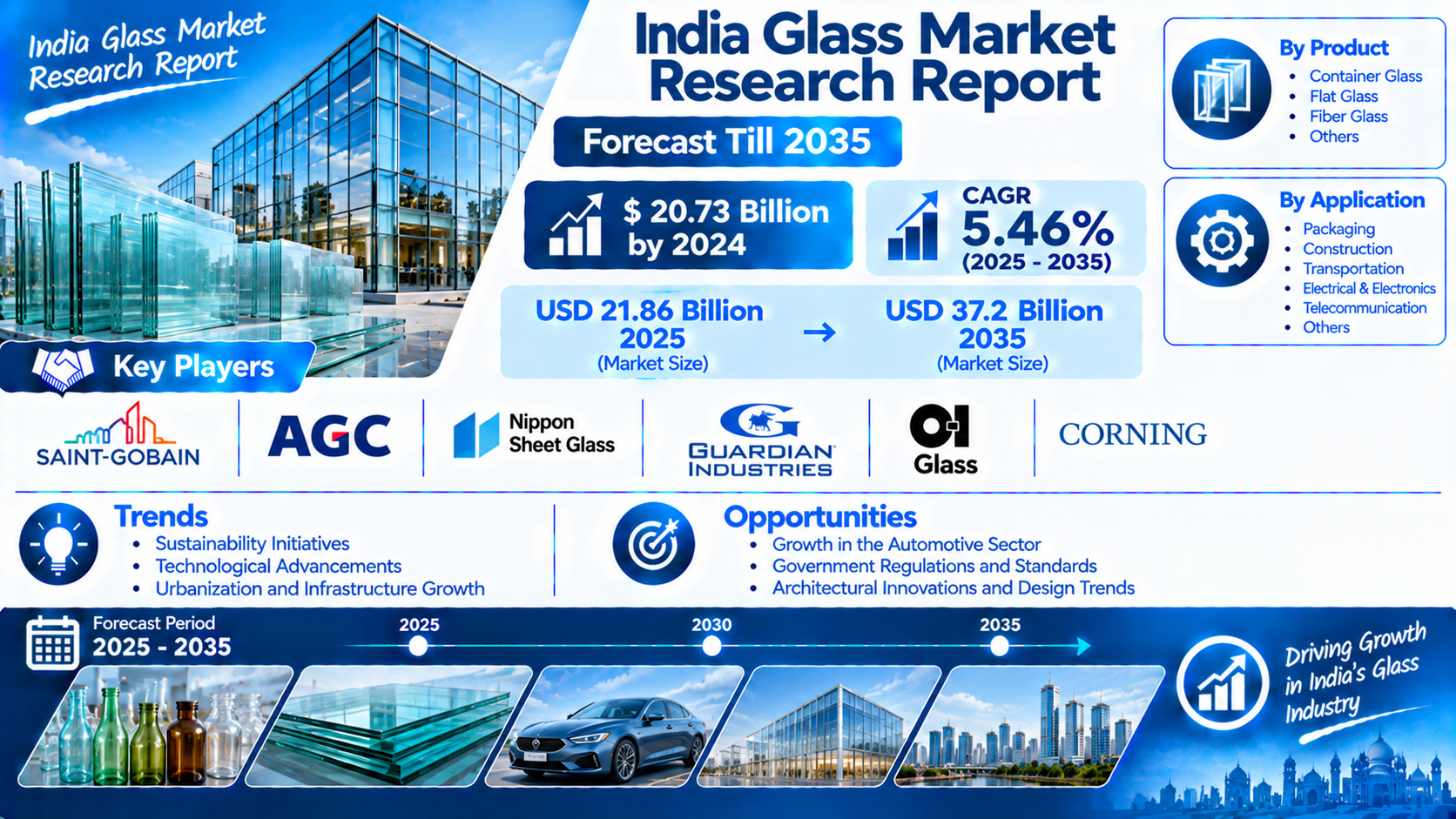
India's glass industry is positioned for continued expansion as demand develops across buildings, packaging, vehicles and technology-oriented applications. According to Market Research Future® (MRFR), the India Glass Market is estimated at USD 21.86 Billion in 2025, following a valuation of USD 20.73 Billion in 2024. The market is expected to reach USD 37.2 Billion by 2035, advancing at a CAGR of 5.46% over the 2025–2035 forecast period. Its outlook reflects the breadth of glass consumption across established industrial sectors and the growing importance of product performance, manufacturing technology and design.
A Market Defined by Product Diversity
Glass is used in applications that require a combination of transparency, durability, surface quality, insulation or reinforcement. The India market is categorized by product into container glass, flat glass, fiber glass and others. This structure reflects the different functions glass performs in consumer packaging, infrastructure, mobility and industrial production.
Container glass serves packaging requirements, particularly for products supplied in bottles, jars and other rigid formats. Its material properties and established recycling potential make it relevant to businesses evaluating packaging performance and presentation. Flat glass, meanwhile, is closely connected to construction and transportation. It can be processed into products designed for architectural glazing and vehicle applications, where dimensions, strength, visibility and safety are important.
Fiber glass occupies a different position within the product mix. Its reinforcement characteristics support uses in applications where a combination of strength and weight is required. The others category captures additional products that serve specialized or varied requirements. Together, these categories give manufacturers exposure to a broad customer base rather than dependence on one end-use industry.
Application Demand Across the Indian Economy
The application segmentation includes packaging, construction, transportation, electrical and electronics, telecommunication and others. Packaging and construction are important sources of demand because glass is used in both everyday consumer products and long-life infrastructure components.
In packaging, manufacturers and brand owners consider protection, appearance, product compatibility and supply-chain requirements when choosing materials. Glass can provide a rigid and transparent format and can be recycled through suitable collection and processing systems. Its weight and handling requirements, however, remain relevant considerations when businesses compare packaging options. This means demand is shaped by both product attributes and the economics of distribution.
Construction creates a separate set of requirements. Glass is incorporated into windows, façades, doors, partitions and other building elements. Architects and developers may specify products based on natural-light requirements, thermal performance, acoustic properties, safety and appearance. As building designs evolve, demand can extend beyond standard glazing toward products that meet more specific performance or aesthetic expectations.
Transportation applications include glass used in vehicle windows and windshields. These components must meet requirements for visibility and occupant safety, making product consistency and quality control essential. Automotive sector growth is identified as an opportunity for the market, as vehicle manufacturing and design developments can influence the volume and specifications of glass required.
Electrical and electronics and telecommunication applications broaden the market's industrial reach. These sectors may use specialized glass products where optical, insulating or other technical characteristics matter. The requirements differ from those of conventional packaging or building glass, creating scope for manufacturers with appropriate processing and product-development capabilities.
Urban Development and Infrastructure as Demand Drivers
Urbanization and infrastructure growth are important trends shaping the market. Expanding cities require residential and commercial buildings, transport facilities and public infrastructure. Glass is used across these settings, although the type and quantity depend on project design, construction standards and material selection.
Architectural innovation is reinforcing the importance of glass in building design. Modern projects may use glazing to create particular exterior appearances, improve daylight access or meet specified building-performance requirements. These design priorities can encourage product differentiation and create opportunities for suppliers capable of delivering glass with controlled dimensions and technical characteristics.
The relationship between construction activity and glass demand is not automatic. Project financing, completion schedules, material prices and the specifications adopted by developers all affect purchasing decisions. Nevertheless, the combination of urban development and architectural innovation provides a meaningful demand base for the industry over the forecast period.
Sustainability and Technology Reshape Production
Sustainability initiatives are influencing both customer expectations and manufacturing priorities. Glass can be recycled, but the practical benefits depend on effective collection, sorting and processing. Recycled material can serve as an input in production when it meets the quality requirements of the manufacturing process. Improvements in recycling systems can therefore support resource efficiency and reduce the volume of material sent for disposal.
Manufacturers must also consider the energy intensity of glass production. Furnace performance, process efficiency, raw material use and logistics contribute to the industry's overall environmental footprint. Sustainability strategies may consequently involve equipment improvements, better process management and increased use of recovered glass where technically and economically feasible.
Technological advancements are another defining trend. Automation and improved process monitoring can help producers manage quality, maintain consistent output and improve operational control. Product innovation is also important because customers across construction, transportation and technical industries may require different combinations of strength, optical performance, thickness and durability. The ability to meet these specifications can influence supplier selection and long-term customer relationships.
Regulation and Industry Opportunities
Government regulations and standards influence the conditions under which glass products are manufactured and used. Requirements related to safety, product quality, building applications and environmental performance can affect material specifications and production practices. Compliance may involve testing, certification and investment in manufacturing systems. For producers, regulatory readiness is therefore both an operating responsibility and a factor in maintaining access to key customer segments.
The automotive sector presents a specific opportunity as manufacturers seek glass products that satisfy vehicle design and safety requirements. Suppliers may benefit from demand for reliable glazing solutions, provided they can meet the technical and commercial expectations of vehicle manufacturers and component suppliers. Changes in vehicle production volumes and sourcing strategies will remain relevant to this opportunity.
Architectural innovations and design trends offer another route for product differentiation. Demand for specialized glazing can encourage investment in processing capabilities and collaboration with architects, developers and construction companies. Manufacturers that understand project specifications and can deliver consistent products may be able to strengthen their position in this segment.
Major Companies and Competitive Positioning
The competitive landscape includes Saint-Gobain, AGC Inc., Nippon Sheet Glass, Guardian Industries, O-I Glass Inc. and Corning Inc. These companies are associated with different areas of the broader glass industry, including building products, container glass and specialized glass applications. Their presence highlights the importance of product portfolios and manufacturing capabilities in serving a diverse market.
Competition is influenced by more than production volume. Quality assurance, technical expertise, product development, customer relationships, delivery reliability and cost management can all affect a company's ability to win business. Producers must also respond to changing energy costs, regulatory requirements and customer expectations around sustainability.
Outlook Through 2035
The India glass market is forecast to grow from USD 21.86 Billion in 2025 to USD 37.2 Billion in 2035, at a CAGR of 5.46%. Demand across packaging, construction, transportation, electrical and electronics, and telecommunication applications provides a diversified foundation for this outlook. Sustainability initiatives and manufacturing technology are likely to remain important industry considerations, while automotive growth, government standards and architectural innovation offer additional opportunities.
As the market develops, manufacturers will need to align product capabilities with application-specific requirements. Investment in process efficiency, quality control, recycling systems and specialized products can help companies respond to a market in which both conventional glass demand and technical applications contribute to growth.

 English
 Arabic
 French
 Spanish
 Deutsch
 Turkish
 Dutch
 Italiano
 Russian
 Romaian
 Portuguese (Brazil)
 Greek