
Polypropylene Market Research: Applications, End Users and Regional Prospects
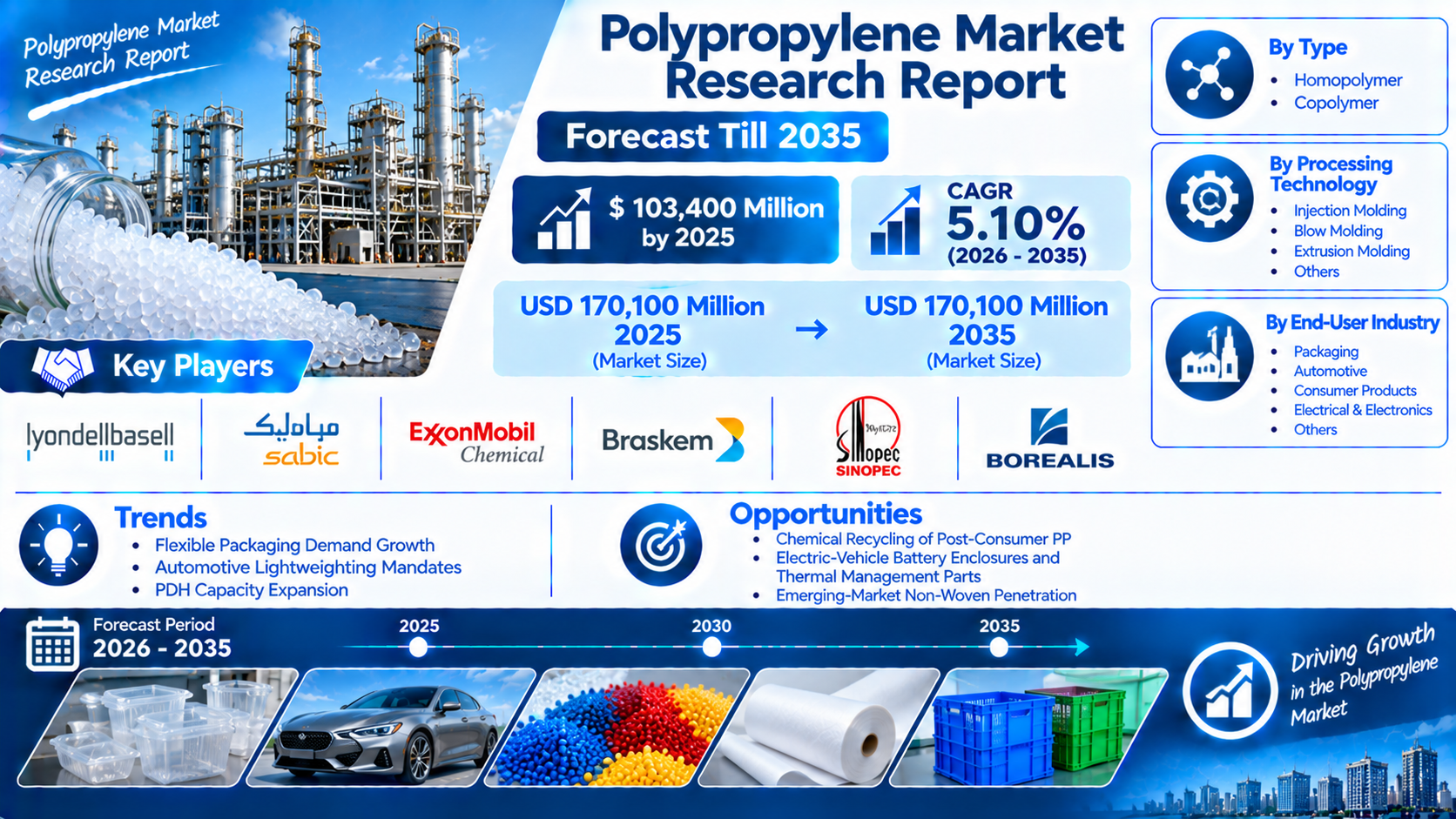
According to Market Research Future® (MRFR), the Polypropylene Market is expected to expand at a CAGR of 5.10% over 2026–2035, reaching USD 170,100 million by the end of the forecast period from a 2025 valuation of USD 103,400 million. Polypropylene's versatility across packaging, automotive, consumer products and electrical and electronics manufacturing supports its position as an important industrial polymer. Demand for flexible packaging, efforts to reduce vehicle weight and investments in propylene dehydrogenation capacity are influencing market development. At the same time, recycling technologies and new electric-vehicle applications are creating opportunities for product innovation.
Polypropylene's Role in Industrial Manufacturing
Polypropylene is a widely used thermoplastic polymer valued for its low density, chemical resistance and ability to be processed into a variety of product forms. Its applications range from flexible packaging and molded household goods to automotive components, fibers and industrial parts. Manufacturers can select from different grades and processing methods to meet specific product requirements.
The market's type segmentation includes homopolymer and copolymer polypropylene. Homopolymer grades are commonly used where stiffness and strength are important. They can be found in rigid packaging, consumer products and molded industrial components. Copolymer grades are modified to provide different performance characteristics, including improved impact resistance and greater suitability for certain demanding operating conditions.
Grade selection is determined by the finished product's requirements. Factors such as stiffness, toughness, temperature performance, chemical exposure and processing behaviour influence purchasing decisions. Producers that can supply consistent resin grades and support downstream manufacturers with technical specifications can address a broad range of customer needs.
Processing Technologies and Product Design
The report identifies injection molding, blow molding, extrusion molding and other technologies as the principal processing categories. Injection molding is suited to high-volume production of components with defined shapes and dimensions. It is used across automotive manufacturing, consumer goods and packaging, where repeatability and efficient production are important.
Blow molding supports the production of hollow products, including selected containers and packaging formats. Product design, wall thickness and resin properties influence the choice of polypropylene grade. Extrusion molding enables continuous production of films, sheets, profiles and other products. It is particularly relevant to packaging and industrial applications in which consistent dimensions and material properties are required.
Processing technology affects more than the shape of the final product. Equipment settings, material flow, cooling and production conditions influence quality and manufacturing efficiency. Investment in modern processing systems and improved resin formulations can help converters meet changing customer specifications and manage production costs.
Packaging Demand and Market Development
Packaging is a major end-user industry for polypropylene. Flexible packaging demand growth is a key trend identified in the report, reflecting the use of PP films and related materials in consumer and industrial packaging. The polymer can provide useful combinations of light weight, moisture resistance and processability, making it suitable for selected bags, wraps, labels and packaging structures.
Demand is influenced by packaged food, personal care, household products and other consumer goods. Packaging manufacturers must consider the intended contents, product protection, sealing performance and applicable safety requirements. The selection of polypropylene depends on the packaging format and the performance needed throughout distribution and use.
Rigid packaging also contributes to demand through containers and molded products. Homopolymer and copolymer grades can serve different functions depending on impact resistance, stiffness and design requirements. Innovation in packaging structures and processing methods may influence the type and quantity of polypropylene used by converters.
Automotive Lightweighting and EV Applications
The automotive industry is another important end-user segment. Manufacturers are evaluating materials that can help reduce vehicle weight while maintaining safety, durability and performance. Polypropylene is used in selected interior and exterior components, including trims, panels and other molded parts. Its low density and processing flexibility can make it suitable for applications where the required engineering properties can be achieved.
Electric vehicles offer additional opportunities for specialized polypropylene applications. The report highlights battery enclosures and thermal management parts as emerging areas. These uses require materials that satisfy demanding mechanical, thermal and electrical requirements. Product formulations must be tested and qualified for the specific component and operating environment; general-purpose polypropylene should not be assumed to meet every EV application requirement.
The broader automotive transition also encourages suppliers to develop materials that support new component designs and manufacturing processes. Collaboration between polymer producers, compounders and automotive suppliers can help identify grades suited to evolving vehicle platforms.
Propylene Supply and PDH Capacity Expansion
PDH capacity expansion is a significant market trend because propylene is the principal feedstock for polypropylene production. Propane dehydrogenation converts propane into propylene, and investment in this technology can influence the availability of feedstock for polymer manufacturers.
The economics of PDH facilities depend on propane prices, energy consumption, operating efficiency and propylene market conditions. New capacity may change regional supply balances and influence competition among producers. Polypropylene manufacturers also evaluate logistics, plant utilization and downstream demand when making investment decisions.
Feedstock price movements remain an important factor in production economics. Changes in propylene costs can affect margins and may influence pricing throughout the value chain. Integrated producers may manage some supply risks differently from companies that rely more heavily on external feedstock purchases.
Recycling and Non-Woven Applications
Chemical recycling of post-consumer PP is identified as an opportunity for the market. Polypropylene waste can enter recycling streams from packaging, household products and industrial uses. However, collection and processing can be complicated by contamination, mixed polymers, additives and product design. Chemical recycling may offer routes for converting suitable waste into feedstock, but its commercial viability depends on process performance, energy use, economics and regulatory acceptance.
Mechanical recycling provides another route for recovering polypropylene. Reprocessed material can be used in applications where its quality and performance meet the required specifications. Improving collection systems, sorting and material traceability can support wider recycling activity.
Emerging-market non-woven penetration is another opportunity. Polypropylene fibers are used in non-woven products serving hygiene, healthcare, filtration and industrial markets. Growth depends on local manufacturing capacity, consumer demand and the availability of suitable converting technologies.
Competitive Landscape and Industry Outlook
The key players identified by MRFR are LyondellBasell Industries, SABIC, ExxonMobil Chemical, Braskem, Sinopec and Borealis. Their competitive position is influenced by production scale, feedstock access, operational efficiency, product portfolios and customer relationships. Research into specialized grades and recycling technologies may also shape future competition.
The market is projected to rise from USD 103,400 million in 2025 to USD 170,100 million in 2035, reflecting a CAGR of 5.10% during 2026–2035. Flexible packaging demand, automotive lightweighting and PDH capacity expansion are central trends, while chemical recycling, EV battery-related components and non-woven products offer opportunities. Market development will depend on industrial demand, feedstock economics, investment in production capacity and the ability to meet evolving performance and sustainability expectations.

 English
 Arabic
 French
 Spanish
 Deutsch
 Turkish
 Dutch
 Italiano
 Russian
 Romaian
 Portuguese (Brazil)
 Greek