
Flame Detectors Market: Emerging Trends and Future Growth Opportunities
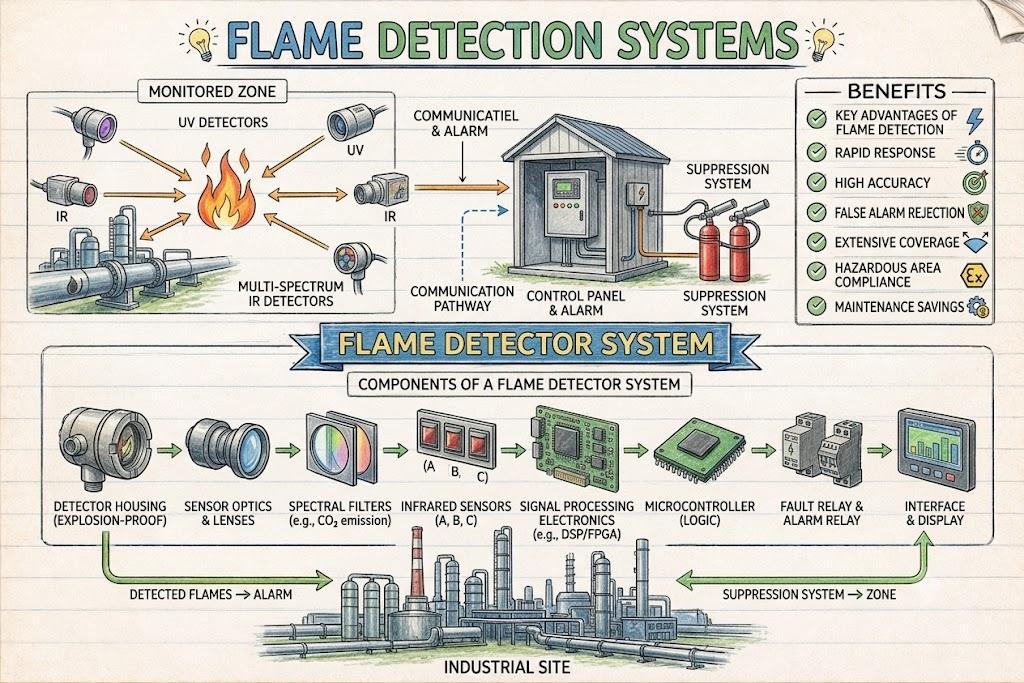
Industrial safety paradigms across hazardous environments depend heavily on advanced optical sensing equipment engineered to identify immediate fire threats. A comprehensive Flame Detectors Market analysis reveals a fundamental transition from single-spectrum detection devices toward multi-spectrum optical sensors capable of distinguishing real fire signatures from false environmental alarms. High-risk operational settings—including offshore oil platforms, chemical processing facilities, power generation plants, and aerospace facilities—require instantaneous flame verification to trigger automated fire suppression systems and emergency isolation protocols. By leveraging multi-spectrum ultraviolet, infrared, and combined UV/IR sensing technologies, modern flame detection platforms continuously analyze light emission patterns, flicker frequencies, and spectral intensities. This continuous monitoring ensures that hazardous hydrocarbon fires, hydrogen ignitions, and metallic combustion events are caught within milliseconds, preventing catastrophic structural damage, loss of life, and environmental contamination.
As industrial automation scales globally and regulatory bodies enforce stringent occupational safety directives, commercial facilities are modernizing their facility protection architectures. According to the Flame Detectors Market forecast, multi-year market projections point toward steady expansion driven by massive capital investments in energy infrastructure, green hydrogen production hubs, and automated manufacturing facilities. Plant engineers are increasingly integrating smart flame detectors equipped with digital communication protocols—such as HART, Modbus, and Ethernet/IP—directly into centralized Safety Instrumented Systems (SIS) and distributed control networks. This seamless integration allows safety managers to perform real-time diagnostics, remote sensitivity adjustments, and predictive maintenance routines, minimizing field maintenance overhead while guaranteeing compliance with global safety integrity level (SIL) certifications.
Frequently Asked Questions
-
What primary optical spectrums are utilized by modern industrial flame detectors? Modern flame detectors utilize ultraviolet (UV), infrared (IR), multi-spectrum infrared (MSIR), and combined UV/IR optical sensors to detect electromagnetic radiation emitted by flames.
-
Why is false alarm immunity critical in high-risk industrial safety environments? False alarms trigger costly unscheduled facility shutdowns, discharge expensive fire suppression agents, and create operational downtime, making high optical immunity against sunlight, arc welding, and hot body radiation essential.

 English
 Arabic
 French
 Spanish
 Portuguese
 Deutsch
 Turkish
 Dutch
 Italiano
 Romaian
 Portuguese (Brazil)
 Greek