
Computer Aided Design Market Forecast, Key Players and Industry Analysis
Computer Aided Design (CAD) Market: Global Industry Analysis and Forecast
Market Overview
The global Computer Aided Design (CAD) market is experiencing steady growth as industries increasingly adopt digital tools to design, visualize, and develop products and infrastructure. CAD software enables engineers, architects, and designers to create accurate two-dimensional (2D) drawings and three-dimensional (3D) models. It is widely used in automotive, aerospace and defense, building and construction, industrial machinery, electronics, and healthcare.
CAD technology helps organizations improve design accuracy, reduce manual errors, streamline workflows, and accelerate product development. The growing adoption of digital engineering, product lifecycle management, and simulation technologies is further strengthening demand. Cloud-based platforms and artificial intelligence (AI) are also transforming how design teams collaborate and manage complex projects.
Download Free PDF Brochure@https://www.maximizemarketresearch.com/request-sample/63443/
Market Size and Growth
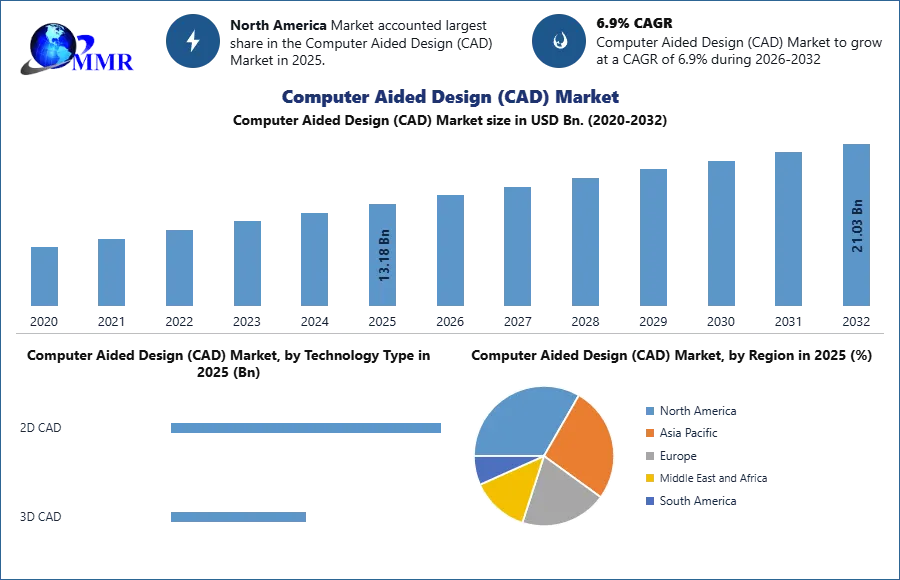
According to Maximize Market Research, the global Computer Aided Design (CAD) market was valued at USD 13.18 billion in 2025 and is projected to reach USD 21.03 billion by 2032, growing at a compound annual growth rate (CAGR) of 6.9% during the forecast period from 2026 to 2032.
Market growth is supported by increasing industrial automation, rising infrastructure development, and the need for efficient product design. Manufacturers are adopting CAD software to improve engineering productivity, reduce development costs, and accelerate time to market. The increasing use of 3D modelling and digital prototyping is also enabling businesses to evaluate product designs before physical production.
Furthermore, advancements in cloud computing and design automation are making CAD solutions more accessible to organizations of different sizes.
Key Market Segmentation
The CAD market is segmented by technology type, deployment model, component, end-use industry, and region.
By technology type, the market includes 2D CAD and 3D CAD. Two-dimensional software is widely used for technical drawings, floor plans, and engineering documentation. Three-dimensional CAD supports complex modelling, visualization, and product development. The 3D CAD segment is expected to hold the largest market share by 2032 because it enables detailed design analysis and reduces costly development errors.
By deployment model, the market is divided into on-premises and cloud-based solutions. On-premises deployment provides organizations with greater control over their systems and data, while cloud-based CAD enables remote access, collaboration, and flexible software updates.
By component, the market includes software and services. Software held the largest share in 2025, supported by demand for design automation and advanced modelling capabilities. Services include consulting, customization, implementation, and training.
By end-use industry, the market covers automotive, aerospace and defense, building and construction, healthcare and medical devices, electronics and semiconductors, and other industries.
Growth Drivers
The increasing adoption of digital engineering is a major driver of the CAD market. Companies are replacing manual drafting processes with advanced design software to improve accuracy, productivity, and operational efficiency.
Growth in the automotive and aerospace industries is also supporting demand. Manufacturers use CAD tools to develop vehicle components, aircraft structures, and complex mechanical systems. These technologies help engineers evaluate designs, improve performance, and reduce development time.
Infrastructure development is another important factor. Architects and construction professionals rely on CAD software to prepare building plans, structural drawings, and engineering layouts. Additionally, the expansion of electronics manufacturing and medical device development is increasing the need for precise digital design tools.
The growing integration of CAD with simulation, manufacturing, and product lifecycle management systems is further improving design-to-production workflows.
Emerging Trends
Artificial intelligence and generative design are emerging as important trends in the CAD industry. AI-powered tools can automate repetitive drafting tasks, suggest design alternatives, and help engineers optimize components according to performance requirements.
Cloud-based CAD solutions are gaining popularity because they support collaboration among geographically distributed teams. Designers can access project files remotely, share updates, and coordinate changes more efficiently.
The integration of CAD with building information modelling (BIM), digital twins, and additive manufacturing is also expanding its applications. These technologies enable professionals to visualize projects, evaluate performance, and prepare designs for advanced manufacturing processes.
Furthermore, virtual reality and augmented reality are improving design visualization by allowing engineers and customers to examine digital models in immersive environments.
Regional Analysis
North America dominates the global CAD market, supported by advanced engineering capabilities, established software providers, and strong adoption across automotive, aerospace, and construction industries. The United States is a major contributor because of its investments in product innovation and digital manufacturing.
Asia Pacific is expected to experience rapid growth during the forecast period. Expanding manufacturing activities, infrastructure development, and industrial digitalization are increasing demand for CAD solutions in China, India, Japan, and South Korea.
Europe remains an important market due to its strong automotive, aerospace, industrial machinery, and architectural design sectors. Companies across the region are investing in advanced engineering software to improve product quality and manufacturing efficiency.
Meanwhile, the Middle East and Africa are creating opportunities through infrastructure projects and industrial diversification. South America is also expected to benefit from construction activity and increasing adoption of digital design technologies.
Competitive Landscape
The CAD market is competitive, with companies focusing on software innovation, cloud integration, AI capabilities, and industry-specific solutions. Leading providers are strengthening their portfolios through product development, strategic partnerships, and acquisitions.
Key players identified by Maximize Market Research include Autodesk Inc., Dassault Systèmes, Siemens Digital Industries Software, PTC Inc., Hexagon AB, Bentley Systems Inc., Ansys Inc., Altair Engineering Inc., Cadence Design Systems Inc., Trimble Inc., Bricsys NV, Graphisoft, Nemetschek SE, and Robert McNeel & Associates.
Autodesk and Dassault Systèmes are significant participants in the market. According to Maximize Market Research, Autodesk accounted for 29% of market revenue in 2025, while Dassault Systèmes accounted for 23%. Competition increasingly depends on advanced functionality, software interoperability, subscription pricing, and customer support.
Download Free PDF Brochure@https://www.maximizemarketresearch.com/request-sample/63443/
Recent Developments
Recent developments highlight the industry's increasing focus on artificial intelligence and integrated engineering workflows.
In October 2025, Siemens Digital Industries Software announced the Solid Edge 2026 update featuring Design Copilot, a conversational AI assistant designed to improve CAD workflows and engineering documentation.
In January 2026, PTC introduced AI-powered FlexPLM capabilities at NRF 2026, integrating generative AI into retail and consumer product design workflows.
In February 2026, PTC released Windchill AI Parts Rationalization, which uses machine learning to support component reuse and reduce design duplication.
These developments demonstrate how software providers are incorporating AI and automation to improve productivity and accelerate product development.
Future Outlook
The CAD market is expected to expand as businesses increasingly adopt digital design, automation, and advanced engineering technologies. Demand for 3D modelling, cloud collaboration, and AI-assisted design is likely to remain strong across manufacturing, construction, automotive, and aerospace industries.
Integration with digital twins, simulation software, and additive manufacturing will create additional opportunities. Cloud-based subscription models may also help smaller organizations access advanced design capabilities without significant upfront investment.
However, high software costs, hardware requirements, cybersecurity risks, and the need for skilled professionals may restrict adoption. Companies that prioritize affordability, interoperability, and continuous innovation will be better positioned for long-term growth.
For full access to the comprehensive strategic report, visit:https://www.maximizemarketresearch.com/market-report/global-computer-aided-design-cad-market/63443/
Conclusion
The global Computer Aided Design market is expected to grow steadily, supported by digital engineering, industrial automation, and increasing demand for accurate product development. With the market projected to rise from USD 13.18 billion in 2025 to USD 21.03 billion by 2032, CAD technology will remain essential across manufacturing, construction, and engineering industries.
AI-powered design, cloud deployment, and advanced 3D modelling will continue to shape the competitive landscape. As organizations prioritize efficiency, innovation, and digital transformation, CAD solutions will play an increasingly important role in improving design quality and accelerating industrial development.
About Maximize Market Research
Maximize Market Research is a multifaceted market research and consulting company with professionals from several industries. Some of the industries we cover include medical devices, pharmaceutical manufacturers, science and engineering, electronic components, industrial equipment, technology and communication, cars and automobiles, chemical products and substances, general merchandise, beverages, personal care, and automated systems. To mention a few, we provide market-verified industry estimations, technical trend analysis, crucial market research, strategic advice, competition analysis, production and demand analysis, and client impact studies.
Contact Maximize Market Research
3rd Floor, Navale IT Park, Phase 2
Pune Bangalore Highway, Narhe,
Pune, Maharashtra 411041, India
[email protected]
+91 96071 95908, +91 9607365656

 Arabic
 French
 Spanish
 Portuguese
 Deutsch
 Turkish
 Dutch
 Italiano
 Russian
 Romaian
 Portuguese (Brazil)
 Greek