
Specialty Alloy Market Trends: Sustainability, Innovation and Emerging Applications
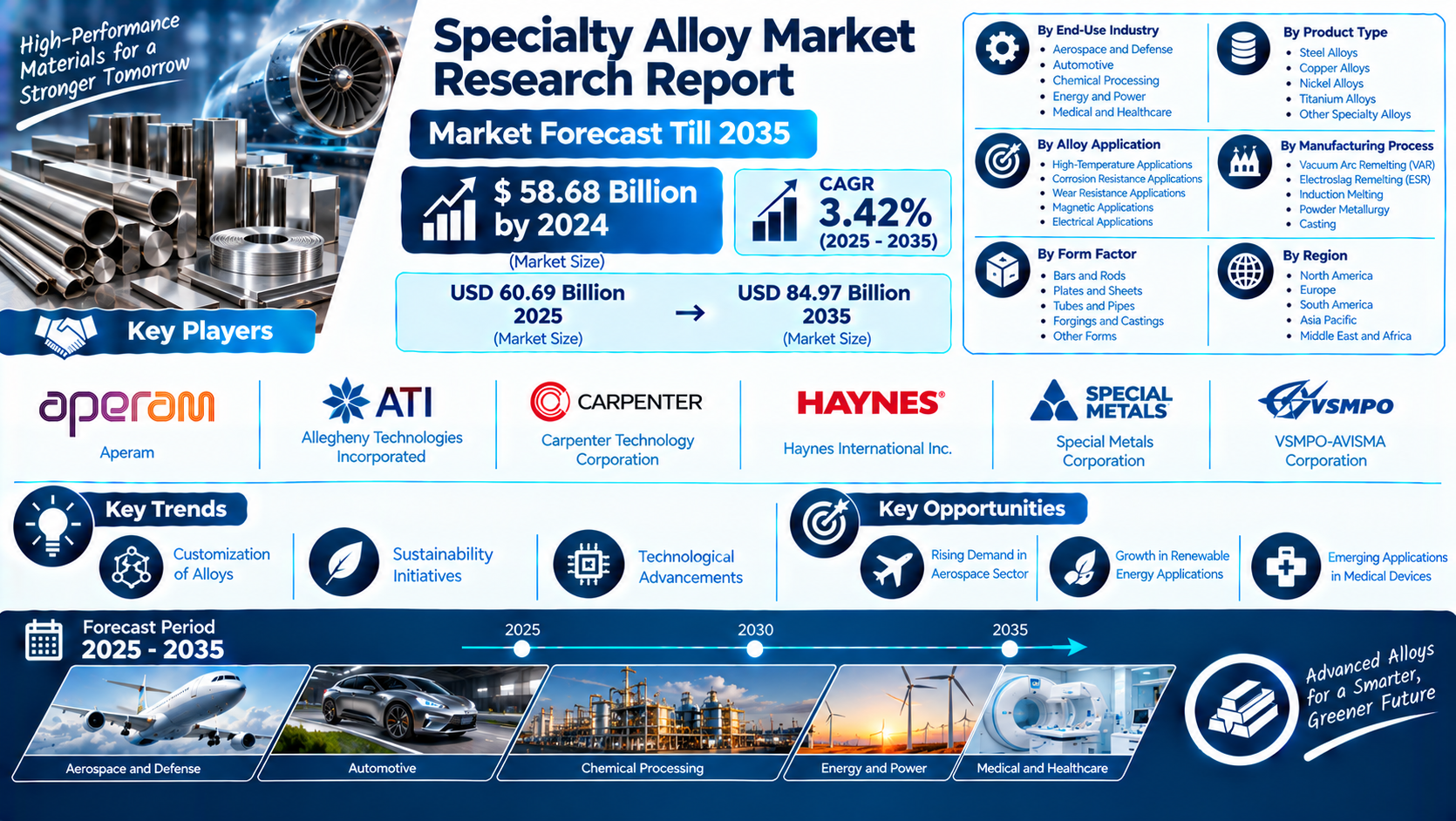
According to Market Research Future® (MRFR), the Specialty Alloy Market is expected to expand from USD 60.69 billion in 2025 to USD 84.97 billion by 2035, reflecting a CAGR of 3.42% over the 2025–2035 forecast period. The market's 2024 valuation was USD 58.68 billion. Its outlook is shaped by the need for engineered materials that can meet specific performance requirements across aerospace and defense, automotive, chemical processing, energy and power, and medical and healthcare industries.
Demand for High-Performance Materials
Specialty alloys occupy an important position in industrial supply chains because their composition and manufacturing processes can be tailored to specific engineering requirements. Instead of serving only general-purpose applications, these materials are selected when components must meet particular expectations for strength, temperature tolerance, corrosion resistance, wear performance, magnetic behavior, or electrical functionality.
Such characteristics are important in equipment and components exposed to challenging operating conditions. Chemical processing facilities may require materials that withstand corrosive substances, while energy infrastructure can demand resistance to heat, pressure, and mechanical stress. Aerospace and defense applications often place substantial emphasis on performance, reliability, and weight considerations. Specialty alloys help manufacturers address these requirements when the selected grade is suitable for the intended service environment.
The market's projected increase from USD 58.68 billion in 2024 to USD 84.97 billion in 2035 reflects continued demand across multiple industrial sectors. The supplied forecast indicates steady expansion rather than exceptionally rapid growth, with a CAGR of 3.42% between 2025 and 2035.
Customization and Manufacturing Innovation
Customization is a defining trend in the specialty alloy industry. Customers may require different combinations of mechanical, thermal, electrical, and chemical properties depending on the design and operating conditions of a component. Producers therefore need to select appropriate alloy compositions and processing methods to satisfy application-specific requirements.
This approach is relevant to industries in which a material's performance can affect product reliability, maintenance requirements, and service life. Collaboration between material suppliers, component manufacturers, and engineering teams can help identify suitable grades and manufacturing specifications. However, customization must be balanced against production complexity, cost, lead times, and the need to maintain consistent quality.
Technological advancements support this process through improvements in melting, refining, casting, and powder-based manufacturing. Vacuum arc remelting (VAR) and electroslag remelting (ESR) are included in the report's manufacturing-process segmentation, alongside induction melting, powder metallurgy, and casting. Each process has different characteristics, and the appropriate choice depends on alloy composition, product requirements, and the desired material properties.
Improved process control and material testing can help manufacturers maintain consistency and verify that products meet technical specifications. These capabilities are particularly relevant in applications where materials must perform reliably under demanding conditions.
Sustainability and Resource Efficiency
Sustainability initiatives are another important influence on market development. Specialty alloy production can involve substantial energy use and complex processing, making resource efficiency a relevant operational priority. Manufacturers may assess ways to improve material yields, reduce waste, recover suitable metal inputs, and optimize production processes.
Recycling can also contribute to resource management when alloy composition and material condition allow recovered metals to be used effectively. Nevertheless, recovery processes must preserve or restore the required chemistry and quality. Different alloy families present different technical challenges, so the potential benefits depend on available technology, collection systems, and processing costs.
Sustainability considerations may also influence customer and supplier relationships as industrial buyers evaluate production practices alongside material performance. Companies that improve manufacturing efficiency while maintaining the required product specifications may strengthen their operational competitiveness.
Product Categories and Functional Applications
The market includes steel alloys, copper alloys, nickel alloys, titanium alloys, and other specialty alloys. Steel alloys can serve industrial and structural uses, while copper alloys are relevant where electrical or thermal properties are important. Nickel alloys can be selected for demanding temperature and corrosion conditions, and titanium alloys can provide useful combinations of strength, relatively low weight, and corrosion resistance. The precise suitability of each material depends on its composition and intended application.
The application categories are high-temperature applications, corrosion resistance applications, wear resistance applications, magnetic applications, and electrical applications. This classification emphasizes the performance characteristics that drive purchasing decisions. Different applications require different testing, specifications, and manufacturing controls, creating opportunities for suppliers with specialized technical capabilities.
The form-factor segment includes bars and rods, plates and sheets, tubes and pipes, forgings and castings, and other forms. These formats allow material producers to supply inputs for machining, fabrication, component production, and specialized equipment manufacturing.
Industry Demand and Regional Development
The end-use industries identified in the report are aerospace and defense, automotive, chemical processing, energy and power, and medical and healthcare. Automotive applications may prioritize durability, component performance, and weight considerations. Chemical processing depends on material compatibility with operating environments, while energy and power applications can involve demanding temperature and pressure conditions. Medical and healthcare uses require materials appropriate to specific devices and subject to relevant quality and regulatory requirements.
Regionally, the market covers North America, Europe, South America, Asia Pacific, and the Middle East and Africa. Industrial investment, manufacturing capacity, infrastructure development, and demand from specialized end-use sectors can influence performance in each region. Regional growth will also depend on technical expertise, supply-chain access, and the ability to manufacture or source alloys meeting required specifications.
Competitive Landscape and Emerging Opportunities
The listed companies include Aperam, Allegheny Technologies Incorporated, Carpenter Technology Corporation, Haynes International Inc., Special Metals Corporation, and VSMPO-AVISMA Corporation. Competitive differentiation may depend on alloy portfolios, process capabilities, product consistency, engineering support, and the ability to supply specialized forms. The supplied information does not provide verified market-share figures or a comparative ranking of these companies.
Growth opportunities include rising aerospace demand, renewable energy applications, and emerging medical device uses. Each opportunity depends on the material specifications of the relevant components and the ability of suppliers to satisfy applicable performance standards.
Outlook Through 2035
With the market projected to reach USD 84.97 billion by 2035 at a CAGR of 3.42%, specialty alloys are expected to remain important to industries requiring carefully engineered material properties. Customization, technological advancement, and sustainability initiatives will influence how producers develop and manufacture their products. Suppliers that combine reliable quality, suitable manufacturing methods, and application-specific expertise may be better positioned to respond to changing industrial requirements over the forecast period.

 English
 Arabic
 French
 Spanish
 Portuguese
 Deutsch
 Turkish
 Dutch
 Italiano
 Russian
 Romaian
 Portuguese (Brazil)