
Linear Alkyl Benzene Market Outlook: Capacity Expansion and Emerging Economy Demand
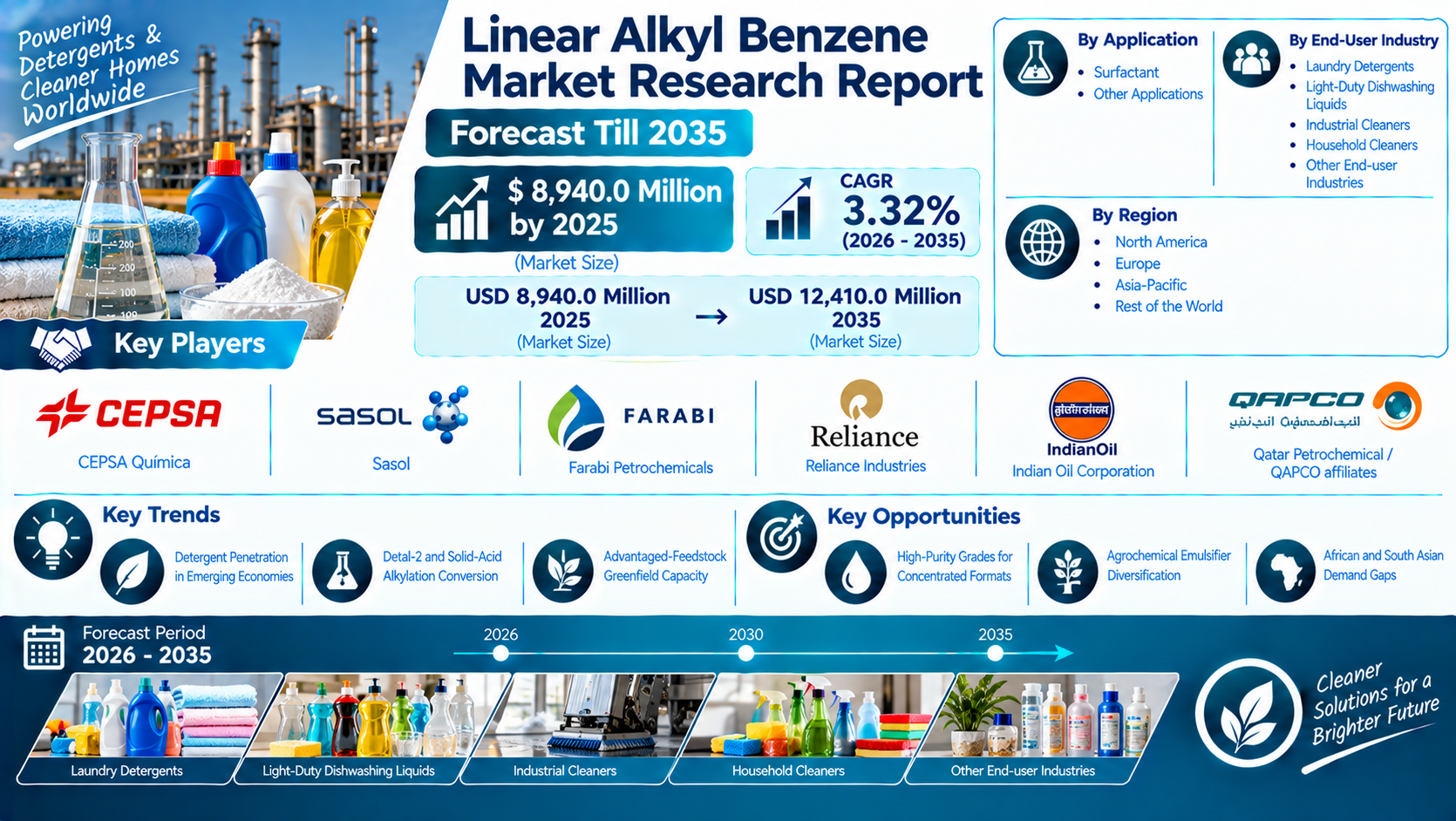
According to Market Research Future® (MRFR), the Linear Alkyl Benzene Market is forecast to grow from USD 8,940.0 million in 2025 to USD 12,410.0 million in 2035, representing a CAGR of 3.32% over the 2026–2035 forecast period. The industry is supported by demand for linear alkyl benzene as a feedstock for surfactants, particularly those used in detergents and cleaning products. Future market development will depend on consumer cleaning-product demand, manufacturing economics, production technology choices, and the ability of suppliers to address emerging applications and regional requirements.
Demand Foundations Across Cleaning Applications
Linear alkyl benzene, commonly abbreviated as LAB, serves as an important raw material for surfactant production. Its role connects the market with products used in routine cleaning activities, including laundry detergents, light-duty dishwashing liquids, household cleaners, and industrial cleaning formulations. These end uses give demand a recurring component because many cleaning products are replenished regularly by consumers and commercial users.
Laundry detergents remain an important demand category within the market's end-user structure. Their consumption is influenced by household needs, product availability, purchasing power, and preferences for different detergent formats. Growth in detergent penetration across emerging economies is a notable industry trend because wider access to packaged cleaning products can increase the addressable market for surfactant ingredients.
Dishwashing liquids and household cleaners extend LAB-related demand into other everyday applications. Industrial cleaners add exposure to commercial and industrial activities that require cleaning formulations for different operating environments. The broader end-user category provides additional potential outlets, although specific requirements vary according to formulation, performance expectations, and the type of cleaning task involved.
Market Size and Forecast Implications
The market's reported size of USD 8,940.0 million in 2025 establishes the baseline for the forecast period. By 2035, the market is projected to reach USD 12,410.0 million. The expected 3.32% CAGR indicates steady expansion across the period, with performance tied to continued demand from established applications and the development of additional markets.
This outlook places emphasis on operational discipline rather than growth through demand alone. LAB producers must consider raw-material availability, production costs, process performance, and the specifications required by downstream customers. Since LAB is used as an input into other products, purchasing decisions by surfactant and detergent manufacturers can influence supplier selection. Consistency, reliable supply, and the ability to meet technical requirements can therefore be important competitive considerations.
The market forecast also provides a context for evaluating investment decisions. Companies considering capacity additions or plant conversion projects must weigh expected demand against construction and operating costs. A favourable demand outlook does not automatically guarantee returns for every investment; regional supply conditions, feedstock economics, and competition remain relevant to project performance.
Production Technology and Capacity Development
Detal-2 and solid-acid alkylation conversion are highlighted as technology-related trends in the market. These approaches point to the importance of production processes in shaping manufacturing decisions. For individual facilities, technology selection can affect equipment requirements, process operation, maintenance needs, and the ability to meet product specifications. Conversion projects therefore require assessments of existing plant configurations and expected operating benefits.
Advantaged-feedstock greenfield capacity is another consideration. Feedstock costs are a key element of chemical manufacturing economics, and access to competitively priced inputs can influence where producers consider building new facilities. Greenfield projects may offer the ability to design plant configurations around selected operating requirements, but they also require capital investment, infrastructure, supply arrangements, and confidence in the market's ability to absorb additional output.
Capacity planning needs to account for the relationship between new production and downstream demand. If supply expands faster than consumption, producers may face greater competitive pressure. Conversely, capacity aligned with customer needs and regional supply gaps may help improve market access. The commercial outcome depends on project execution and broader market conditions.
Emerging Opportunities in Product Development
High-purity grades for concentrated formats offer a potential opportunity for suppliers seeking to address specific customer requirements. Concentrated cleaning products can place particular emphasis on formulation efficiency and consistent ingredient quality. Suppliers may benefit from working closely with customers to understand technical specifications and qualification requirements. Such opportunities are likely to depend on the ability to deliver suitable grades reliably and at commercially acceptable costs.
Agrochemical emulsifier diversification could widen the range of applications served by market participants. Some agricultural chemical formulations use emulsifiers to support the distribution of ingredients. Exploring this area may help suppliers reduce reliance on a narrow group of end uses, although entry into new applications requires appropriate technical evaluation and customer acceptance. Product suitability, regulatory considerations, and competition from alternative ingredients will affect the viability of diversification.
Regional demand gaps in Africa and South Asia offer another area for consideration. Where customer demand and supply availability are not fully aligned, opportunities may arise for producers, distributors, or regional partners to improve access to LAB. However, market entry requires an understanding of import logistics, infrastructure, distribution capabilities, and customer purchasing patterns. Regional growth potential must be assessed against the costs and practical challenges of serving individual markets.
Competitive Environment
CEPSA Química, Sasol, Farabi Petrochemicals, Reliance Industries, Indian Oil Corporation, and Qatar Petrochemical / QAPCO affiliates are identified among the market's key players. The competitive environment encourages producers to consider manufacturing efficiency, product quality, feedstock access, customer service, and reliable delivery. The relative importance of these factors can vary by buyer and region.
Companies may pursue different strategies according to their existing assets and customer bases. Some may focus on operating efficiency or production technology, while others may evaluate additional capacity or opportunities to serve specialized applications. No single approach guarantees an advantage; performance depends on investment discipline, customer requirements, and market conditions.
Outlook to 2035
The Linear Alkyl Benzene Market is positioned for continued expansion, with its forecast growth underpinned by the role of LAB in surfactant production and the ongoing need for household and industrial cleaning products. Rising detergent penetration in emerging economies may support demand, while process conversion and feedstock-oriented capacity planning will influence production decisions. High-purity grades, agrochemical emulsifiers, and opportunities in African and South Asian markets provide additional avenues for development. Reaching the projected USD 12,410.0 million market size by 2035 will depend on the industry's ability to align supply, product quality, operating economics, and customer demand.

 English
 Arabic
 French
 Spanish
 Portuguese
 Turkish
 Dutch
 Italiano
 Russian
 Romaian
 Portuguese (Brazil)
 Greek