
Transportation Infrastructure Market Forecast 2026–2035: Key Players and Opportunities
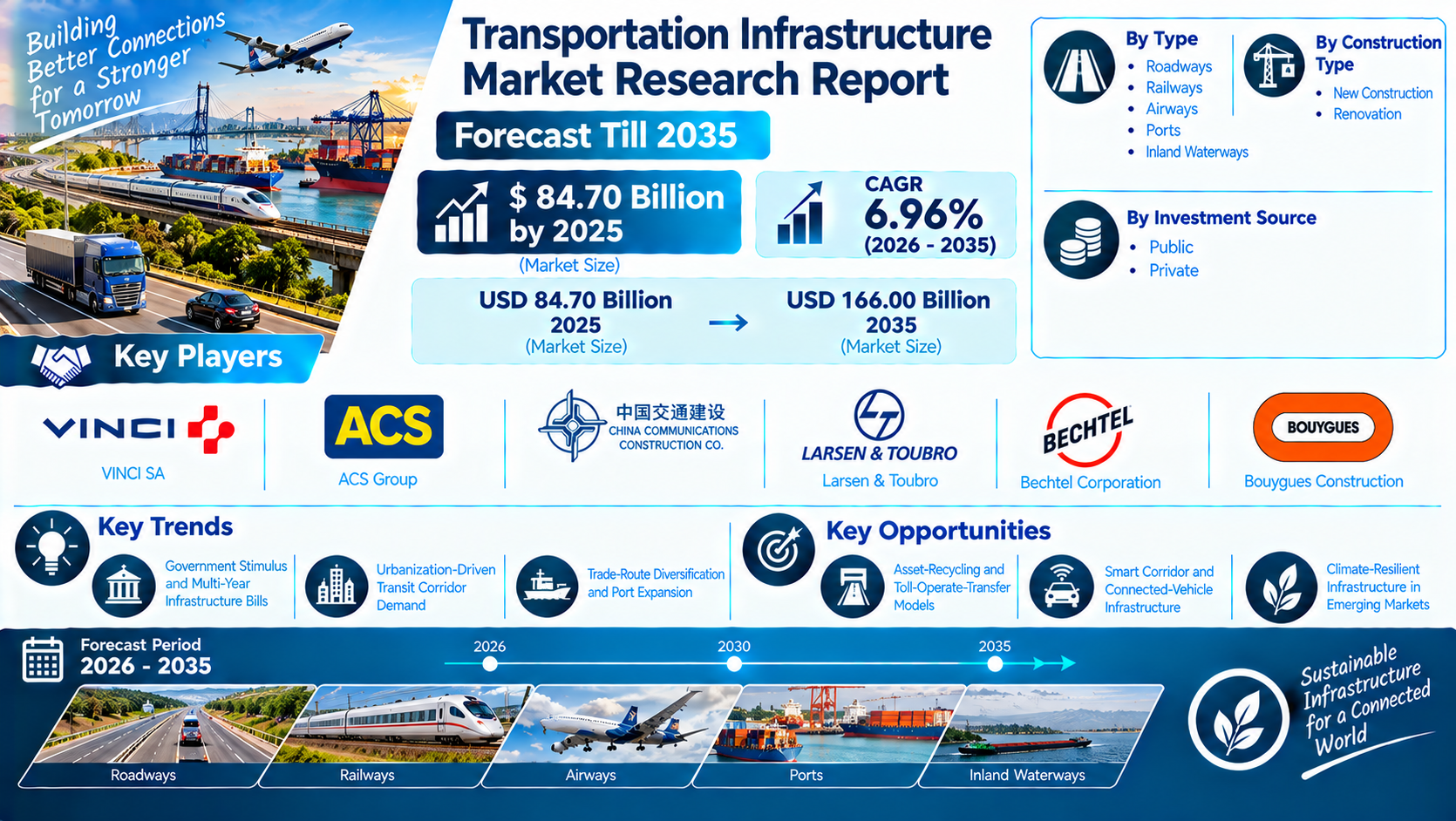
According to Market Research Future® (MRFR), the Transportation Infrastructure Market is expected to increase from USD 84.70 billion in 2025 to USD 166.00 billion by 2035, reflecting a compound annual growth rate (CAGR) of 6.96% during the 2026–2035 forecast period. Investment in transport networks is gaining importance as countries address urban mobility, freight efficiency, aging assets and the need for stronger links between economic centers. Public infrastructure programmes, private-sector participation and technology-led improvements are creating opportunities across road, rail, air and water transportation projects.
Market Dynamics and Infrastructure Requirements
Transportation infrastructure encompasses the assets and facilities that enable people and goods to move between locations. Roadways provide essential connections for daily commuting and commercial deliveries, while railways support passenger transport and freight movement over established corridors. Airways connect domestic and international destinations, and ports and inland waterways facilitate the movement of cargo through maritime and river-based networks.
These systems operate as interconnected parts of the wider economy. A highway project may improve access to a manufacturing zone, but its full logistical value can depend on connections to rail terminals, airports or ports. Infrastructure planning therefore increasingly requires attention to network integration rather than the performance of individual assets alone.
The market's projected expansion reflects demand for both additional capacity and improvements to existing facilities. New projects can address connectivity gaps, while renovation helps maintain the performance of established networks. The balance between these approaches varies by region, the condition of existing infrastructure, population growth and changing trade requirements.
Public Funding and Private Capital
Government stimulus and multi-year infrastructure bills are significant trends in the market. Transportation assets often require substantial initial investment, and their benefits may extend over decades. Public funding can support projects that improve accessibility, road safety, public mobility and regional economic integration, including projects that may not generate sufficient direct revenue to attract private investment independently.
Stable funding programmes can also help project developers plan procurement, workforce requirements and construction schedules. Nevertheless, infrastructure spending commitments do not automatically translate into completed projects. Planning approvals, land acquisition, environmental reviews, budget constraints and coordination between government bodies can affect delivery.
Private investment can supplement public funding through concessions, partnerships and other project-specific structures. Private participants may contribute financing, technical capabilities and operational expertise, particularly where an asset has a defined revenue model. The allocation of construction, demand and operating risks is central to determining whether a financing structure is viable.
Asset-recycling and toll-operate-transfer models provide one potential route for mobilizing capital. Under suitable arrangements, an existing asset's operating rights or revenue potential may be used to attract investment, allowing public authorities to redirect resources toward other infrastructure priorities. The approach requires clear contracts, appropriate oversight and careful assessment of long-term asset obligations.
Urban Growth and Changing Trade Routes
Urbanization is increasing pressure on transportation networks in expanding cities. Population growth can raise demand for road capacity, public transport corridors and connections between residential districts and employment centers. Congestion and unreliable travel times can also affect productivity and freight operations, encouraging investment in better-planned transport systems.
Urban transport requirements extend beyond constructing new roads. Railways and integrated corridors can provide alternative movement options, while improved links between different modes can help passengers and freight move through complex urban regions. Project selection needs to reflect expected usage, land availability and compatibility with surrounding development.
Trade-route diversification is creating additional considerations for ports and supporting infrastructure. As shipping patterns and supply chains evolve, ports may need improvements in capacity, access roads, rail connections and cargo-handling facilities. Inland waterways can also form part of regional freight networks where geography and operating conditions make them suitable. Infrastructure investment decisions depend on cargo demand, connectivity and the economic feasibility of each project.
New Construction and Renovation
The market's construction categories are new construction and renovation. New projects add capacity or establish transport connections where networks are incomplete. Examples include new roadways, railway links, airport facilities and port developments. Such projects can support regional integration, but their economic value depends on realistic demand forecasts and effective integration with existing infrastructure.
Renovation covers the renewal, repair and modernization of established assets. Aging roads, bridges, rail systems and terminal facilities may require improvements to maintain safety and reliability. Renovation projects can also introduce updated operational systems or adapt assets to changing traffic volumes and technical standards.
Deciding between new construction and renovation involves more than comparing upfront costs. Infrastructure owners must consider asset condition, expected service life, maintenance requirements, disruption during construction and future demand. A balanced investment programme can combine network expansion with the maintenance needed to protect the value of existing infrastructure.
Smart Corridors and Climate Resilience
Connected-vehicle infrastructure and smart corridors offer opportunities to improve how transport networks are monitored and managed. Digital sensors, traffic-management systems and connected technologies can support better information about traffic conditions and infrastructure performance. These systems may help operators identify congestion, coordinate movement and plan maintenance more effectively.
Deployment, however, requires compatible technology, dependable communications, secure data handling and cooperation among transport authorities and infrastructure operators. Technology investments need to align with operational objectives rather than being adopted without a clear use case.
Climate-resilient infrastructure is another important opportunity, especially in emerging markets developing new transport capacity. Flooding, extreme temperatures and severe weather can damage transport assets or interrupt service. Incorporating suitable drainage, durable materials and climate-related risk assessments into project design can help reduce exposure and improve long-term reliability. Resilience measures may increase initial project requirements but can support better lifecycle management.
Competitive Environment and Outlook to 2035
The market's key players include VINCI SA, ACS Group, China Communications Construction Co., Larsen & Toubro, Bechtel Corporation and Bouygues Construction. Their competitive position can depend on engineering expertise, project management, construction delivery, financing arrangements and the ability to work across complex regulatory and operating environments.
The Transportation Infrastructure Market is forecast to reach USD 166.00 billion by 2035 from USD 84.70 billion in 2025, with a CAGR of 6.96% for 2026–2035. Public spending, urban corridor demand, port expansion, asset-recycling models, smart transport technology and climate resilience are likely to shape project priorities. The sector's long-term performance will depend on disciplined investment decisions, reliable delivery and infrastructure that remains functional as travel patterns, trade networks and environmental conditions evolve.

 English
 Arabic
 French
 Spanish
 Portuguese
 Turkish
 Dutch
 Italiano
 Russian
 Romaian
 Portuguese (Brazil)
 Greek