
Decorative Laminates Market Forecast: Functional Surfaces and Sustainability
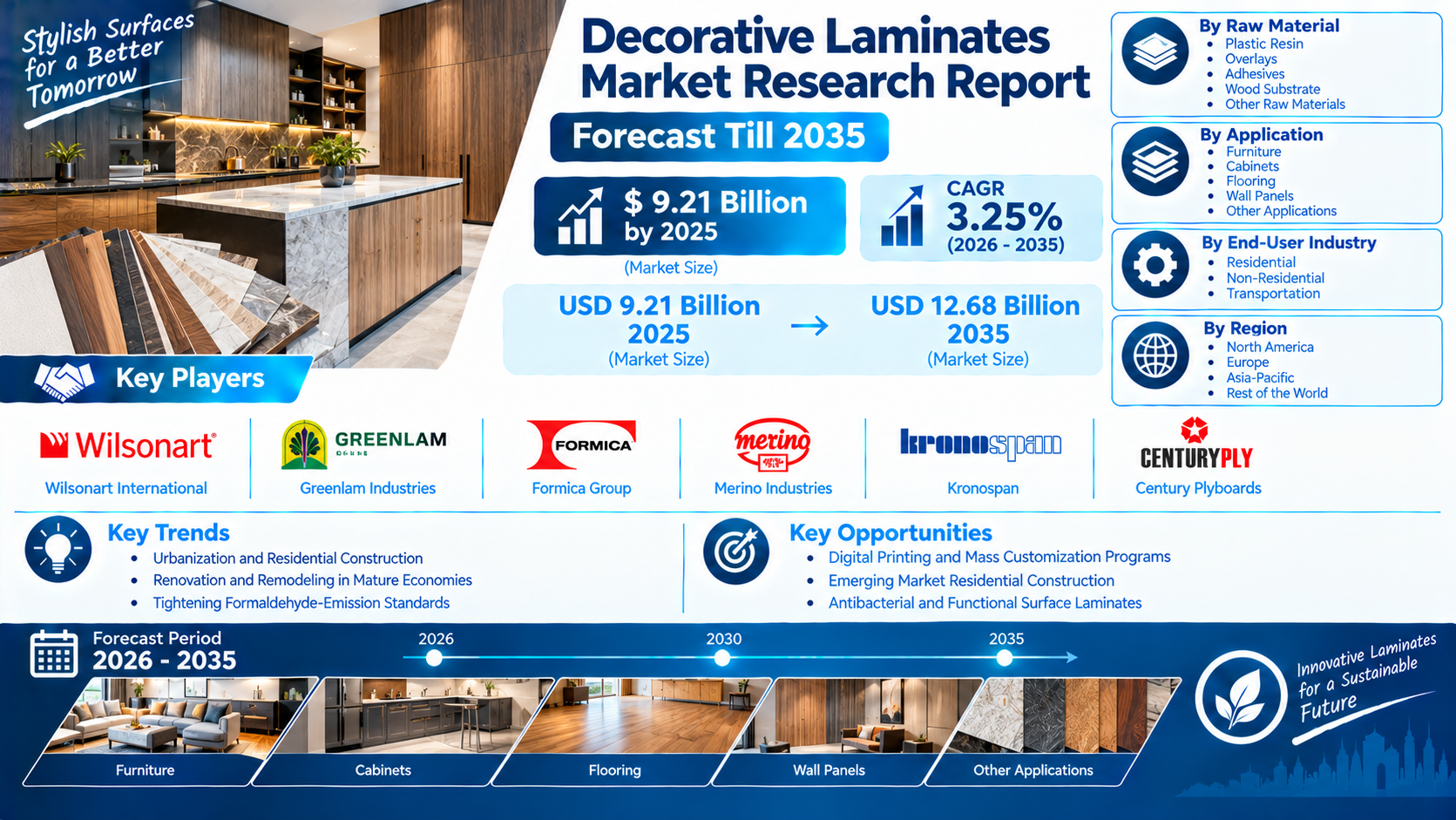
According to Market Research Future® (MRFR), the Decorative Laminates Market is expected to expand from USD 9.21 billion in 2025 to USD 12.68 billion by 2035, representing a CAGR of 3.25% throughout the 2026–2035 forecast period. Decorative laminates are used to finish surfaces in furniture, cabinets, flooring, and wall panels, offering manufacturers and property owners a variety of appearance and application options. Construction activity, interior renovation, emission standards, and evolving design preferences are shaping market requirements. Advances in digital printing, customized finishes, and functional surface products provide additional avenues for industry development.
Construction Activity and Interior Design Demand
The demand for decorative laminates is closely connected to the construction and interior furnishing industries. Residential buildings require surface materials for kitchens, storage units, furniture, and other interior components. Commercial spaces also use decorative finishes to support interior design objectives in offices, retail premises, hospitality settings, and other facilities. The transportation sector represents an additional end-user category for relevant surface applications.
Urbanization and residential construction are important trends influencing the market. As cities expand and housing requirements change, construction activity can create demand for materials used in interior finishing. Decorative laminates offer a range of patterns and appearances, allowing designers and manufacturers to select finishes suited to different spaces. Purchasing decisions also depend on installation requirements, expected use, maintenance needs, and compatibility with the underlying substrate.
Demand is not limited to new buildings. Renovation and remodeling in mature economies create opportunities as property owners update interiors and furnishings. Existing kitchens, cabinets, furniture, and wall surfaces may be refreshed as part of broader improvement projects. These applications can require products that fit established dimensions and work with existing structures, making product suitability and ease of installation relevant considerations.
Product Composition and Application Diversity
The market's raw material categories include plastic resin, overlays, adhesives, wood substrate, and other raw materials. These materials contribute different functions to the finished product, depending on the laminate structure and intended use. Manufacturers need to consider material compatibility, production requirements, surface appearance, and the conditions under which the product will be installed and used.
The application segments are furniture, cabinets, flooring, wall panels, and other applications. Furniture and cabinetry require finishes that complement interior styles while meeting the practical demands of everyday use. Flooring and wall panels have their own performance and installation requirements. Consequently, product selection needs to reflect the intended application rather than relying on appearance alone.
The diversity of applications creates opportunities for manufacturers to develop products with different finishes and specifications. Suppliers must also respond to customer expectations regarding design consistency, product quality, and material suitability. Coordination between raw material suppliers, laminate manufacturers, fabricators, and end users can help ensure that products meet project requirements.
Emission Standards and Material Considerations
Tightening formaldehyde-emission standards are an identified market trend. These standards can influence the selection and assessment of materials used in relevant laminate products and associated substrates. Manufacturers must understand the requirements applicable to their products and markets, including any relevant testing or compliance obligations.
Material evaluation can involve several considerations at once. A product must meet its intended surface and installation requirements while also satisfying applicable standards. This can encourage manufacturers to review material specifications and coordinate with suppliers to maintain consistency. The effect of regulatory changes will vary according to the applicable rules, product composition, and destination market.
Compliance is therefore relevant to both product development and market access. Companies that understand customer specifications and applicable standards can make more informed decisions about materials and production processes. However, the appropriate approach depends on the individual product and its intended use.
Digital Printing and Customized Designs
Digital printing and mass customization programs offer opportunities to broaden the range of decorative laminate designs. Customers may seek finishes that match particular interior concepts, furniture styles, or project specifications. Digital production capabilities can help manufacturers respond to these preferences by offering greater design flexibility where the technology and manufacturing process are suitable.
Customization can also create operational challenges. Manufacturers need to manage design specifications, production consistency, lead times, and cost considerations. The commercial value of customization depends on whether suppliers can deliver the required finish while maintaining acceptable quality and production efficiency.
Antibacterial and functional surface laminates represent another identified opportunity. Such products may be considered for settings where additional surface characteristics are desired. Their suitability depends on the intended application, product performance, and evidence supporting any functional claims. Manufacturers must ensure that additional features are compatible with the required appearance, durability, and installation conditions.
Regional Market and Competitive Landscape
The market covers North America, Europe, Asia-Pacific, and the Rest of the World. Regional conditions can differ according to residential construction, remodeling activity, commercial property development, customer design preferences, and applicable material standards. Emerging market residential construction presents an opportunity where housing development creates demand for interior finishing materials. The scale of this opportunity will depend on construction activity, purchasing power, distribution capabilities, and supplier access to local customers.
Key companies identified in the market include Wilsonart International, Greenlam Industries, Formica Group, Merino Industries, Kronospan, and Century Plyboards. Competition can involve manufacturing capabilities, product consistency, design variety, distribution reach, customer service, and the ability to meet changing product requirements. Companies may also seek differentiation through customized designs and functional surface options.
Suppliers need to balance product innovation with practical considerations, including material sourcing, manufacturing processes, compliance, and customer specifications. Serving diverse applications and regions requires an understanding of how performance expectations and design preferences vary among buyers.
Decorative Laminates Market Outlook to 2035
The market is projected to grow at a CAGR of 3.25% during 2026–2035, increasing from USD 9.21 billion in 2025 to USD 12.68 billion by 2035. Urbanization, residential construction, renovation activity, and emission standards will remain relevant to market demand. Digital printing, mass customization, and antibacterial or functional surface laminates offer further development opportunities. Manufacturers that respond to changing design preferences while maintaining product suitability and compliance may be better positioned to address demand across residential, non-residential, and transportation applications.

 English
 French
 Spanish
 Portuguese
 Deutsch
 Turkish
 Dutch
 Italiano
 Russian
 Romaian
 Portuguese (Brazil)
 Greek