
Logistics & Supply Chain Market Outlook Across Major End-Use Industries
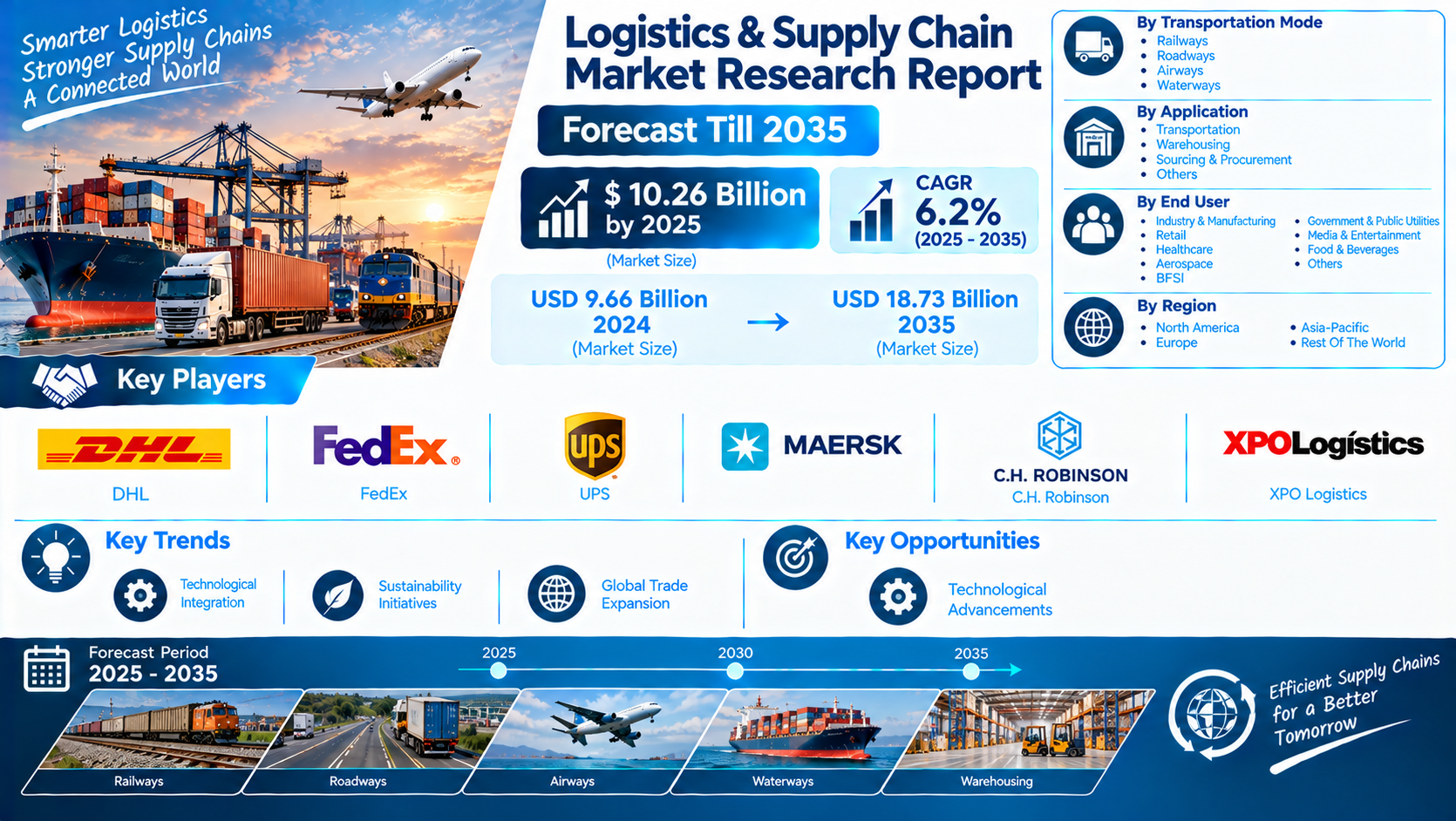
According to Market Research Future® (MRFR), the Logistics & Supply Chain Market is expected to expand from $10.26 billion in 2025 to $18.73 billion by 2035, at a CAGR of 6.2% throughout the 2025–2035 forecast period. The market recorded a value of $9.66 billion in 2024. Logistics and supply chain services form the operational link between sourcing, transportation, storage, and product delivery. Their role extends across manufacturing, retail, healthcare, government, and other industries that depend on the organized movement of goods and resources. Digital transformation, sustainability priorities, and international trade activity are among the major themes influencing market development.
The Role of Integrated Supply Chain Management
Supply chains involve multiple connected activities, from obtaining raw materials and arranging procurement to transporting products, managing inventories, and delivering orders. Logistics helps coordinate these stages so that goods can move through the network according to business and customer requirements. When the activities are poorly aligned, organizations may encounter delays, inventory imbalances, or difficulties coordinating deliveries. Effective supply chain management therefore requires visibility into operations and communication among the parties responsible for each stage.
The forecast growth of the market highlights the importance of logistics services to businesses operating across different industries. Manufacturing companies must coordinate incoming materials and outgoing products, while retailers need distribution arrangements that support inventory availability. Healthcare organizations have logistics requirements related to medical products and supplies, and food and beverage businesses depend on transportation and storage systems suited to their distribution needs. Aerospace, banking, financial services and insurance (BFSI), government and public utilities, media and entertainment, and other end users also require logistics support appropriate to their operations.
These varied requirements encourage businesses to assess logistics as a connected operating function rather than a collection of separate tasks. Transportation capacity, warehouse processes, procurement decisions, and delivery schedules can influence one another. Coordinating these activities can help organizations plan resources and respond to changes in demand or supply conditions.
Digital Transformation and Technology Opportunities
Technological integration is an important trend across logistics and supply chain operations. Digital systems can help organizations coordinate orders, share shipment information, monitor inventory, and manage warehouse activities. Better access to operational information can support planning across departments and improve communication between businesses and their logistics partners.
Technology is particularly relevant when supply chains involve multiple locations and service providers. Connected systems can help procurement teams coordinate with warehouses and transportation providers, while shipment information can support decisions about replenishment and delivery schedules. The effectiveness of these tools depends on the reliability of the data, the compatibility of systems, and whether employees can use the information in daily operations.
Technological advancements also create opportunities for market participants to improve service delivery and operational coordination. Businesses may explore digital tools that reduce manual processes, improve information exchange, and make logistics activities easier to monitor. Logistics providers can use technology to support customer communication and coordinate services across different stages of the supply chain.
Nevertheless, implementation involves practical considerations. Existing systems may require integration, employees may need training, and organizations must ensure that information remains accurate as it moves between platforms. The most useful investments are those that address specific operational needs and contribute to better coordination, service quality, or resource management.
Sustainability and Changing Trade Patterns
Sustainability initiatives are another identified trend in the market. Companies increasingly need to consider how their transportation, storage, and distribution activities align with environmental objectives. Logistics planning can influence resource use through decisions about transportation arrangements, facility operations, and network design. Opportunities to improve efficiency depend on the products being moved, the available infrastructure, and the requirements of each delivery route.
Sustainability decisions must also account for practical business priorities. Delivery reliability, transportation costs, inventory requirements, and customer expectations remain important when organizations evaluate logistics alternatives. A suitable approach balances these considerations instead of assuming that one operational model will meet every company's needs.
Global trade expansion is also shaping demand for coordinated logistics services. Businesses sourcing products or materials internationally must connect suppliers, transport networks, warehouses, and customers across different locations. This can require coordination among several providers and careful alignment of procurement schedules with transportation and inventory planning.
The market covers North America, Europe, Asia-Pacific, and the Rest of the World. Each region has its own combination of infrastructure, industry demand, distribution networks, and trade connections. Companies operating in several regions must account for local logistics conditions while maintaining consistency across their broader supply chain. Regional requirements can influence the selection of transportation modes, warehousing arrangements, and service partners.
Transportation, Applications, and End Users
Transportation mode segmentation includes railways, roadways, airways, and waterways. Road transportation can connect production sites, warehouses, and final destinations. Railways provide freight options along established rail networks, while airways can serve shipments where delivery speed is a priority. Waterways provide another route for cargo movement. The appropriate mode depends on shipment characteristics, route availability, delivery requirements, and cost.
The application categories are transportation, warehousing, sourcing and procurement, and others. Transportation focuses on moving goods through the network, while warehousing supports storage, inventory management, and distribution. Sourcing and procurement help organizations obtain the materials and products required for business activities. Coordinating these functions can help companies align supply with operational and customer needs.
By end user, the market includes industry and manufacturing, retail, healthcare, aerospace, BFSI, government and public utilities, media and entertainment, food and beverages, and other sectors. Each group has distinct operating requirements, from moving production inputs to distributing retail goods or coordinating essential supplies. This diversity creates demand for flexible logistics services that can accommodate different shipment types, delivery schedules, and network structures.
Competitive Landscape
DHL, FedEx, UPS, Maersk, C.H. Robinson, and XPO Logistics are among the key players identified in the market. Competition can center on network coverage, transportation and warehousing capabilities, service reliability, customer relationships, and the ability to coordinate multiple supply chain functions. Digital integration and sustainability initiatives may also influence service development as businesses review their logistics requirements.
Providers must respond to customer expectations while managing operational complexity across transport modes and distribution networks. Companies that combine dependable execution with effective technology and adaptable services may be well placed to serve different industries. However, performance depends on operational capabilities and customer needs rather than technology adoption alone.
Market Forecast Through 2035
The Logistics & Supply Chain Market is projected to rise from $9.66 billion in 2024 and $10.26 billion in 2025 to $18.73 billion by 2035, reflecting a 6.2% CAGR during 2025–2035. Technological advancement, sustainability initiatives, and global trade expansion are central themes in the market outlook. As organizations seek stronger coordination between procurement, transportation, warehousing, and distribution, integrated logistics management will remain important. Providers that align technology with practical operating requirements and reliable service delivery may be better equipped to respond to the changing needs of businesses across regions and industries.

 English
 Arabic
 French
 Spanish
 Portuguese
 Deutsch
 Turkish
 Dutch
 Italiano
 Russian
 Romaian
 Portuguese (Brazil)