
Bunker Fuel Market Competitive Landscape: Major Suppliers and Future Opportunities
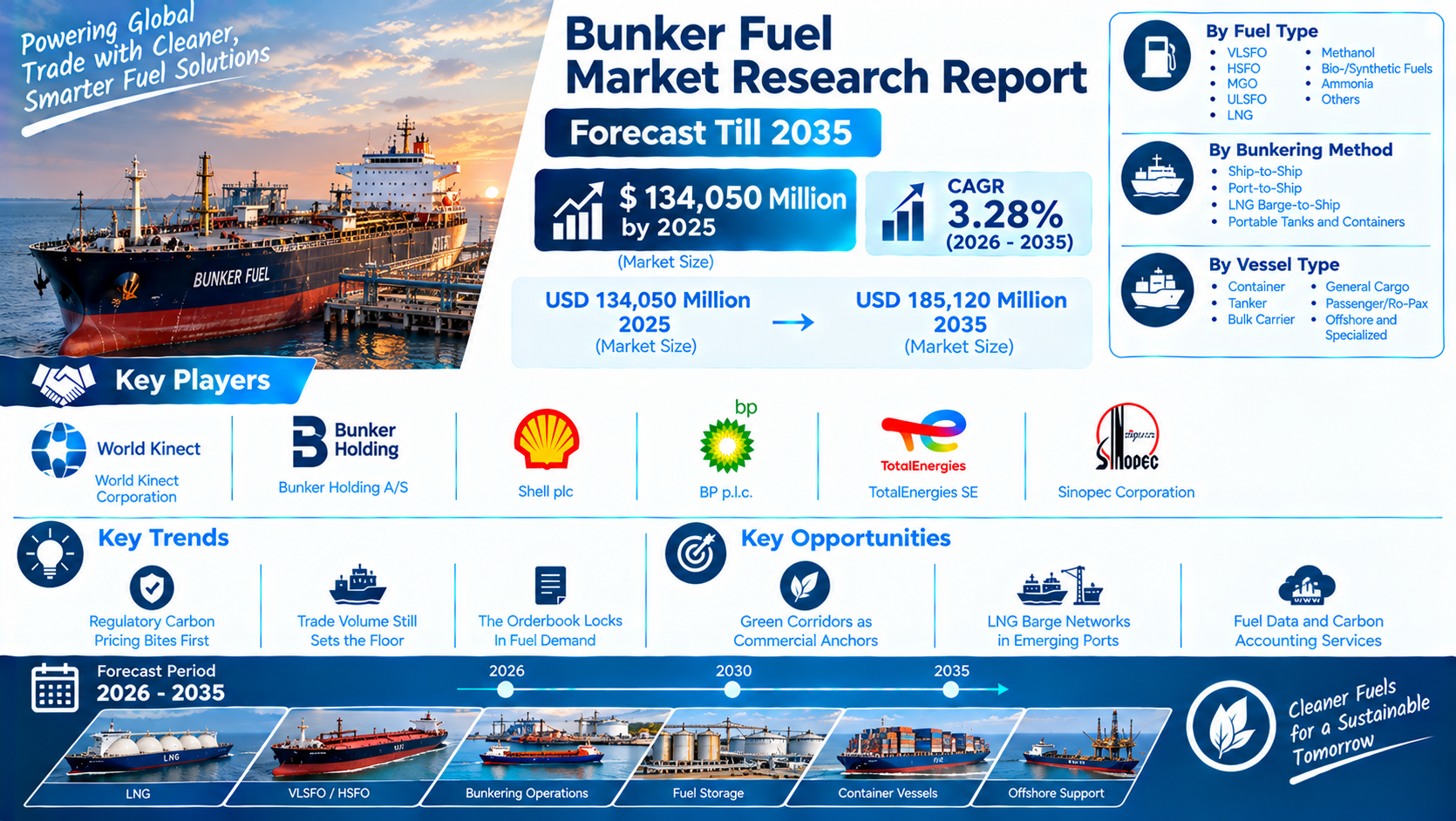
According to Market Research Future® (MRFR), the Bunker Fuel Market is forecast to reach USD 185,120 Million by 2035, up from USD 134,050 Million in 2025. The market is expected to register a CAGR of 3.28% over the 2026–2035 forecast period. Its outlook reflects the continuing importance of marine transportation, alongside regulatory pressure, vessel investment decisions, and the gradual development of alternative marine fuel supply chains. Suppliers face the challenge of meeting established fuel requirements while preparing for a shipping industry increasingly focused on emissions performance and operational efficiency.
Market Overview and Growth Drivers
Bunker fuel supports the movement of goods and passengers by sea, making it a critical input for global maritime operations. Container ships transport manufactured products, tankers carry liquid commodities, and bulk carriers move raw materials and other bulk cargoes. General cargo vessels, passenger and Ro-Pax ships, and offshore and specialized vessels add further diversity to demand. Fuel purchasing consequently reflects shipping activity across multiple vessel classes and trade routes.
The market’s growth outlook is closely connected to the volume of maritime trade. Vessel movements and utilization influence fuel consumption, while shipping schedules, route selection, and fleet composition affect where and how fuel is purchased. Changes in trading conditions can therefore influence demand, but the continuing need to operate a large global fleet supports the market’s underlying importance.
Regulation is another major influence. Carbon pricing and other emissions-related requirements can change the relative economics of different fuel types, encouraging operators to evaluate fuel efficiency, emissions exposure, and compliance costs together. At the same time, the arrival of new vessels can influence demand over many years, depending on their propulsion systems and compatibility with conventional or alternative fuels.
Regulatory Pressure and Fuel Choices
Carbon Costs Influence Procurement
Regulatory carbon pricing is becoming an important consideration in maritime fuel procurement. For shipping companies, the choice of bunker fuel increasingly involves evaluating more than the purchase price. Operators may also consider emissions implications, reporting requirements, vessel efficiency, and the effect of applicable regulations on operating expenses.
This environment can encourage interest in lower-emission fuel options and more detailed tracking of fuel consumption. However, the pace of change depends on the practical availability of suitable fuels, access to infrastructure, and the technical requirements of individual vessels. Existing ships cannot necessarily switch fuels without considering equipment compatibility, operational constraints, and the cost of modifications.
Alternative Fuels Expand the Market Landscape
The market includes very low sulfur fuel oil (VLSFO), high sulfur fuel oil (HSFO), marine gas oil (MGO), ultra-low sulfur fuel oil (ULSFO), LNG, methanol, bio-/synthetic fuels, ammonia, and others. Each category occupies a different position in the broader marine fuel landscape, with selection influenced by vessel specifications, fuel access, operational needs, and regulatory considerations.
Conventional marine fuels continue to matter because a substantial operating fleet depends on established supply arrangements. Alternative fuels, meanwhile, are relevant to the industry's longer-term transition. Their wider adoption requires coordination among vessel owners, fuel producers, ports, infrastructure developers, and regulators. The availability of a fuel at a commercially useful location can be as important as its potential emissions benefits.
Vessel Orders and Bunkering Infrastructure
New vessel orders create long-term implications for bunker fuel suppliers. Shipowners make investment decisions based on operating costs, expected service life, fuel availability, and anticipated environmental requirements. The resulting fleet mix can influence fuel demand well beyond the year in which a vessel enters service.
For suppliers, this creates a need to track changes in vessel technology while maintaining dependable service for existing customers. A varied fleet is likely to require multiple fuel options and delivery arrangements. Suppliers must therefore balance current demand with investment decisions that could support future fuel transitions.
Bunkering methods also affect access and logistics. Ship-to-ship transfers, port-to-ship delivery, LNG barge-to-ship services, and portable tanks and containers serve different operating situations. The suitability of each method depends on port infrastructure, vessel requirements, fuel characteristics, safety procedures, and delivery constraints. As ports consider new marine fuels, storage, transfer equipment, and distribution networks will influence which options can be supplied reliably.
Market Segmentation
The market is organized across three principal dimensions: fuel type, bunkering method, and vessel type. This segmentation highlights the range of products, delivery systems, and maritime customers served by the industry.
Fuel types span VLSFO, HSFO, MGO, ULSFO, LNG, methanol, bio-/synthetic fuels, ammonia, and others. Bunkering methods include ship-to-ship, port-to-ship, LNG barge-to-ship, and portable tanks and containers. Vessel categories comprise container, tanker, bulk carrier, general cargo, passenger/Ro-Pax, and offshore and specialized vessels. These categories differ in operating patterns and fuel requirements, so demand and delivery needs are not uniform across the market.
Emerging Commercial Opportunities
Green Corridors
Green corridors can create a structured basis for developing lower-emission shipping routes. By coordinating participating ports, shipping companies, and fuel suppliers, these initiatives can help align fuel availability with vessel requirements. They may also provide a commercial setting for infrastructure investment and collaboration. Their effectiveness, however, depends on reliable supply, viable economics, and coordinated implementation.
LNG Networks in Emerging Ports
LNG barge networks in emerging ports offer an opportunity to expand access where suitable demand and infrastructure requirements exist. Barge-based delivery can form part of a broader bunkering network, but development requires appropriate storage, transfer capabilities, operating procedures, and investment. Port readiness and the presence of vessels able to use LNG will influence the commercial case for expansion.
Fuel Data and Carbon Accounting
Fuel data and carbon accounting offer another avenue for market development. Better records of fuel purchases, consumption, delivery, and emissions can help shipping companies make procurement decisions and manage reporting responsibilities. Suppliers that support transparent data practices may strengthen customer relationships while helping operators evaluate fuel options and operational performance.
Competitive Landscape
Key players include World Kinect Corporation, Bunker Holding A/S, Shell plc, BP p.l.c., TotalEnergies SE, and Sinopec Corporation. Competitive positioning depends on reliable fuel supply, customer service, geographic reach, product availability, and the ability to respond to changing requirements. As the market evolves, alternative-fuel access, bunkering infrastructure, and carbon-related data services may become increasingly relevant alongside established fuel distribution capabilities.
Market Outlook Through 2035
The Bunker Fuel Market is projected to grow at a CAGR of 3.28% during 2026–2035, reaching USD 185,120 Million by 2035 from USD 134,050 Million in 2025. Maritime trade remains a central demand foundation, while carbon pricing, fleet renewal, and infrastructure investment influence the market’s direction. Companies that combine dependable conventional fuel supply with adaptable bunkering services, alternative-fuel readiness, and effective carbon accounting will be better equipped to respond to changing maritime requirements.

 Arabic
 French
 Spanish
 Portuguese
 Deutsch
 Turkish
 Dutch
 Italiano
 Russian
 Romaian
 Portuguese (Brazil)
 Greek