
Europe Aluminum Market Research Report: Key Drivers and Industry Forecast
Market Overview
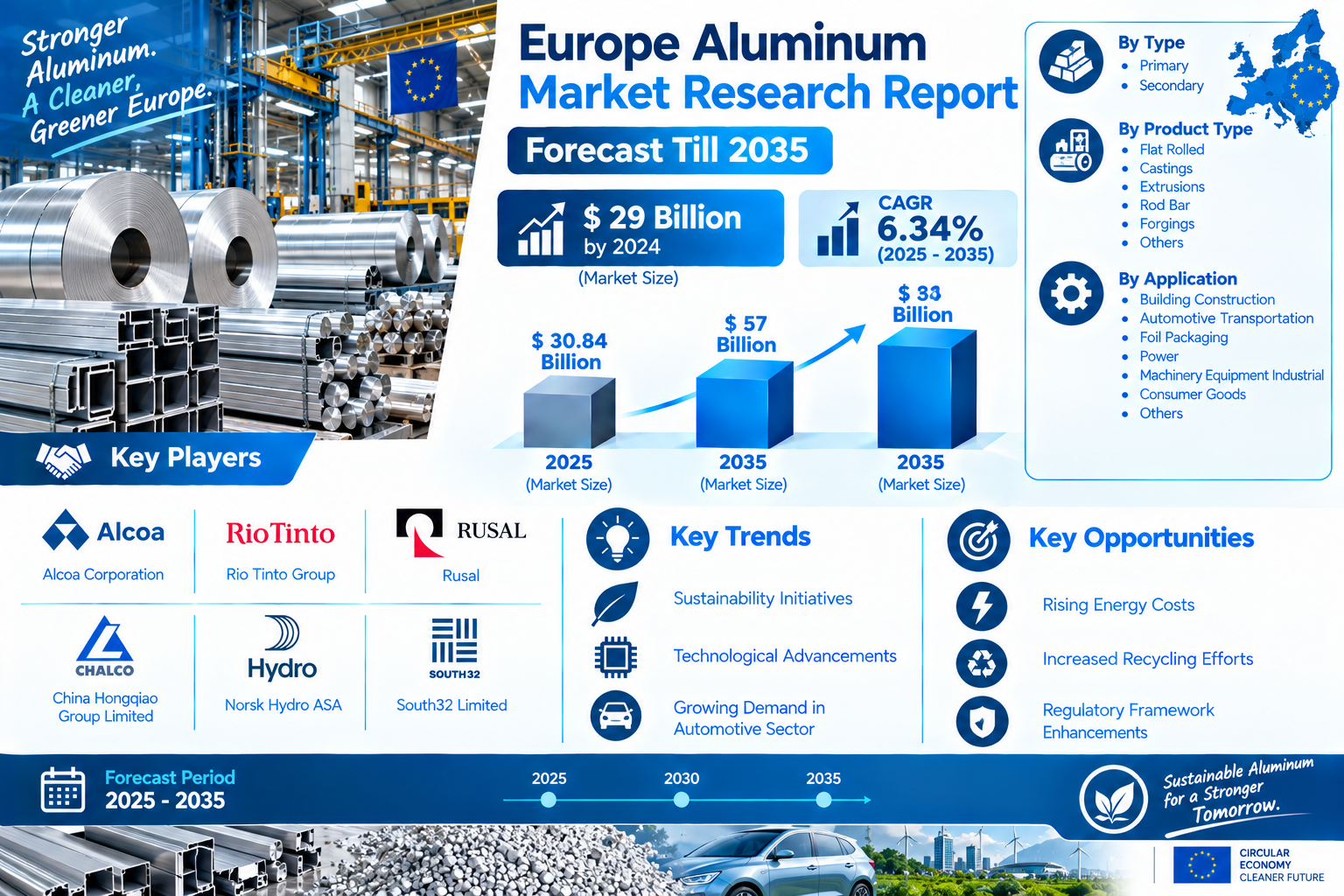
According to Market Research Future® (MRFR), the Europe Aluminum Market is expected to expand as aluminum remains a widely used material across Europe's industrial and consumer economies. Its combination of low weight, corrosion resistance, formability, and recyclability makes it valuable for a diverse range of products, from vehicle components and building systems to packaging, power infrastructure, and machinery. Demand is shaped by manufacturing activity, construction investment, transportation requirements, energy economics, and the adoption of circular-material practices.
Aluminum supply comes from primary production and secondary recovery. Primary aluminum supports demand for newly produced metal, while secondary aluminum uses recovered scrap as a feedstock. Both routes are important to the wider industry, although they differ in their resource requirements, cost structures, and processing considerations. A well-functioning recycling chain can preserve metal value and increase the availability of secondary material, but performance depends on collection rates, sorting, scrap composition, and the needs of end users.
The market's segmentation covers primary and secondary aluminum, flat rolled products, castings, extrusions, rod and bar, forgings, and other product types. End-use applications include building and construction, automotive and transportation, foil and packaging, power, machinery and equipment, consumer goods, and other industries. These applications create a diversified demand base, with growth influenced by different economic and technological factors.
Market Size and Forecast Outlook
The Europe Aluminum Market was valued at USD 29 billion in 2024 and is projected to reach USD 30.84 billion in 2025. By 2035, the market is forecast to reach USD 57 billion, reflecting a projected CAGR of 6.34% over the 2025–2035 period. This outlook indicates the potential for further growth across established applications and areas where lightweight, durable, and recyclable materials provide practical advantages.
The forecast depends on more than final-product demand. The availability of competitive energy, reliable raw materials, efficient production facilities, and functioning recycling systems can affect the industry's ability to supply customers at sustainable cost levels. Changes in industrial output, construction activity, vehicle production, and trade conditions may also influence market performance during the forecast period.
Product diversification is another important consideration. Flat rolled aluminum serves packaging, transportation, and industrial applications, while extrusions can be shaped for construction systems and engineered components. Castings offer design flexibility for complex parts, and rod and bar products and forgings support various electrical, mechanical, and industrial uses. This range allows suppliers to address multiple markets, although each application imposes its own material and processing requirements.
Growth Opportunities
Rising energy costs represent a major operational concern for aluminum producers and an opportunity to improve efficiency. Because primary aluminum production requires substantial electricity, energy-price volatility can affect manufacturing costs and capacity decisions. Producers may seek to improve energy management, optimize equipment, reduce process losses, and evaluate more stable energy arrangements. These measures can help strengthen resilience, although the scale of improvement depends on local infrastructure, capital availability, and operating conditions.
Increased recycling efforts offer another opportunity. Secondary aluminum can reduce demand for primary metal when recovered material is suitable for the intended use. Improved collection systems, more accurate scrap sorting, and better processing can increase the volume and quality of recycled feedstock. Manufacturers may also benefit from closer coordination with suppliers and waste-management organizations to ensure that scrap streams meet specific alloy and purity requirements.
Regulatory framework enhancements can influence investment and purchasing decisions. Clear requirements and consistent implementation can help companies plan recycling activities, improve material recovery, and assess product-related environmental obligations. Policy design is important: effective frameworks need to account for technical feasibility, infrastructure, cost, and the different requirements of industrial sectors.
Automotive and transportation applications provide further growth opportunities. Aluminum can help reduce weight in suitable vehicle structures and components, while construction applications benefit from its corrosion resistance and design flexibility. Packaging and power-related uses offer additional demand channels. The strongest opportunities will arise where the material's technical properties justify its cost and where producers can provide reliable quality and supply.
Regional Analysis
The European market includes countries with different industrial structures, energy systems, manufacturing specializations, and recycling capabilities. As a result, demand and production conditions are not uniform across the region. Construction activity, automotive manufacturing, packaging conversion, and industrial investment can each influence local aluminum consumption.
Industrial centers with substantial automotive and engineering activity may create demand for castings, extrusions, flat rolled products, and other forms suited to component manufacturing. Regions with significant construction and renovation activity can support demand for architectural systems and building products. Packaging and consumer-goods production also contribute to demand for aluminum products, depending on local manufacturing capacity and purchasing patterns.
Energy conditions are an important factor in regional competitiveness. Differences in electricity prices, supply security, and the availability of lower-carbon energy can influence production costs and investment decisions. Recycling capacity also matters because the ability to recover and process scrap can affect the availability of secondary aluminum and the resilience of material supply chains.
Regional demand will therefore depend on a combination of industrial activity, investment, regulation, logistics, and production economics. The broad European outlook is supported by aluminum's varied uses, but growth rates and opportunities may differ between individual countries and end-use sectors.
Recent Industry Developments
The supplied market information identifies sustainability initiatives, technological advancements, and growing automotive-sector demand as important industry trends. These themes describe broad areas of market change rather than specific dated announcements. No individual company launches, acquisitions, capacity expansions, or other dated developments were provided in the supplied information.
Across the industry, sustainability efforts are increasing attention to recycling, energy use, and material efficiency. Secondary aluminum can contribute to circularity when collection and processing systems recover scrap suitable for reuse. Technological improvements in forming, casting, extrusion, and rolling can also support more precise production and better material utilization.
Automotive manufacturers continue to evaluate aluminum in applications where weight reduction and component performance justify its use. Meanwhile, improvements in manufacturing processes and digital monitoring may help producers control quality and improve operating efficiency. The commercial impact of these developments depends on investment, implementation, customer specifications, and the overall economics of production.
Market Challenges
The industry faces challenges related to energy intensity, cost volatility, competition, and feedstock quality. High electricity costs can place pressure on primary aluminum production, while fluctuations in raw-material prices and trade conditions can complicate planning. Producers must also maintain quality and delivery reliability while responding to changes in demand.
Recycling presents its own technical challenges. Scrap streams can contain different alloys, coatings, impurities, and mixed materials. Sorting and processing systems must preserve the properties required by the next application. Although secondary aluminum can provide important resource-efficiency benefits, not every recovered stream is suitable for every product without additional processing.
Manufacturers must also weigh aluminum's performance benefits against the cost and technical requirements of alternative materials. Product redesign, joining methods, tooling, and quality testing can affect the feasibility of switching materials. Market growth will depend on the ability to overcome these barriers while keeping aluminum competitive.
Competitive Landscape
The key players identified for the market are Alcoa Corporation, Rio Tinto Group, Rusal, China Hongqiao Group Limited, Norsk Hydro ASA, and South32 Limited. Competition across the wider aluminum sector is influenced by production scale, energy costs, product quality, operational reliability, customer access, and recycling capabilities.
Companies may seek to strengthen their positions through process efficiency, product development, supply-chain partnerships, and improvements in secondary-metal recovery. Their relative performance in Europe will also depend on trade patterns, local demand, operating costs, and the ability to meet customers' technical specifications.
Looking ahead, the projected growth of the Europe Aluminum Market will depend on the interaction of industrial demand, energy economics, recycling capacity, and technology. Suppliers that can deliver consistent products while managing costs and improving resource efficiency may be well placed to address evolving needs across transportation, construction, packaging, power, and manufacturing.

 English
 Arabic
 French
 Spanish
 Portuguese
 Deutsch
 Turkish
 Dutch
 Italiano
 Russian
 Romaian
 Greek