
Frozen Food Market Growth, Company Revenue Share, Key Drivers & Trend Analysis By Fact.MR
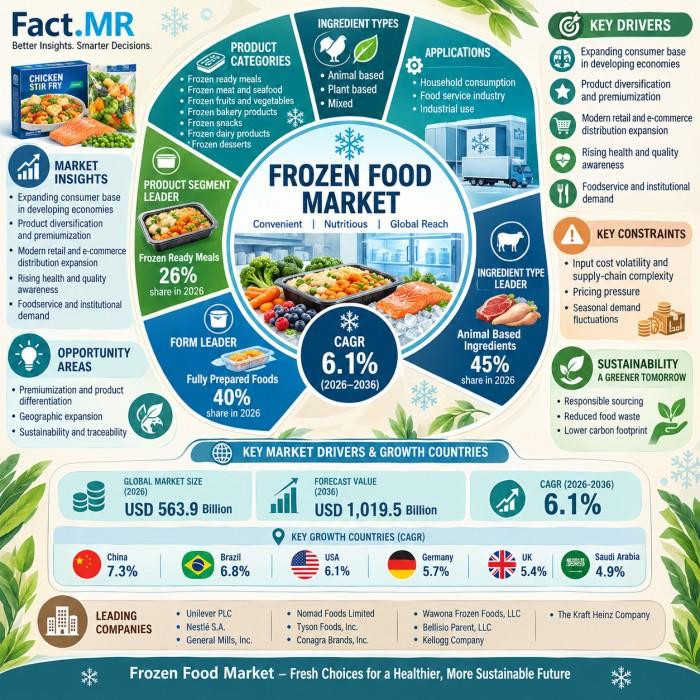
Rockville, Maryland — October 6, 2026: New Fact.MR research shows the global frozen food market expanding from USD 563.9 billion in 2026 to USD 1019.5 billion by 2036, advancing at a 6.1% CAGR over the forecast period. The market is set to create an absolute dollar opportunity of USD 455.5 billion, reflecting expanding consumption in developing economies, premiumization in mature markets, and wider distribution through modern retail and e-commerce channels.
Get detailed market forecasts, competitive benchmarking, and pricing trends:
Demand is gaining momentum as rising disposable incomes and urbanization expand the consumer base for frozen products in developing economies. At the same time, product diversification across premium, value, and functional categories is broadening market opportunities. Improvements in distribution infrastructure are also increasing accessibility across underserved urban and semi-urban areas, while growing health and quality awareness is encouraging buyers to consider traceable sourcing, cleaner ingredient profiles, and differentiated product positioning. Foodservice and institutional procurement provide an additional demand channel as hospitality and food processing capacity expands.
Frozen Ready Meals leads the product landscape, accounting for 26% of product share in 2026. The segment benefits from established demand patterns, broad commercial applicability, competitive pricing relative to alternatives, and wide distribution availability. Its established buyer base and consistent performance support repeat purchasing, while continued adoption in emerging markets adds incremental demand. Animal Based Ingredients represents the leading ingredient type, holding 45% share in 2026, supported by broad commercial applicability and established demand across core end-use channels.
China stands out as the fastest-growing country market, with a projected CAGR of 7.3% through 2036. Expanding domestic consumption, manufacturing scale, and favorable policy conditions are supporting its trajectory, while product quality, pricing, and supply reliability remain key procurement considerations. Germany is forecast to advance at 5.7% CAGR, supported by quality-focused procurement standards, a strong industrial base, and regulatory compliance. In the UK, the market is expected to grow at 5.4% CAGR, with established retail and institutional channels, regulatory alignment, and stable demand supporting expansion. Across these markets, commercial development and distribution reach remain important factors widening the addressable opportunity.
Competition in the frozen food market includes major global and regional companies with broad portfolios and established distribution networks. Unilever PLC, Nestlé S.A., General Mills, Inc., and Nomad Foods Limited are among the prominent participants, while Tyson Foods, Inc., Conagra Brands, Inc., and Wawona Frozen Foods, LLC also maintain positions across specific segments and regional niches. The competitive environment is shaped by product breadth, pricing strategy, geographic coverage, supply reliability, and the ability to develop higher-value offerings.
The next phase of frozen food market growth is expected to be influenced by premiumization, product differentiation, geographic expansion, sustainability, and traceability. Companies seeking to strengthen their market positions will need to balance product development with supply chain efficiency and distribution reach as consumer preferences and procurement requirements continue to evolve. For detailed market sizing, segment analysis, country forecasts, competitive benchmarking, and strategic insights through 2036, access the complete Fact.MR Frozen Food Market report.
The report also identifies margin pressure as a consideration, particularly in commodity-oriented segments where input cost volatility, supply chain complexity, competitive pricing, and institutional procurement practices can affect profitability. Seasonal demand patterns and cyclical end-market fluctuations may add uncertainty for businesses planning capacity, inventory, and distribution strategies.
Opportunity areas extend beyond volume growth. Premiumization can create room for differentiated products positioned around quality and traceability, while geographic expansion into underpenetrated markets can add incremental demand. Product development focused on sustainability and transparent sourcing may support premium pricing where buyers place greater value on these attributes. The market’s segmentation across product, ingredient type, form, application, and end use gives suppliers multiple routes to address buyer requirements.
Fully Prepared Foods accounts for 40% of the form segment in 2026, highlighting the importance of convenient product formats within the frozen food landscape. Household consumption, foodservice activity, industrial use, retail consumers, institutional buyers, and food manufacturers form demand channels covered by the report.
Unlock 360° insights for strategic decision making and investment planning:
Fact.MR’s analysis covers North America, Latin America, Europe, East Asia, South Asia and Pacific, and the Middle East and Africa. The research incorporates country-level demand assessment, product benchmarking, pricing analysis, shipment validation, and primary interviews with manufacturers, distributors, retailers, and end users. This outlook reinforces the role of portfolio breadth, channel development, and market-specific positioning in capturing demand across the forecast period ahead globally.
Explore More Related Studies Published by Fact.MR Research
Functional Soy Concentrates Market
Gluten-free Baking Mixes Market
About Fact.MR
Fact.MR is a global market research and consulting firm, trusted by Fortune 500 companies and emerging businesses for reliable insights and strategic intelligence. With a presence across the U.S., UK, India, and Dubai, we deliver data-driven research and tailored consulting solutions across 30+ industries and 1,000+ markets. Backed by deep expertise and advanced analytics, Fact.MR helps organizations uncover opportunities, reduce risks, and make informed decisions for sustainable growth.
- Contact Us -
11140 Rockville Pike, Suite 400, Rockville,
MD 20852, United States
Tel: +1 (628) 251-1583 | [email protected]

 Arabic
 French
 Spanish
 Portuguese
 Deutsch
 Turkish
 Dutch
 Italiano
 Russian
 Romaian
 Portuguese (Brazil)
 Greek