
Herbal Tea Market Analysis 2026: Wellness Trends, Product Innovation & Industry Outlook
Herbal Tea Market 2026: Responses to Key Searches
Herbal Tea Market 2026 Overview
The Herbal Tea Market in 2026 is driven by the consumers' growing preference for drinks made out of botanical materials, caffeine-free beverages, high-end infusions, innovations in terms of flavoring, health-conscious positioning, convenient packaging and increased popularity of drinks composed of easily identifiable plant-based ingredients.
One of the key points of the Herbal Tea Market analysis is that the herbal tea is not always a tea in the conventional sense of the word. Conventional tea is manufactured using Camellia sinensis, while the herbal infusions can be made using flowers, leaves, herbs, roots, fruits and other parts of plants. According to the EU's current food contaminant legislation "teas" and "herbal infusions" are considered to be separate categories and include such herbal infusions as chamomile, hibiscus, rose, jasmine, lime/linden, rooibos, mate, valerian and ginseng.
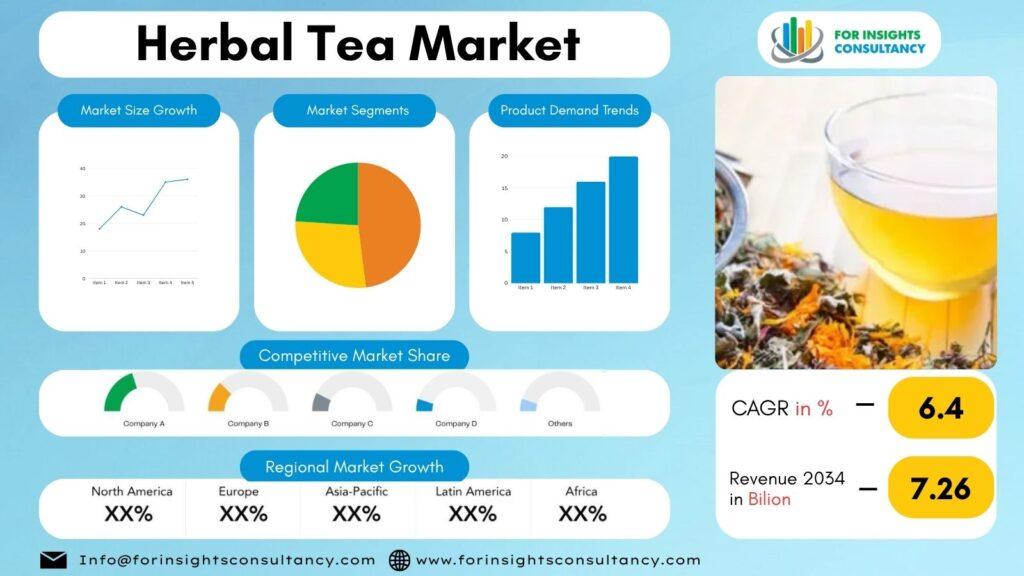
How Large Is the Herbal Tea Market in 2026?
There is no global government statistic reporting the size of the Herbal Tea Market as the sum of revenue of the worldwide market.
Different products included in the category have various botanical ingredients and classifications. Chamomile infusion, peppermint infusion, rooibos, hibiscus, ginger, tulsi, lavender.
What Is Herbal Tea?
Herbal tea is often referred to as a consumer term for drinks made using herbs, flowers, roots, leaves, fruits or other botanicals that are steeped in hot water.
Examples of such commercial varieties include chamomile, peppermint, hibiscus, ginger, rooibos and botanical blends. Such drinks can be packaged into tea bags, loose form, in capsules or as ready-to-drink depending on the particular product format.
Regulatory definitions may vary as the EU makes a clear difference between herbal infusions and tea made from Camellia sinensis, and in turn FSSAI classifies both herbal and fruit infusions under the hot beverages.
Is Herbal Tea Free From Caffeine?
While many herbal infusions are naturally free from caffeine due to absence of Camellia sinensis leaves in the process of preparation, there are exceptions.
An infusion that is labeled as an herbal variety may contain a number of botanicals or may even be blended with tea or any other drink containing caffeine. Therefore, label is the only source to find out caffeine content of a particular product.
This is an important distinction in a commercial sense as caffeine-free beverages open up a new market niche for night-time consumption.
Related Market Reports
Energy Drink Market Size, Shares and 8.18% CAGR by 2034
Ready-To-Drink Market Report: Size, Share & Analysis 2034
Beer and Energy Drinks Market Insights 2026: Trends & Forecast 2034
Alcoholic Drinks Market Report — Beer, Spirits, RTD Beverages, Wine, 2034

 English
 Arabic
 Spanish
 Portuguese
 Deutsch
 Turkish
 Dutch
Dutch
 Italiano
 Russian
 Romaian
 Portuguese (Brazil)
 Greek
Greek